

Rat High mobility group protein B1,HMGB-1 ELISA Kit

Referencia CSB-E08224r-96T
embalaje : 96T
Marca : Cusabio
Contact local distributor :

Teléfono : +1 850 650 7790
 SDS
| Size | 96T,5×96T,10×96T |
Product Details
| Intra-assay Precision (Precision within an assay): CV%<8% | ||||||
| Three samples of known concentration were tested twenty times on one plate to assess. | ||||||
| Inter-assay Precision (Precision between assays): CV%<10% | ||||||
| Three samples of known concentration were tested in twenty assays to assess. | ||||||
| To assess the linearity of the assay, samples were spiked with high concentrations of rat HMGB-1 in various matrices and diluted with the Sample Diluent to produce samples with values within the dynamic range of the assay. | ||||||
|
| Sample | Serum(n=4) | ||||
| 1:1 | Average % | 94 | ||||
| Range % | 85-98 | |||||
| 1:2 | Average % | 97 | ||||
| Range % | 91-103 | |||||
| 1:4 | Average % | 102 | ||||
| Range % | 92-110 | |||||
| 1:8 | Average % | 93 | ||||
| Range % | 86-98 | |||||
| The recovery of rat HMGB-1 spiked to levels throughout the range of the assay in various matrices was evaluated. Samples were diluted prior to assay as directed in the Sample Preparation section. | ||||||
| Sample Type | Average % Recovery | Range | ||||
| Serum (n=5) | 95 | 89-98 | ||||
| EDTA plasma (n=4) | 97 | 90-101 | ||||
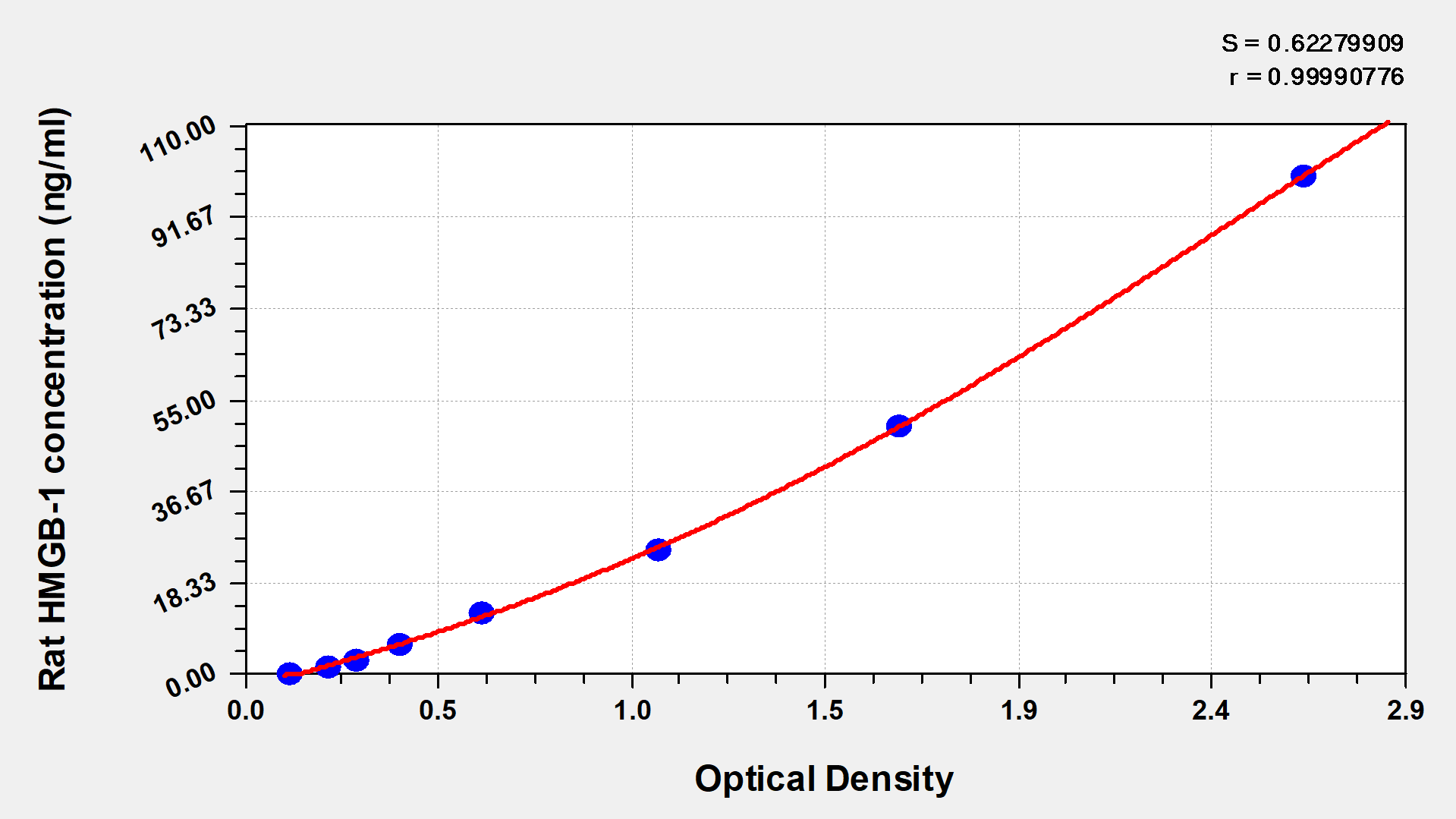
| These standard curves are provided for demonstration only. A standard curve should be generated for each set of samples assayed. | |||||||
|
| |||||||
| ng/ml | OD1 | OD2 | Average | Corrected | |||
| 100 | 2.671 | 2.634 | 2.653 | 2.527 | |||
| 50 | 1.625 | 1.667 | 1.646 | 1.521 | |||
| 25 | 1.059 | 1.028 | 1.044 | 0.918 | |||
| 12.5 | 0.582 | 0.619 | 0.601 | 0.475 | |||
| 6.25 | 0.392 | 0.401 | 0.396 | 0.271 | |||
| 3.12 | 0.295 | 0.283 | 0.289 | 0.164 | |||
| 1.56 | 0.222 | 0.214 | 0.218 | 0.093 | |||
| 0 | 0.126 | 0.125 | 0.125 |
| |||
and FAQs
Citations
- L Alkharashi, I Hasan, A Almomen, QH Alqahtani,Biomolecules,2025
- W Zhu, N Zhao, Y Ma, W Zhang, J Ma, M Cao, Y Yang,PloS one,2025
- F Chen, T Peng, M Gou,Arabian Journal of Chemistry,2024
- D Davaanyam,Experimental & molecular medicine,2023
- X Cheng,Journal of applied toxicology,2023
- X Wang,Journal of controlled release,2023
- M Jiang,BMC immunology,2023
- DM Abdallah,Scientific reports,2023
- MM El Tabaa,International Immunopharmacology,2022
- RA Ammar,Inflammopharmacology,2022
Customer Reviews and Q&A
Sample type: Tissue homogenate Lung tissue, intestinal tissue
Sample species: Rat
Sample dilution: No dilution
Review: I used CSB-E08224r to detect the content of HMGB1 in colon and lung tissue homogenates. The product is convenient and fast, with high sensitivity. The experimental results are reliable, the detection results are reliable, and the trend is obvious. It can be used with confidence. For rat...
By Anonymous
Target Background
(From Uniprot)
- miR-381could inhibit neuropathic pain development through targeting HMGB1 and CXCR4.
- Ketamine delays the progression of oxidative and damaged cataract by regulating HMGB-1/NF-kappaB expression, inhibiting TNF-alpha, IL-1beta, and apoptosis, and promoting cell proliferation.
- High HMGB1 expression is associated with sepsis-induced kidney injury.
- Chronic unpredictable stress (CUS) promotes significant morphological changes and causes robust upregulation of HMGB1 messenger RNA in enriched hippocampal microglia and robust and persistent upregulation of RAGE messenger RNA. CUS increased surface expression of RAGE protein on hippocampal microglia and anhedonic behavior. HMGB1 infusion into the hippocampus was sufficient to cause anhedonic behavior.
- Autophagy was the leading cause of adriamycin-induced cardiotoxicity, and HMGB1 played a vital role in the process of up-regulating autophagy.
- concluded that in mild oxidative stress, HMGB1 is cytoprotective, whereas in intense oxidative stress, HMGB1 actions promote cell death and liver damage
- Findings suggested that overexpression of Pgp during seizures may be regulated by HMGB1 via the RAGE/NFkappaB signaling pathway.
- Up-regulation of miR-129-5p might suppress the HMGB1-RAGE signaling pathway to restrain the revascularization of rats with ICH.
- Investigation identified that HMGB1 promotes neurovascular recovery via Rage and may act in the oxidized state in the late stage of SAH.
- our findings demonstrated an elevation of HMGB1 in pulmonary fibrosis; HMGB1 promoted the increment of proliferation, extracellular matrix production and aerobic glycolysis of embryonic lung fibroblast
- the HMGB1-TLR9 signaling pathway may be involved in the pathogenesis of diabetic retinopathy.
- In conclusion, the results suggested that GL attenuated TBI by inhibiting M1 phenotype while inducing M2 phenotype activation of microglia/macrophages, at least partly through inhibiting HMGB1. Also, targeting HMGB1 to modulate the microglia/macrophage polarization should be one potential therapeutic approach for TBI.
- The neuroimmune activation induced by chronic alcohol may involve the danger signaling molecule high mobility group box 1 (HMGB1), which binds Toll-like receptors 4 (TLR4).
- Glycyrrhizin may protect rats against sepsis by blocking the interaction of HMGB1 with cell surface receptors and HMGB1-mediated inflammatory responses
- These results suggest that HMGB1-modulated TLR5 signaling is responsible for pain hypersensitivity.
- HMGB1 modulation may lengthen the therapeutic window for stroke treatments.
- this study provides the first evidence showing that HMGB1 plays a critical role in regulating VSMC phenotypic modulation, suggesting that HMGB1 may be a potential therapeutic target to prevent vascular occlusive diseases.
- HMGB1 and its signaling transduction have critical roles in the pathogenesis of septic brain injury.
- Anti-proliferative effect of terameprocol in pulmonary hypertension seems to be explained, at least in part, by the down-regulation of the transcription factor HMGB1.
- Oxidative stress during epileptogenesis was associated with de novo brain and blood generation of disulfide high mobility group box 1 (HMGB1), a neuroinflammatory molecule implicated in seizure mechanisms.
- Results suggest that electroacupuncture pretreatment could alleviate spinal cord ischemia-reperfusion injury. These protective effects of electroacupuncture pretreatment may relate to the block of pro-inflammatory cytokines release and attenuation of apoptosis via inhibition of HMGB1 release in a LXA4 receptor-dependent manner.
- Further, HMGB1 antagonism prevented prolonged infection-induced neuroinflammatory and sickness responses in aged rats. Overall, blocking HMGB1 "desensitized" microglia in the aged brain, thereby preventing pathological infection-elicited neuroinflammatory responses.
- HMGB1 plays a key pathophysiological role in the onset of epilepsy-related hyperexcitability.
- Suggest that HMGB1 may not be a major player in cerebral vascular dilating dysfunction after subarachnoid hemorrhage.
- study suggests that HMGB1 can positively influence the survival of spiral ganglion neurons following ototoxic exposure via both its extracellular and intranuclear functions
- binding proteins of cytoplasmic HMGB1 during hepatic Ischemia/reperfusion injury were identified.
- These findings suggested that the cytoplasmic translocation of HMGB1 may be caused by diabetes and high glucose in retinal pericytes, and that the pathogenic role of HMGB1 may be dependent on the expression of RAGE and activation of NFkappaB.
- The present study confirmed that Cerebral ischemic postconditioning inhibited autophagy and HMGB1 secretion, autophagy inhibition induced a decrease in HMGB1 secretion, and HMGB1 secretion attenuation caused autophagy inhibition in return, as demonstrated by immunofluorescence and western blot analyses.
- in an ANP model, HMGB1 was initially increased in the nuclei to initiate autophagy. Subsequently, it moved into the cytoplasm, where it interacted with Beclin 1 to enhance autophagy, and HMGB1 was released into the blood, leading to the deterioration of ANP.
- Regnase-1 can be induced by HMGB1 in microglia and negatively regulates HMGB1-mediated neuroinflammation and neuronal toxicity
- HMGB1 contributes significantly to cardiac arrest-induced brain dysfunction
- the present study suggested that upregulation of miR451 could protect against A/Rinduced cardiomyocyte injury by inhibiting HMGB1 expression.
- Hypoxia enhanced the expression of HMGB1 in bone marrow mesenchymal stem cells with influences on apoptosis and adhesion.
- Bone marrow stromal cell-treated type 2 diabetic rats inhibited inflammation and improved functional outcome after stroke; data suggest that BMSCs-induced reduction of HMGB1 and RAGE in type 2 diabetic-middle cerebral artery occlusion rats contributed to attenuated inflammatory response in the ischemic brain, which may lead to the beneficial effects of bone marrow stromal cells treatment.
- Hemorrhagic shock elicited significant increases in the mRNA and protein expressions of HMGB1 and RAGE in the kidney.
- Results suggest that high mobility group box-1 mediates, in part, the neuroinflammatory effects of methamphetamine and thus may alert central nervous system innate immune cells to the toxic effects of methamphetamine.
- ketamine protects rats against HMGB1-RAGE activation in a rat model of sepsis-induced acute lung injury
- Extracellular high-mobility group box-1 (HMGB1) was identified as the likely endogenous regulator of IL1 expression after injury
- Polygonum cuspidatum extract prevents diabetes-induced vascular permeability by inhibiting HMGB1/RAGE/NFkappaB activation in diabetic retinas.
- bone marrow mesenchymal stem cell transplantation improves liver function/pathology in acute liver failure rats and decreases the serum/liver HMGB1.
- HMGB1 is increasingly expressed in parallel to the development of cerebral vasospasm in this rat experimental model of subarachnoid hemorrhage
- These findings indicate that administration of 1alpha,25(OH)2D3 might provide a favorable microenvironment for orthodontic tooth movement by downregulating expression of HMGB1 in periodontal ligament cells.
- These results suggest that intravenous pre-treatment with HMGB1 may exert its cardioprotective effects via the upregulation of the myocardial expression of HIF-1alpha, which may be regulated by the PI3K/Akt signaling pathway, in rats following acute myocardial I/R.
- Results indicate that HMGB1 is a critical regulator of autophagy and HMGB1-induced autophagy plays a protective role in spinal neurons against injuries
- determined that the plasma levels and hepatic tissue levels of HMGB1 were significant increased in acute liver failure
- Increased levels of PKR and HMGB1 in synovium or blood appear to be involved in the occurrence and development ofrheumatoid arthritis (RA )in a rat model. Selective inhibition of PKR improves the symptoms of RA perhaps by inhibiting the release of HMGB1
- HMGB1 or Beclin1 upregulate alpha-synuclein degradation, ameliorating alpha-synuclein-mediated autophagy reduction in PC12 cells.
- The data indicate that HMGB1 accumulates in renal tissue and enters the urine, and the interaction between HMGB1 and TLR4 turns renal tubular epithelial cells into inflammatory promoters during sepsis.
- Overexpression of miR141 alleviates neuropathic pain development via targeting and inhibiting HMGB1.
- findings demonstrate an important role of HMGB1 in mediating inflammasome activation in the development of liver injury
KEGG:
STRING:
UniGene: