

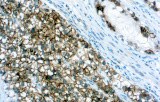
Placental alkaline phosphatase (PLAP) is a membrane-bound glycoprotein enzyme belonging to the alkaline phosphatase isoenzyme family. Under physiological conditions, PLAP expression is largely confined to placental trophoblastic tissue, with minimal expression in most normal adult somatic tissues. Re-expression of PLAP has been widely documented in germ-cell tumors and selected malignancies, supporting its established role as an immunohistochemical marker in diagnostic surgical pathology.
Biological Significance of PLAP
- PLAP represents a placental alkaline phosphatase isoenzyme predominantly associated with trophoblastic differentiation and germ-cell lineage biology.
- Aberrant PLAP expression has been reported across multiple tumor types, most prominently in testicular germ-cell neoplasms, where gene and protein overexpression have been demonstrated in large tumor cohorts.
- Immunohistochemical studies consistently show strong PLAP expression in seminoma and intratubular germ-cell neoplasia (ITGCN), reflecting underlying germ-cell differentiation pathways.
Diagnostic Utility of PLAP in Genitourinary Pathology
- PLAP immunoreactivity demonstrates high sensitivity for seminoma and related germ-cell tumors, with reported positivity rates approaching 96–98% in seminomatous components.
- Staining patterns are typically membranous with variable cytoplasmic accentuation and are often diffuse in seminoma, contributing to differential diagnosis when interpreted alongside additional germ-cell markers.
- Tissue-microarray analyses confirm that PLAP is a useful confirmatory marker in suspected metastatic germ-cell tumors; however, interpretation within a multiparametric IHC panel is recommended because PLAP expression may occur in other malignancies.
- Recent studies have identified PLAP positivity in a subset of urothelial carcinomas, expanding the spectrum of tumors in which PLAP expression may be encountered.
Key Characteristics of Anti-PLAP Antibodies in Immunohistochemistry
- Monoclonal anti-PLAP antibodies have been extensively used for immunohistochemical detection in formalin-fixed, paraffin-embedded (FFPE) tissues using enzyme-based chromogenic detection systems.
- Certain antibody clones recognize both classical PLAP and PLAP-like isoforms, supporting sensitive detection across germ-cell tumor subtypes.
- Strong and diffuse staining intensity is frequently observed in seminoma and ITGCN specimens, reflecting high antigen expression levels.
- For optimal diagnostic accuracy, PLAP is typically incorporated into multiparametric germ-cell tumor IHC panels that may include markers such as OCT3/4, SALL4, CD117, and D2-40, with interpretation guided by morphologic context.