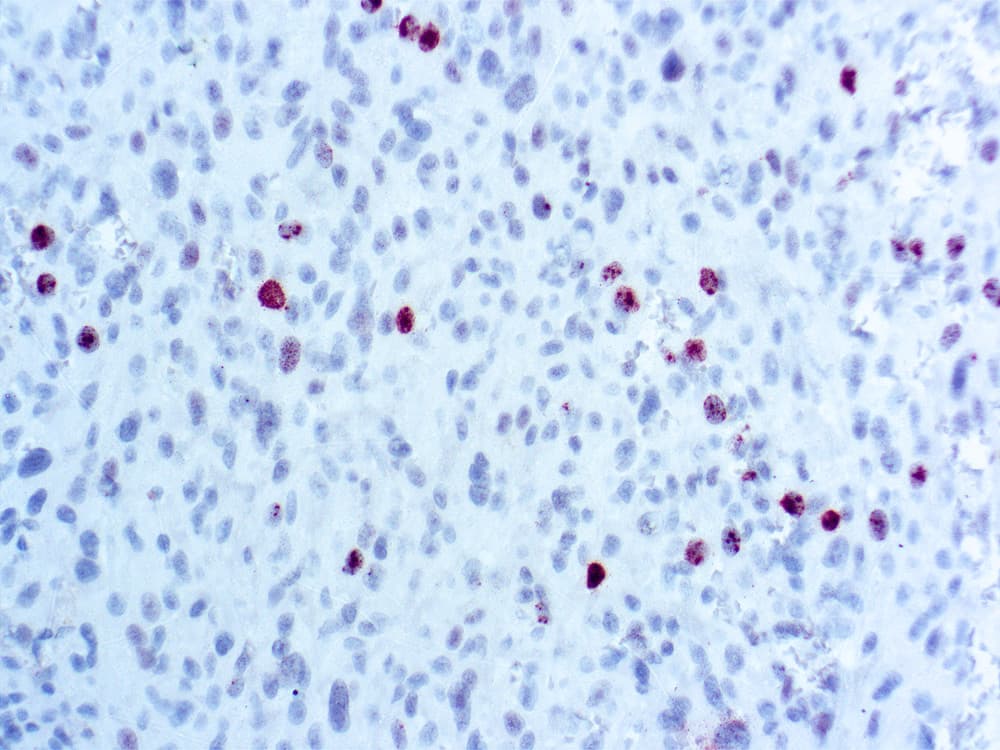

Phosphohistone H3 (PHH3) is a mitosis-specific immunomarker that detects histone H3 phosphorylated on serine residues (commonly Ser10 and Ser28) during chromatin condensation in late G2 and M phase.
Anti-PHH3 immunohistochemistry (PHH3 IHC) provides a clear, easily scorable nuclear signal that highlights true mitotic figures and reliably distinguishes them from apoptotic bodies and pyknotic nuclei. Because of its mitosis specificity and high reproducibility, PHH3 IHC, when supplied as CE/IVD marked reagents, has become a practical tool for routine diagnostics, tumor grading and research in breast and gynecological pathology.
Clinical utility in breast pathology
- Improves accuracy and reproducibility of mitotic counts versus H&E (Hematoxylin and Eosin) alone and often correlates more strongly with mitotic index than Ki-67. This can reduce inter-observer variability and, in some series, has led to re-grading of a meaningful subset of invasive breast carcinomas.
- PHH3-based mitotic indices have been associated with prognostic end points (including disease-specific survival) and may complement Ki-67 and traditional mitotic counts in prognostic models.
Clinical utility in gynecological pathology
- In endometrial and other uterine neoplasms, PHH3 IHC improves identification of mitotic hot-spots and helps distinguish leiomyosarcoma from benign smooth muscle lesions and STUMP by providing a more specific mitotic index. It has also been reported as useful in stratifying endometrial carcinoma grade and risk.
- PHH3 can assist in assessing proliferative activity in ovarian and trophoblastic lesions and may help resolve difficult cases where H&E mitoses are ambiguous.
Key features of CE/IVD Anti-PHH3 antibodies
- Mitosis-specific nuclear staining (Ser10/Ser28) with low background staining in interphase nuclei.
- High concordance with manual H&E mitotic counts and improved inter-observer reproducibility compared with Ki-67 or standard mitotic assessment.
- Compatible with routine FFPE sections, automated IHC platforms and digital image analysis workflows which enables hotspot detection and objective counts.