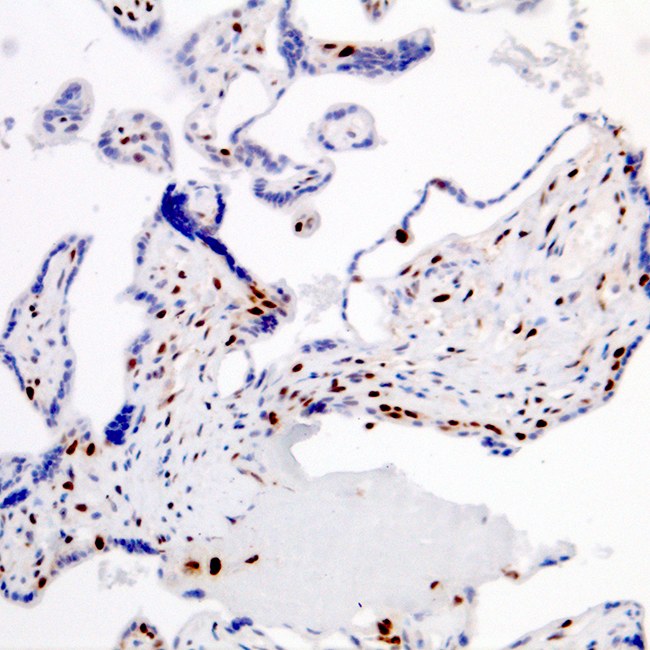

p57Kip2 (CDKN1C) is a cyclin-dependent kinase inhibitor widely used in immunohistochemistry (IHC) as an imprinting-dependent biomarker. In research and clinical diagnostic workflows, anti-p57Kip2 antibodies enable nuclear detection in formalin-fixed paraffin-embedded (FFPE) tissues, supporting interpretation within gestational trophoblastic and reproductive pathology panels when integrated with morphology and molecular testing.
Biological Significance of p57Kip2
- p57Kip2 (CDKN1C) is a cell-cycle inhibitor and tumor-suppressor protein that induces G1-phase arrest and negatively regulates cellular proliferation.
- The gene is paternally imprinted and maternally expressed, a property that directly influences diagnostic staining patterns.
- Altered expression contributes to abnormal growth regulation and imprinting-related disease processes, highlighting its relevance in developmental and oncologic pathology.
Diagnostic Utility of p57Kip2 in Gestational Trophoblastic and Reproductive Pathology
- Nuclear p57Kip2 expression reflects maternal genomic contribution; absence of staining correlates with androgenetic lesions such as complete hydatidiform mole.
- Meta-analyses in gestational trophoblastic disease report high diagnostic performance (AUC ≈ 0.98) for distinguishing complete hydatidiform mole from its histologic mimics when p57 IHC is used within algorithmic workflows.
- Immunostaining patterns are reproducible in FFPE tissues and assist in differentiating related entities; however, interpretation should consider known limitations such as rare biparental complete moles, mosaicism, or retained maternal chromosome 11, and should be correlated with morphology and, when indicated, genotyping.
Technical Features of Anti-p57Kip2 Antibodies
- Monoclonal antibodies demonstrate nuclear immunoreactivity in cytotrophoblast and villous mesenchymal cells in FFPE sections.
- Compatible with routine formalin-fixed paraffin-embedded workflows used in histopathology laboratories.
- Intended for ancillary use alongside histomorphology and molecular analysis to improve diagnostic accuracy rather than as a standalone test.