

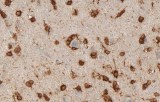
Mutations in the isocitrate dehydrogenase 1 (IDH1) gene represent one of the most important molecular biomarkers in diffuse gliomas. The IDH1 R132H substitution is the predominant IDH alteration, accounting for approximately 85–90% of IDH-mutant diffuse gliomas, including astrocytomas, oligodendrogliomas, and tumors previously classified as secondary glioblastomas. This mutation confers a neomorphic enzymatic activity that promotes accumulation of the oncometabolite D-2-hydroxyglutarate (2-HG), leading to widespread epigenetic dysregulation and contributing to gliomagenesis. IDH-mutant gliomas are consistently associated with a more favorable prognosis than their IDH-wildtype counterparts.
Diagnostic Utility of IDH1 R132H in Neuropathology
- Mutation-specific anti-IDH1 R132H antibodies have become a cornerstone of modern neuropathology.
- Immunohistochemical detection of the mutant protein provides a rapid and cost-effective method for identifying IDH-mutant gliomas in formalin-fixed, paraffin-embedded (FFPE) tissue.
- IDH1 R132H immunostaining supports the integrated diagnosis and classification of diffuse gliomas according to the WHO Classification of Central Nervous System Tumours, assists in distinguishing infiltrating glioma cells from reactive brain tissue, and contributes to the differential diagnosis of astrocytoma, oligodendroglioma, and glioblastoma.
- Numerous studies have demonstrated high specificity and strong concordance between IDH1 R132H immunohistochemistry and molecular testing for the canonical R132H mutation.
Key Features of IDH1 R132H CE-IVD Antibodies
- Mutation-specific recognition of the IDH1 R132H protein with minimal reactivity toward wild-type IDH1.
- Validated for immunohistochemistry on formalin-fixed paraffin-embedded (FFPE) tissue sections used in diagnostic neuropathology.
- Monoclonal antibody formats optimized for clear cytoplasmic staining of tumor cells and visualization of infiltrating glioma cells.
- Demonstrated strong concordance with DNA-based mutation testing for the R132H variant.
- Available as CE-IVD reagents for professional in vitro diagnostic use in routine pathology workflows.
- Negative staining does not exclude the presence of rarer IDH1 or IDH2 mutations, which may require molecular confirmation.