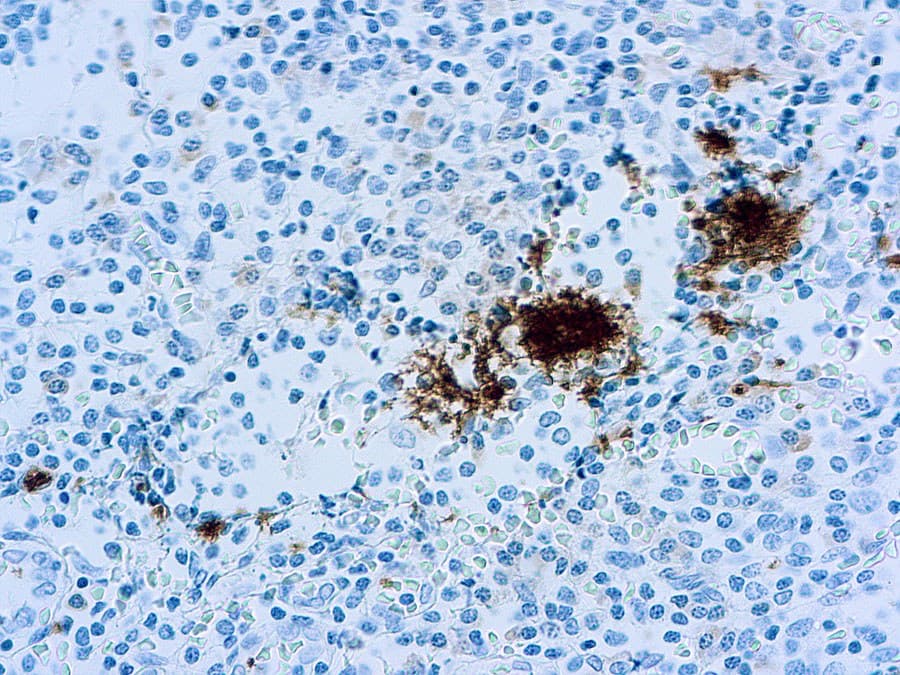

Anti-CD61 CE/IVD antibodies are widely used in hematopathology to identify megakaryocytic lineage cells and support the assessment of platelet-associated disorders. CD61, a transmembrane integrin β3 subunit, plays a central role in hemostasis and integrin-mediated signaling. It is a reliable marker of megakaryocytic differentiation when interpreted alongside complementary markers such as CD41 and CD42b.
Biological Significance of CD61 (Integrin β3)
- CD61 heterodimerizes with CD41 (αIIb) or CD51 (αV), forming receptors such as αIIbβ3 (glycoprotein IIb/IIIa) and αVβ3.
- The αIIbβ3 complex mediates platelet adhesion and aggregation via fibrinogen and von Willebrand factor binding.
- CD61 is strongly expressed on megakaryocytes and platelets, with increasing expression during megakaryocytic maturation.
- It contributes to cell adhesion, migration, survival, and intracellular signaling through integrin-dependent pathways.
Diagnostic Utility in Hematopathology
- IHC for CD61 is routinely applied to identify and quantify megakaryocytes in bone marrow biopsies, supporting evaluation of thrombopoiesis.
- It is a key marker in acute megakaryoblastic leukemia (AMKL) and assists in confirming megakaryocytic lineage in challenging acute leukemia cases.
- When combined with CD41 and CD42b, CD61 enhances diagnostic specificity in myeloid neoplasms with megakaryocytic differentiation.
- CD61 may also assist in detecting platelet-rich thrombi and evaluating myeloproliferative neoplasms or myelodysplastic syndromes, though interpretation should consider potential expression in non-megakaryocytic cells.
Key Features of CD61 CE/IVD Antibodies (IHC)
- Monoclonal formats ensure high specificity for integrin β3 epitopes.
- Validated for formalin-fixed, paraffin-embedded (FFPE) tissue sections, compatible with standard pathology workflows.
- Provide distinct membranous and cytoplasmic staining in megakaryocytes and platelets.
- Available as ready-to-use or concentrated CE/IVD reagents for standardized diagnostic applications.