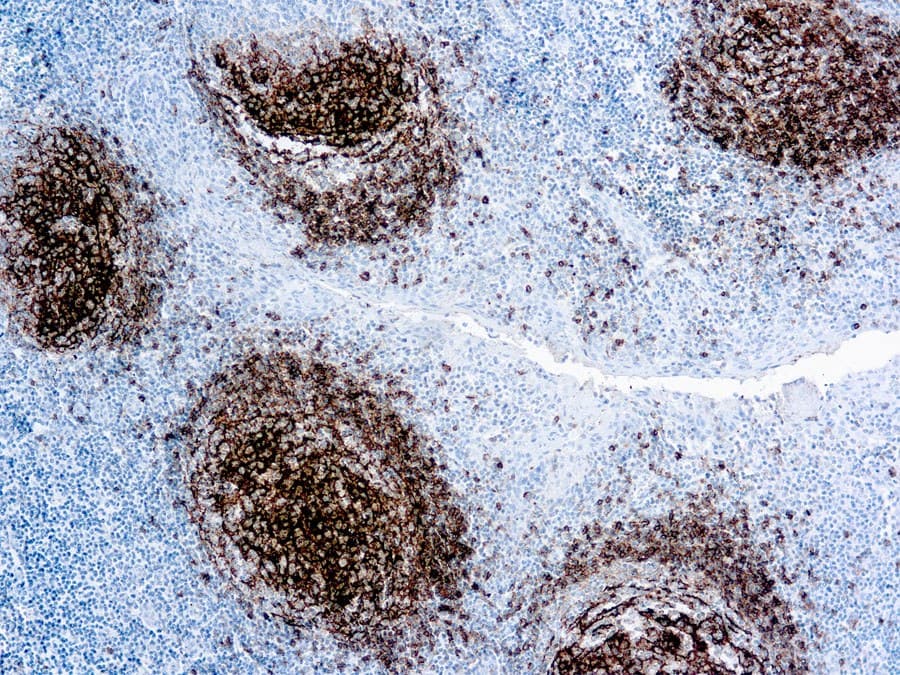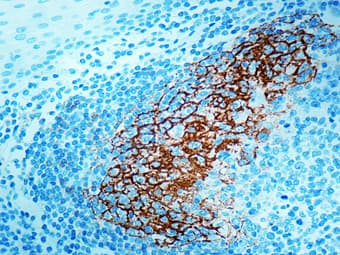

Precise immunophenotypic profiling is essential for the diagnosis and classification of lymphoid malignancies. Anti-CD23 CE/IVD antibodies for immunohistochemistry (IHC) enable reliable detection of CD23 antigen expression in formalin-fixed paraffin-embedded (FFPE) tissues, supporting the characterization of B-cell lymphoproliferative disorders and evaluation of lymphoid microarchitecture.
Biological Significance of Cluster of Differentiation 23 (CD23)
- Molecular identity: CD23, also known as FcεRII and encoded by the FCER2 gene, is a type II transmembrane glycoprotein belonging to the C-type lectin family that functions as the low-affinity receptor for immunoglobulin E (IgE).
- Cellular expression: CD23 is predominantly expressed on activated or mature B lymphocytes and on follicular dendritic cells within germinal centers. Expression has also been reported on additional immune and epithelial cell types, although B cells represent the principal lymphoid population in hematopathology contexts.
- Immune regulation: Through its interaction with IgE and associated signaling pathways, CD23 contributes to the regulation of IgE synthesis, B-cell activation, and antigen-dependent immune responses.
- Soluble CD23: Proteolytic cleavage of membrane CD23 generates soluble CD23 fragments (sCD23), which retain biological activity and can influence B-cell growth, differentiation, and IgE-mediated immune regulation.
These biological properties make CD23 a useful biomarker for studying B-cell activation and lymphoid tissue organization.
Diagnostic Utility of CD23 in Hematopathology
- CLL/SLL immunophenotype: CD23 expression is commonly observed in chronic lymphocytic leukemia/small lymphocytic lymphoma (CLL/SLL) and contributes to their characteristic immunophenotypic profile.
- Differential diagnosis of B-cell lymphomas: CD23 staining is frequently used to help distinguish CLL/SLL from mantle cell lymphoma, which typically lacks CD23 expression.
- Follicular dendritic cell networks: Strong CD23 staining highlights follicular dendritic cell meshworks, facilitating visualization of germinal-center architecture in reactive and neoplastic lymphoid tissues.
- Multiparametric lymphoma panels: CD23 is routinely evaluated alongside markers such as CD20, CD5, and CD21 to support lymphoma classification.
Key Features of CD23 CE/IVD Antibodies for IHC
- Validated performance on FFPE tissue sections for diagnostic IHC workflows.
- High specificity for CD23 antigen detection in lymphoid tissues.
- Compatibility with automated staining platforms and standard detection systems.
- Reproducible staining patterns suitable for diagnostic immunophenotyping panels.
- CE/IVD compliance supporting regulated in-vitro diagnostic use in clinical laboratories.