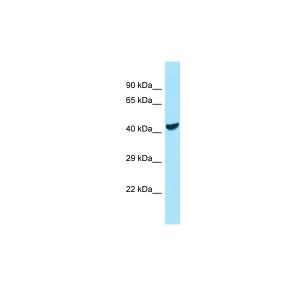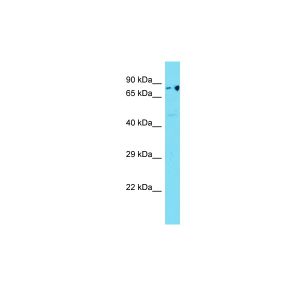

COQ6 Antibody - N-terminal region - HRP

Cat# ARP64161_P050-HRP
Size : 100ul
Brand : Aviva Systems Biology
Contact local distributor :
 Phone : +1 850 650 7790
COQ6 Antibody - N-terminal region : HRP (ARP64161_P050-HRP)
| Datasheets/Manuals | Printable datasheet for anti-COQ6 (ARP64161_P050-HRP) antibody |
|---|
| Predicted Species Reactivity | Human, Mouse, Rat, Cow, Dog, Guinea Pig, Horse, Rabbit, Yeast |
|---|---|
| Product Format | Liquid. Purified antibody is supplied in high phosphate PBS, 100 mm phosphate, 150 mM NaCl, pH 7.6. |
| Clonality | Polyclonal |
| Host | Rabbit |
| Conjugation | HRP: Horseradish Peroxidase |
| Application | WB |
| Reconstitution and Storage | All conjugated antibodies should be stored in light-protected vials or covered with a light protecting material (i.e. aluminum foil). Conjugated antibodies are stable for at least 12 months at 4C. If longer storage is desired (24 months), conjugates may be diluted with up to 50% glycerol and stored at -20C to -80C. Freezing and thawing conjugated antibodies will compromise enzyme activity as well as antibody binding. |
| Immunogen | The immunogen is a synthetic peptide directed towards the N-terminal region of Human COQ6 |
| Purification | Affinity Purified |
| Predicted Homology Based on Immunogen Sequence | Cow: 93%; Dog: 86%; Guinea Pig: 86%; Horse: 93%; Human: 100%; Mouse: 93%; Rabbit: 100%; Rat: 93%; Yeast: 80% |
| Peptide Sequence | Synthetic peptide located within the following region: ILLLEAGPKKVLEKLSETYSNRVSSISPGSATLLSSFGAWDHICNMRYRA |
| Concentration | 0.5 mg/ml |
| Blocking Peptide | For anti-COQ6 (ARP64161_P050-HRP) antibody is Catalog # AAP64161 |
| Gene Symbol | COQ6 |
|---|---|
| Alias Symbols | CGI10, CGI-10, COQ10D6 |
| NCBI Gene Id | 51004 |
| Protein Name | Ubiquinone biosynthesis monooxygenase COQ6 |
| Description of Target | The protein encoded by this gene belongs to the ubiH/COQ6 family. It is an evolutionarily conserved monooxygenase required for the biosynthesis of coenzyme Q10 (or ubiquinone), which is an essential component of the mitochondrial electron transport chain, and one of the most potent lipophilic antioxidants implicated in the protection of cell damage by reactive oxygen species. Knockdown of this gene in mouse and zebrafish results in decreased growth due to increased apoptosis. Mutations in this gene are associated with autosomal recessive coenzyme Q10 deficiency-6 (COQ10D6), which manifests as nephrotic syndrome with sensorineural deafness. Alternatively spliced transcript variants encoding different isoforms have been described for this gene. |
| Uniprot ID | Q9Y2Z9-3 |
| Protein Accession # | NP_872286 |
| Nucleotide Accession # | NM_182480 |
| Protein Size (# AA) | 443 |
| Molecular Weight | 48kDa |
| Protein Interactions | SUMO1; UBC; NEDD8; APP; CDK2; ZBTB16; ARSE; |