

TNFSF13 ELISA Kit (Monkey)

Referência OKBB00848
Tamanho : 96wells/kit,withremovablestrips.
Marca : Aviva Systems Biology
Contactar o distribuidor local :

Telefone : +1 850 650 7790
TNFSF13 ELISA Kit (Monkey) (OKBB00848)
| Datasheets/Manuals | Click here to download product manual. As variation between lots may occur, always reference the lot-specific manual received with each kit. |
|---|
| Predicted Species Reactivity | Monkey | ||||||||||||||||||||||||||||||||||||||||||
|---|---|---|---|---|---|---|---|---|---|---|---|---|---|---|---|---|---|---|---|---|---|---|---|---|---|---|---|---|---|---|---|---|---|---|---|---|---|---|---|---|---|---|---|
| Application | ELISA | ||||||||||||||||||||||||||||||||||||||||||
| ELISA Kit Detection Method | Colorimetric, OD450 nm | ||||||||||||||||||||||||||||||||||||||||||
| ELISA Kit Duration | ~ 3 Hours | ||||||||||||||||||||||||||||||||||||||||||
| ELISA Kit Principle | Aviva's Monkey TNFSF13 ELISA Kit was based on standard sandwich enzyme-linked immune-sorbent assay technology. A monoclonal antibody from mouse specific for TNFSF13 has been precoated onto 96-well plates. Standards (NS0,A105-L250) and test samples are added to the wells, a biotinylated detection polyclonal antibody from goat specific for TNFSF13 is added subsequently and then followed by washing with PBS or TBS buffer. Avidin-Biotin-Peroxidase Complex was added and unbound conjugates were washed away with PBS or TBS buffer. HRP substrate TMB was used to visualize HRP enzymatic reaction. TMB was catalyzed by HRP to produce a blue color product that changed into yellow after adding acidic stop solution. The absorbance of yellow is proportional to the Monkey TNFSF13 amount of sample captured in plate. | ||||||||||||||||||||||||||||||||||||||||||
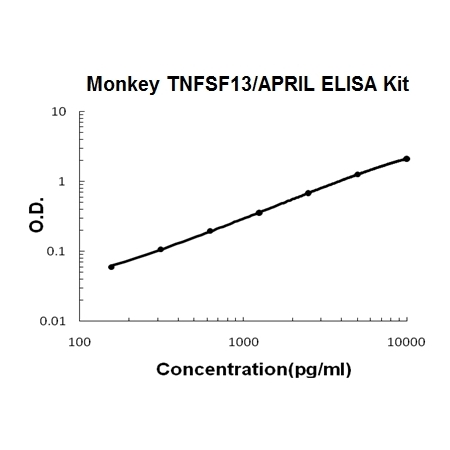
| ELISA Kit Range | 156 pg/ml - 10,000 pg/ml | ||||||||||||||||||||||||||||||||||||||||||
| ELISA Kit Reproducibility |
| ||||||||||||||||||||||||||||||||||||||||||
| ELISA Kit Component |
| ||||||||||||||||||||||||||||||||||||||||||
| Additional Information | To assay reproducibility, three samples with differing target protein concentrations were assayed using four different lots.
*number of samples for each test n=16. | ||||||||||||||||||||||||||||||||||||||||||
| :: |
| ||||||||||||||||||||||||||||||||||||||||||
| Reconstitution and Storage | Store at 4C for 6 months, at -20C for 12 months. Avoid multiple freeze-thaw cycles (Shipped with wet ice.) | ||||||||||||||||||||||||||||||||||||||||||
| Sample Type | Sandwich High Sensitivity ELISA kit for Quantitative Detection of monkey primate TNFSF13/APRIL | ||||||||||||||||||||||||||||||||||||||||||
| Sensitivity | <10 pg/ml | ||||||||||||||||||||||||||||||||||||||||||
| Immunogen | Expression system for standard: NS0; Immunogen sequence: A105-L250 | ||||||||||||||||||||||||||||||||||||||||||
| Gene Symbol | TNFSF13 |
|---|---|
| Gene Full Name | tumor necrosis factor (ligand) superfamily, member 13 |
| Alias Symbols | Tumor necrosis factor (Ligand) superfamily member 13 transcript variant delta ;Tumor necrosis factor ligand superfamily member 13 ;TNFSF13 ; |
| NCBI Gene Id | 100551507 |
| Protein Name | Tumor necrosis factor ligand superfamily member 13 |
| Description of Target | Tumor necrosis factor ligand superfamily member 13(TNFSF13) also known as a proliferation-inducing ligand(APRIL) is a protein that in humans is encoded by the TNFSF13 gene. TNFSF13 has also been designated CD256(cluster of differentiation 256). The protein encoded by this gene is a member of the tumor necrosis factor ligand(TNF) ligand family. This protein is a ligand for TNFRSF17/BCMA, a member of the TNF receptor family. This protein and its receptor are both found to be important for B cell development. In vivo experiments suggest an important role for APRIL in the long-term survival of plasma cells in the bone marrow. Mice deficient in April showed a reduced ability to support plasma cell survival In vitro experiments suggested that this protein may be able to induce apoptosis through its interaction with other TNF receptor family proteins such asTNFRSF6/FAS and TNFRSF14/HVEM. Three alternatively spliced transcript variants of this gene encoding distinct isoforms have been reported. The TNFSF13 gene lies 878 bp downstream of the TNFSF12 gene on chromosome 17p13.1. |
| Uniprot ID | Q2QBA2 |
| Protein Accession # | NP_001185551.1 |
| Nucleotide Accession # | NM_001198622.1 |