

Recombinant Human Roundabout homolog 4 (ROBO4), partial - E.coli

Referência CSB-EP845177HU1d7-100ug
Tamanho : 100ug
Marca : Cusabio
Contactar o distribuidor local :

Telefone : +1 850 650 7790
| Abbreviation | Recombinant Human ROBO4 protein, partial |
| MSDS | |
| Image | |
Product Details
Purity
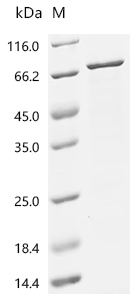
≥ 85% as determined by SDS-PAGE.
Activity
Not Test
Target Names
Uniprot No.
Research Area
Cancer
Alternative Names
Magic roundabout
Species
Homo sapiens (Human)
Source
E.coli
Expression Region
490-1007aa
Target Protein Sequence
HRRRRARVHLGPGLYRYTSEDAILKHRMDHSDSQWLADTWRSTSGSRDLSSSSSLSSRLGADARDPLDCRRSLLSWDSRSPGVPLLPDTSTFYGSLIAELPSSTPARPSPQVPAVRRLPPQLAQLSSPCSSSDSLCSRRGLSSPRLSLAPAEAWKAKKKQELQHANSSPLLRGSHSLELRACELGNRGSKNLSQSPGAVPQALVAWRALGPKLLSSSNELVTRHLPPAPLFPHETPPTQSQQTQPPVAPQAPSSILLPAAPIPILSPCSPPSPQASSLSGPSPASSRLSSSSLSSLGEDQDSVLTPEEVALCLELSEGEETPRNSVSPMPRAPSPPTTYGYISVPTASEFTDMGRTGGGVGPKGGVLLCPPRPCLTPTPSEGSLANGWGSASEDNAASARASLVSSSDGSFLADAHFARALAVAVDSFGFGLEPREADCVFIDASSPPSPRDEIFLTPNLSLPLWEWRPDWLEDMEVSHTQRLGRGMPPWPPDSQISSQRSQLHCRMPKAGASPVDYS
Note: The complete sequence may include tag sequence, target protein sequence, linker sequence and extra sequence that is translated with the protein sequence for the purpose(s) of secretion, stability, solubility, etc.
If the exact amino acid sequence of this recombinant protein is critical to your application, please explicitly request the full and complete sequence of this protein before ordering.
Mol. Weight
65.0 kDa
Protein Length
Partial
Tag Info
C-terminal 10xHis-tagged
Form
Liquid or Lyophilized powder
Note: We will preferentially ship the format that we have in stock, however, if you have any special requirement for the format, please remark your requirement when placing the order, we will prepare according to your demand.
Note: We will preferentially ship the format that we have in stock, however, if you have any special requirement for the format, please remark your requirement when placing the order, we will prepare according to your demand.
Buffer
If the delivery form is liquid, the default storage buffer is Tris/PBS-based buffer, 5%-50% glycerol. If the delivery form is lyophilized powder, the buffer before lyophilization is Tris/PBS-based buffer, 6% Trehalose.
Reconstitution
We recommend briefly centrifuging the vial prior to opening to bring the contents to the bottom. Reconstitute the lyophilized protein in sterile deionized water to a recommended concentration of 0.1–1.0 mg/mL. If used immediately after reconstitution, glycerol is not required. If not for immediate use, after the protein is completely dissolved, add glycerol to a final concentration of 5%–50% (default: 50%), aliquot as needed, and store at -20℃/-80℃ for long-term storage. If dilution is needed during subsequent use, dilute with the same buffer as the protein, but without stabilizers (e.g., glycerol, trehalose, etc).
Troubleshooting and FAQs
Storage Condition
Store at -20°C/-80°C upon receipt, aliquoting is necessary for mutiple use. Avoid repeated freeze-thaw cycles.
Shelf Life
The shelf life is related to many factors, storage state, buffer ingredients, storage temperature and the stability of the protein itself.
Generally, the shelf life of liquid form is 6 months at -20°C/-80°C. The shelf life of lyophilized form is 12 months at -20°C/-80°C.
Generally, the shelf life of liquid form is 6 months at -20°C/-80°C. The shelf life of lyophilized form is 12 months at -20°C/-80°C.
Notes
Repeated freezing and thawing is not recommended. Store working aliquots at 4°C for up to one week.
Datasheet & COA
Please contact us to get it.
Customer Reviews and Q&A
■ Customer Reviews
There are currently no reviews for this product.
Target Background
Function
Receptor for Slit proteins, at least for SLIT2, and seems to be involved in angiogenesis and vascular patterning. May mediate the inhibition of primary endothelial cell migration by Slit proteins. Involved in the maintenance of endothelial barrier organization and function.
Gene References into Functions
- Low expression level of ROBO4 is associated with evasive resistance and disease progression in cancer.
- GM-CSF and IL-1beta. Taken together, we demonstrated novel Robo4 functions in inflammation, i.e., it promotes IL-6 production by endothelial cells and immune cells via crosstalk.
- Results show that hyperglycemia-induced upregulation of Robo4 in retinal endothelial cells is directly mediated by transcription factor SP1 which increases the transcription of Robo4 via an additional binding site in Robo4 promoter. SP1/Robo4 can regulate the migration, monolayer permeability and angiogenesis of retinal endothelial cells under hyperglycemic conditions.
- Overexpression of Roundabout4 is associated with glioma.
- there was a increase in Robo4 expression under hyperglycemic conditions, while there was a decrease under hypoxic and combined hypoxic and hyperglycemic conditions, suggesting Robo4 might play different roles in various stages of diabetic retinopathy
- These results suggest that Slit2/Robo1 binding exerts an effect on cell migration, which is negatively regulated by Robo4, and Robo1 may function by interacting with CdGAP in HUVECs.
- results indicate that AP-1 complexes regulate Robo4 gene expression in endothelial cells
- BM Robo4 expression can serve as a new biomarker to predict clinical outcomes in AML patients and Robo4 may serve as a potential therapeutic target in patients with higher Robo4 expression.
- Robo4 suppressed glioma-induced endothelial cell proliferation, migration and tube formation in vitro by inhibiting VEGR2-mediated activation of PI3K/AKT and FAK signaling pathways.
- Increased or decreased expression of Robo4 by stimulation or knockdown of HIF-1alpha suggesting that Robo4 is positively regulated by HIF-1alpha under normoxic and hypoxic conditions in microvascular endothelial cells in vitro.
- Plasma Robo4 levels are increased, transiently, following cardiac surgery requiring CPB
- This study demonistrated that roundabout 4 regulates blood-tumor barrier permeability through the modulation of ZO-1, Occludin, and Claudin-5 expression.
- Endothelial cell-specific DNA methylation pattern of the Robo4 proximal promoter is determined during cell differentiation and contributes to regulation of EC-specific Robo4 gene expression.
- SLIT3-ROBO4 activation promotes vascular network formation in human engineered tissue and angiogenesis in vivo.
- Slit2-Robo4 is a key regulator of endothelial inflammation, and its dysregulation during endotoxemia is a novel mechanism for LPS-induced vascular pathogenesis.
- Here I will discuss the regulation mechanism of Robo4 gene expression by transcription factors and epigenetic control. [Review]
- SiRNA knockdown of Robo4 in pulmonary microvascular endothelial cells prevented Slit2 inhibition of Andes virus induced permeability demonstrating that Robo4 receptors determine pulmonary microvascular endothelial cells responsiveness to Slit2
- targeting Slit2/Robo4 signaling may protect the integrity of the lymphatic barrier and limit the dissemination of HIV in the host.
- Protein expression of Slit2/3 and Robo1/4 was also identified in OVCAR-3 and SKOV-3 cells.
- REVIEW: Robo4-dependent Slit signaling stabilizes the vasculature during pathologic angiogenesis and cytokine storm
- Activating with the soluble ligand Slit an endothelium-specific, Robo4-dependent signaling pathway that strengthens the vascular barrier, diminishing deleterious aspects of the host's response to the pathogen-induced cytokine storm.
- roundabout gene family extends beyond neuronal tissue and that roundabout/slit interactions are likely to have a role in angiogenesis
- We therefore hypothesize that expression of MRB is involved in regulating the migration of endothelial cells during tumor angiogenesis.
- Expression of Robo1 is mainly in tumor cells, whereas Robo4 is primarily in endothelial cells of tumor vessels. Therefore, the Robo proteins provide potential target structures for the anti-tumorigenic and anti-angiogenic therapy of colorectal carcinoma.
- 3-kb upstream promoter of human Robo4 contains information for cell type-specific expression in the intact endothelium.
- No evidence for association between Gilles de la Tourette Syndrome and either the ROBO4 gene. Thus, this gene is unlikely to be the susceptibility genes contributing to GTS on 11q24.
- One SNP of ROBO3 showed association with autism
- role of the GABP-binding motif in mediating Robo4 expression in the intact endothelium
- Robo1 is essential for Robo4-mediated filopodia induction
- The knockdown of robo4 abrogated the chemotactic response of endothelial cells to serum but enhanced a chemokinetic response to Slit2, while robo1 knockdown cells do not display chemotactic response to serum or VEGF.
- Investigated Robo4 in fibrovascular membranes (FVMs) from patients with proliferative diabetic retinopathy and in 2 cell lines. The level of Robo4 mRNA was high in FVMs. Found Robo4 may play a role in the formation of FVMs.
- data reveal that a Slit2-Robo4-paxillin-GIT1 network inhibits the cellular protrusive activity underlying neovascularization and vascular leak, and identify a new therapeutic target for ameliorating diseases involving the vascular system
- ROBO4 mRNA decreases during pulmonary fibrosis and hypertension
Protein Families
Immunoglobulin superfamily, ROBO family
Tissue Specificity
Specifically expressed in endothelial cells. Expressed in endothelial and intimal cells of the ascending aorta.
Database Links
HGNC:
OMIM:
KEGG:
STRING:
UniGene: