

Quinacrine (dihydrochloride hydrate)

Referência NB-64-12470-500mg
Tamanho : 500mg
Marca : Neo Biotech
Contactar o distribuidor local :
 Telefone : +1 850 650 7790
Quinacrine (dihydrochloride hydrate) (Synonyms: Quinacrine (hydrochloride hydrate) (83-89-6 free base))
Catalog No. T23210 Copy Product Info
Quinacrine is a compound that is commonly used as an anti-protozoal agent. It inhibits voltage-dependent sodium channels (IC50: 3.3 μM) and suppresses aldehyde oxidase (IC50: 3.3 μM). Quinacrine prevents misfolding of prion protein (EC50: 0.3 μM). As an effective riboflavin antagonist, quinacrine associates with the riboflavin-binding protein (Ki: 6.7 μM). Voltage-dependent sodium channels play a vital role in action potential initiation and propagation in excitable cells, including muscle, nerve, and neuroendocrine cell types.
Quinacrine (dihydrochloride hydrate)
Copy Product InfoSynonyms Quinacrine (hydrochloride hydrate) (83-89-6 free base)
Quinacrine is a compound that is commonly used as an anti-protozoal agent. It inhibits voltage-dependent sodium channels (IC50: 3.3 μM) and suppresses aldehyde oxidase (IC50: 3.3 μM). Quinacrine prevents misfolding of prion protein (EC50: 0.3 μM). As an effective riboflavin antagonist, quinacrine associates with the riboflavin-binding protein (Ki: 6.7 μM). Voltage-dependent sodium channels play a vital role in action potential initiation and propagation in excitable cells, including muscle, nerve, and neuroendocrine cell types.
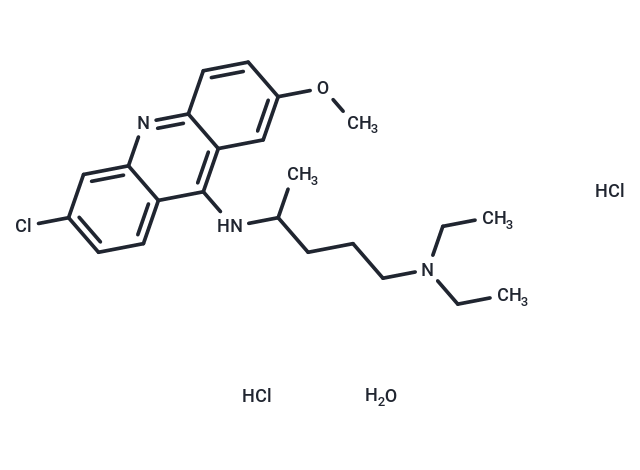
Cas No. 207671-43-0
Product Introduction
Bioactivity
Chemical Properties
Storage & Solubility Information
| Description | Quinacrine is a compound that is commonly used as an anti-protozoal agent. It inhibits voltage-dependent sodium channels (IC50: 3.3 μM) and suppresses aldehyde oxidase (IC50: 3.3 μM). Quinacrine prevents misfolding of prion protein (EC50: 0.3 μM). As an effective riboflavin antagonist, quinacrine associates with the riboflavin-binding protein (Ki: 6.7 μM). Voltage-dependent sodium channels play a vital role in action potential initiation and propagation in excitable cells, including muscle, nerve, and neuroendocrine cell types. |
| In vitro | Quinacrine, in a dose-dependent manner, effectively reversed the resistance in the multi-drug resistance (MDR) K562 cells. Quinacrine displayed strong toxicity to the MDR K562 cells at a concentration of 10.0 μM. Compared to the control, quinacrine significantly increased the activity of caspase-9 and -3 activities in the MDR K562 and K562 cells in a dose-dependent fashion [1]. |
| In vivo | Female BALB/c nude mice, bearing MDR K562 cell xenografts, were injected with quinacrine at a dose of 10 mg/kg via tail vein for 13 days. Compared to the control group, quinacrine inhibited tumor growth obviously in the treated groups. Furthermore, quinacrine enhanced the anti-tumor effects of vincristine [1]. |
| Synonyms | Quinacrine (hydrochloride hydrate) (83-89-6 free base) |
| Molecular Weight | 472.9 |
| Formula | C23H30ClN3O·2HCl·xH2O |
| Cas No. | 207671-43-0 |
| Smiles | ClC1=CC=C2C(NC(C)CCCN(CC)CC)=C3C(C=CC(OC)=C3)=NC2=C1.Cl.Cl.O |
| Relative Density. | no data available |
| Storage | Powder: -20°C for 3 years | In solvent: -80°C for 1 year Shipping with blue ice/Shipping at ambient temperature. |
| Solubility Information | H2O: ≥18.65 mg/mL, Sonication is recommended. |