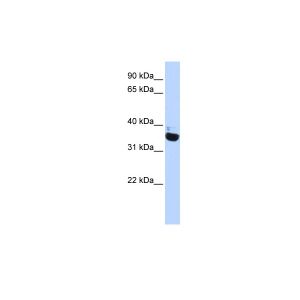
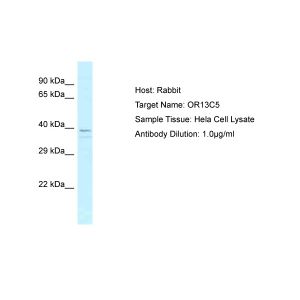
OR13C5 Antibody - middle region - FITC

Referência ARP31561_P050-FITC
Tamanho : 100ul
Marca : Aviva Systems Biology
Contactar o distribuidor local :

Telefone : +1 850 650 7790
OR13C5 Antibody - middle region : FITC (ARP31561_P050-FITC)

Click here to learn more about Aviva's By-Request Conjugation Service.
| Datasheets/Manuals | Printable datasheet for anti-OR13C5 (ARP31561_P050-FITC) antibody |
|---|
| Predicted Species Reactivity | Human, Rat, Cow, Dog, Horse, Pig |
|---|---|
| Product Format | Liquid. Purified antibody supplied in 1x PBS buffer. |
| Clonality | Polyclonal |
| Host | Rabbit |
| Conjugation | FITC: Fluorescein Isothiocyanate |
| Application | WB |
| Reconstitution and Storage | All conjugated antibodies should be stored in light-protected vials or covered with a light protecting material (i.e. aluminum foil). Conjugated antibodies are stable for at least 12 months at 4C. If longer storage is desired (24 months), conjugates may be diluted with up to 50% glycerol and stored at -20C to -80C. Freezing and thawing conjugated antibodies will compromise enzyme activity as well as antibody binding. |
| Immunogen | The immunogen is a synthetic peptide directed towards the middle region of human OR13C5 |
| Purification | Affinity Purified |
| Predicted Homology Based on Immunogen Sequence | Cow: 86%; Dog: 100%; Horse: 93%; Human: 100%; Pig: 86%; Rat: 85% |
| Peptide Sequence | Synthetic peptide located within the following region: CGTIFLMYMKPKSQETLNSDDLDATDKLIFIFYRVMTPMMNPLIYSLRNK |
| Concentration | 0.5 mg/ml |
| Blocking Peptide | For anti-OR13C5 (ARP31561_P050-FITC) antibody is Catalog # AAP31561 (Previous Catalog # AAPP02339) |
| Reference | Humphray,S.J., (2004) Nature 429 (6990), 369-374 |
|---|---|
| Gene Symbol | OR13C5 |
| Gene Full Name | Olfactory receptor, family 13, subfamily C, member 5 |
| Alias Symbols | OR9-11 |
| NCBI Gene Id | 138799 |
| Protein Name | Olfactory receptor 13C5 |
| Description of Target | Olfactory receptors interact with odorant molecules in the nose, to initiate a neuronal response that triggers the perception of a smell. The olfactory receptor proteins are members of a large family of G-protein-coupled receptors (GPCR) arising from single coding-exon genes. Olfactory receptors share a 7-transmembrane domain structure with many neurotransmitter and hormone receptors and are responsible for the recognition and G protein-mediated transduction of odorant signals. The olfactory receptor gene family is the largest in the genome. The nomenclature assigned to the olfactory receptor genes and proteins for this organism is independent of other organisms.Olfactory receptors interact with odorant molecules in the nose, to initiate a neuronal response that triggers the perception of a smell. The olfactory receptor proteins are members of a large family of G-protein-coupled receptors (GPCR) arising from single coding-exon genes. Olfactory receptors share a 7-transmembrane domain structure with many neurotransmitter and hormone receptors and are responsible for the recognition and G protein-mediated transduction of odorant signals. The olfactory receptor gene family is the largest in the genome. The nomenclature assigned to the olfactory receptor genes and proteins for this organism is independent of other organisms. |
| Uniprot ID | Q8NGS8 |
| Protein Accession # | NP_001004482 |
| Nucleotide Accession # | NM_001004482 |
| Protein Size (# AA) | 318 |
| Molecular Weight | 36kDa |