

Quimigen Portugal > KIN Antibody - middle region - Biotin
KIN Antibody - middle region - Biotin

Referência ARP31690_P050-Biotin
Tamanho : 100ul
Contactar o distribuidor local :

Telefone : +1 850 650 7790
Marca : Aviva Systems Biology
Contactar o distribuidor local :
Telefone : +1 850 650 7790
Size:100ul
Bulk
Order
Order
Aviva's
Satisfaction
Guarantee
Satisfaction
Guarantee
Contact Us:
- Toll Free: 888-880-0001
- Phone: 858-552-6979
- Email: info@avivasysbio.com
Shipping Info:
- : Antibody & Protein in US
- + /Kit in US
- Contact us for international orders.
KIN Antibody - middle region : Biotin (ARP31690_P050-Biotin)
Click here to learn more about Aviva's By-Request Conjugation Service.
| Datasheets/Manuals | Printable datasheet for anti-KIN (ARP31690_P050-Biotin) antibody |
|---|
| Predicted Species Reactivity | Human, Rat, Cow, Dog, Guinea Pig, Horse, Rabbit |
|---|---|
| Product Format | Liquid. Purified antibody supplied in 1x PBS buffer. |
| Clonality | Polyclonal |
| Host | Rabbit |
| Conjugation | Biotin |
| Application | IHC, WB |
| Reconstitution and Storage | All conjugated antibodies should be stored in light-protected vials or covered with a light protecting material (i.e. aluminum foil). Conjugated antibodies are stable for at least 12 months at 4C. If longer storage is desired (24 months), conjugates may be diluted with up to 50% glycerol and stored at -20C to -80C. Freezing and thawing conjugated antibodies will compromise enzyme activity as well as antibody binding. |
| Immunogen | The immunogen is a synthetic peptide directed towards the middle region of human KIN |
| Purification | Affinity Purified |
| Predicted Homology Based on Immunogen Sequence | Cow: 85%; Dog: 85%; Guinea Pig: 85%; Horse: 100%; Human: 100%; Rabbit: 85%; Rat: 85% |
| Peptide Sequence | Synthetic peptide located within the following region: LKTIGSSASVKRKESSQSSTQSKEKKKKKSALDEIMEIEEEKKRTARTDY |
| Concentration | 0.5 mg/ml |
| Blocking Peptide | For anti-KIN (ARP31690_P050-Biotin) antibody is Catalog # AAP31690 (Previous Catalog # AAPP02477) |
| Sample Type Confirmation | KIN is supported by BioGPS gene expression data to be expressed in HepG2 |
| Reference | Despras,E., et al., (2003) Radiat.Res.159(6),748-758 |
|---|---|
| Gene Symbol | KIN |
| Gene Full Name | KIN, antigenic determinant of recA protein homolog (mouse) |
| Alias Symbols | BTCD, Rts2, KIN17 |
| NCBI Gene Id | 22944 |
| Protein Name | DNA/RNA-binding protein KIN17 |
| Description of Target | Kin is a nuclear protein that forms intranuclear foci during proliferation and is redistributed in the nucleoplasm during the cell cycle. Short-wave ultraviolet light provokes the relocalization of the protein, suggesting its participation in the cellular response to DNA damage. Originally selected based on protein-binding with RecA antibodies, the mouse protein presents a limited similarity with a functional domain of the bacterial RecA protein, a characteristic shared by the human ortholog. |
| Uniprot ID | O60870 |
| Protein Accession # | NP_036443 |
| Nucleotide Accession # | NM_012311 |
| Protein Size (# AA) | 393 |
| Molecular Weight | 45kDa |
| Protein Interactions | UBC; HECW2; RPA1; PCNA; METTL22; Bud13; RPA2; |
-
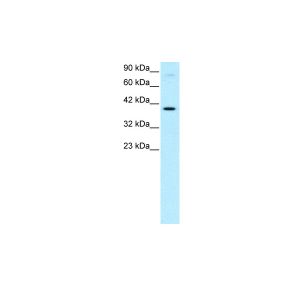 KIN Antibody - middle region (ARP31690_P050)Catalog #: ARP31690_P050Species Tested: HumanApplication: IHC, WBFormat: Liquid. Purified antibody supplied in 1x PBS buffer with 0.09% (w/v) sodium azide and 2% sucrose.
-
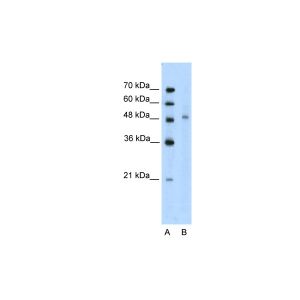 KIN Antibody - middle region (ARP32295_T100)Catalog #: ARP32295_T100Species Tested: HumanApplication: WBFormat: Liquid. Purified antibody supplied in 1x PBS buffer with 0.09% (w/v) sodium azide and 2% sucrose.