IL23A ELISA Kit (Human)

Referência OKCD06279
Tamanho : 96Wells
Marca : Aviva Systems Biology
Contactar o distribuidor local :

Telefone : +1 850 650 7790
IL23A ELISA Kit (Human) (OKCD06279)
| Datasheets/Manuals | Printable datasheet for IL23A ELISA Kit (Human) (OKCD06279) |
|---|
| Predicted Species Reactivity | Homo sapiens|Human | ||||||||||||||||||||||
|---|---|---|---|---|---|---|---|---|---|---|---|---|---|---|---|---|---|---|---|---|---|---|---|
| Application | ELISA-Sandwich | ||||||||||||||||||||||
| ELISA Kit Detection Method | Colorimetric | ||||||||||||||||||||||
| ELISA Kit Duration | 3h | ||||||||||||||||||||||
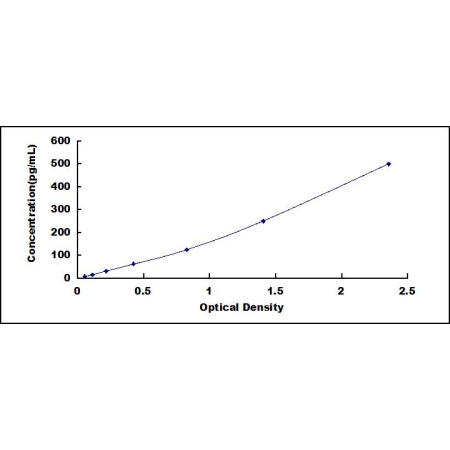
| ELISA Kit Principle | The test principle applied in this kit is Sandwich enzyme immunoassay. The microtiter plate provided in this kit has been pre-coated with an antibody specific to Interleukin 23 Subunit Alpha (IL23a). Standards or samples are then added to the appropriate microtiter plate wells with a biotin-conjugated antibody specific to Interleukin 23 Subunit Alpha (IL23a). Next, Avidin conjugated to Horseradish Peroxidase (HRP) is added to each microplate well and incubated. After TMB substrate solution is added, only those wells that contain Interleukin 23 Subunit Alpha (IL23a), biotin-conjugated antibody and enzyme-conjugated Avidin will exhibit a change in color. The enzyme-substrate reaction is terminated by the addition of sulphuric acid solution and the color change is measured spectrophotometrically at a wavelength of 450nm +/- 10nm. The concentration of Interleukin 23 Subunit Alpha (IL23a) in the samples is then determined by comparing the O.D. of the samples to the standard curve. | ||||||||||||||||||||||
| ELISA Kit Range | 7.8-500pg/mL | ||||||||||||||||||||||
| ELISA Kit Reproducibility | Intra-assay Precision (Precision within an assay): 3 samples with low, middle and high level Interleukin 23 Subunit Alpha (IL23a) were tested 20 times on one plate, respectively. Inter-assay Precision (Precision between assays): 3 samples with low, middle and high level Interleukin 23 Subunit Alpha (IL23a) were tested on 3 different plates, 8 replicates in each plate. CV(%) = SD/meanX100 Intra-Assay: CV<10% Inter-Assay: CV<12% | ||||||||||||||||||||||
| ELISA Kit Component |
| ||||||||||||||||||||||
| Reconstitution and Storage | 2°C to 8°C|-20°C | ||||||||||||||||||||||
| Sample Type | Serum, plasma, tissue homogenates, cell lysates, cell culture supernates and other biological fluids | ||||||||||||||||||||||
| Sensitivity | < 2.8pg/mL |
| Gene Symbol | IL23A |
|---|---|
| Gene Full Name | interleukin 23 subunit alpha |
| Alias Symbols | IL-23;IL-23 subunit alpha;IL-23A;IL-23-A;IL-23p19;IL23P19;interleukin 23 p19 subunit;interleukin 23, alpha subunit p19;interleukin-23 subunit alpha;interleukin-23 subunit p19;interleukin-six, G-CSF related factor;JKA3 induced upon T-cell activation;P19;SGRF. |
| NCBI Gene Id | 51561 |
| Protein Name | Interleukin-23 subunit alpha |
| Description of Target | Associates with IL12B to form the IL-23 interleukin, a heterodimeric cytokine which functions in innate and adaptive immunity. IL-23 may constitute with IL-17 an acute response to infection in peripheral tissues. IL-23 binds to a heterodimeric receptor complex composed of IL12RB1 and IL23R, activates the Jak-Stat signaling cascade, stimulates memory rather than naive T-cells and promotes production of proinflammatory cytokines. IL-23 induces autoimmune inflammation and thus may be responsible for autoimmune inflammatory diseases and may be important for tumorigenesis. |
| Uniprot ID | Q9NPF7 |
| Protein Accession # | NP_057668.1 |
| Nucleotide Accession # | NM_016584.2 |