Human LCK Antibody : PE (Phospho-Tyr505)

Referência OAAQ00178-10tests
Tamanho : 10Tests
Marca : Aviva Systems Biology
Contactar o distribuidor local :

Telefone : +1 850 650 7790
Human LCK Antibody : PE (Phospho-Tyr505)
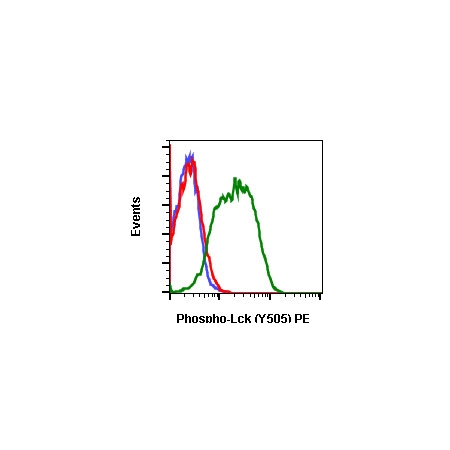
Human LCK Antibody : PE (Phospho-Tyr505) (OAAQ00178)
| Datasheets/Manuals | Printable datasheet for OAAQ00178 |
|---|
| Tested Species Reactivity | Human |
|---|---|
| Predicted Species Reactivity | Mouse, Rat |
| Product Format | Liquid. 1X PBS, 0.09% NaN3, 0.2% BSA. |
| Clonality | Monoclonal |
| Clone | LckY505-A3 |
| Isotype | Rabbit IgG1k |
| Host | Rabbit |
| Conjugation | PE: Phycoerythrin |
| Application | FC |
| Reconstitution and Storage | 2-8C |
| Immunogen | A synthetic phospho-peptide corresponding to residues surrounding Tyr505 of human phospho Lck |
| Purification | Protein A+G |
| Target Post-Translational Modification | Phospho-Tyr505 |
| Application Info | For flow cytometric staining, the suggested use of this reagent is 5 uL per million cells or 5 uL per 100 uL of staining volume. It is recommended that the reagent be titrated for optimal performance for each application. |
| Reference | Serafin V, Capuzzo G, Milani G, et al. (2017) Blood. 130: 2750-2761. Lee KC, Ouwehand I, Giannini AL, et al. (2010) Leukemia. 24: 896-900. |
|---|---|
| Gene Symbol | LCK |
| Gene Full Name | LCK proto-oncogene, Src family tyrosine kinase |
| Alias Symbols | LSK, YT16, IMD22, p56lck, pp58lck |
| NCBI Gene Id | 3932 |
| Protein Name | tyrosine-protein kinase Lck |
| Description of Target | This gene is a member of the Src family of protein tyrosine kinases (PTKs). The encoded protein is a key signaling molecule in the selection and maturation of developing T-cells. It contains N-terminal sites for myristylation and palmitylation, a PTK domain, and SH2 and SH3 domains which are involved in mediating protein-protein interactions with phosphotyrosine-containing and proline-rich motifs, respectively. The protein localizes to the plasma membrane and pericentrosomal vesicles, and binds to cell surface receptors, including CD4 and CD8, and other signaling molecules. Multiple alternatively spliced variants encoding different isoforms have been described. |
| Uniprot ID | P06239 |
| Protein Accession # | NP_001036236.1 |
| Nucleotide Accession # | NM_001042771.2 |