DNMT1 Antibody

Referência OASE00145
Tamanho : 100ug
Marca : Aviva Systems Biology
Contactar o distribuidor local :

Telefone : +1 850 650 7790
DNMT1 Antibody (OASE00145)
| Datasheets/Manuals | Printable datasheet for DNMT1 Antibody (OASE00145) |
|---|---|
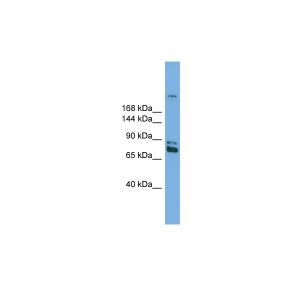
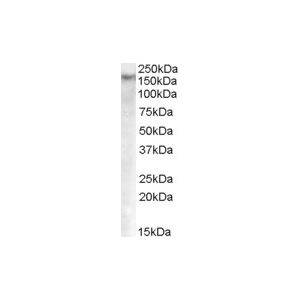
| COA Datasheet | 2 µg/ml of SMC-200 was sufficient for detection of Dnmt1 in 10 µg of mouse ES cell lysate by colorimetric immunoblot analysis using Goat anti-mouse IgG:HRP as the secondary antibody. |
| Predicted Species Reactivity | Fish|Human|Mouse|Zebrafish |
|---|---|
| Clonality | Monoclonal |
| Clone | 60B1220.1 |
| Isotype | IgG1 Kappa |
| Host | Mouse |
| Conjugation | Unconjugated |
| Application | CHIP,IHC,IP,WB |
| Additional Information | Background Info: It will cross-react with mouse DNMT1. |
| :: | Scientific Background: Methylation of DNA at cytosine residues plays an important role in regulation of gene expression, genomic imprinting and is essential for mammalian development. Hypermethylation of CpG islands in tumor suppressor genes or hypomethylation of bulk genomic DNA may be linked with development of cancer. To date, 3 families of mammalian DNA methyltransferase genes have been identified which include Dnmt1, Dnmt2 and Dnmt3. Dnmt1 is constitutively expressed in proliferating cells and inactivation of this gene causes global demethylation of genomic DNA and embryonic lethality. Dnmt2 is expressed at low levels in adult tissues and its inactivation does not affect DNA methylation or maintenance of methylation. The Dnmt3 family members, Dnmt3a and Dnmt3b, are strongly expressed in ES cells but their expression is down regulated in differentiating ES cells and is low in adult somatic tissue. Dnmt1 co-purifies with the retinoblastoma (Rb) tumour suppressor gene product, E2F1, and HDAC1. Dnmt1 also cooperates with Rb to repress transcription from promoters containing E2F-binding sites suggesting a link between DNA methylation, histone deacetylase and sequence-specific DNA binding activity, as well as a growth-regulatory pathway that is disrupted in nearly all cancer cells (1-6). |
| :: | Certificate of Analysis: 2 ug/mL was sufficient for detection of Dnmt1 in 10ug of mouse ES cell lysate by colorimetric immunoblot analysis using Goat anti-mouse IgG:HRP as the secondary antibody. |
| Reconstitution and Storage | -20°C |
| Immunogen | Raised against a synthetic peptide corresponding to amino acids 637-650 of human DNMT1 |
| Purification | Protein G Purified |
| Concentration | 1 mg/ml |
| Specificity | Detects ~180kDa. It will cross-react with mouse DNMT1. |
| Dilution | WB (1:1000), IHC (1:1000); optimal dilutions for assays should be determined by the user. |
| Storage Buffer | PBS, 50% glycerol, 0.09% sodium azide |
| Description | Methylation of DNA at cytosine residues plays an important role in regulation of gene expression, genomic imprinting and is essential for mammalian development. Hypermethylation of CpG islands in tumor suppressor genes or hypomethylation of bulk genomic DNA may be linked with development of cancer. To date, 3 families of mammalian DNA methyltransferase genes have been identified which include Dnmt1, Dnmt2 and Dnmt3. Dnmt1 is constitutively expressed in proliferating cells and inactivation of this gene causes global demethylation of genomic DNA and embryonic lethality. Dnmt2 is expressed at low levels in adult tissues and its inactivation does not affect DNA methylation or maintenance of methylation. The Dnmt3 family members, Dnmt3a and Dnmt3b, are strongly expressed in ES cells but their expression is down regulated in differentiating ES cells and is low in adult somatic tissue. Dnmt1 co-purifies with the retinoblastoma (Rb) tumour suppressor gene product, E2F1, and HDAC1. Dnmt1 also cooperates with Rb to repress transcription from promoters containing E2F-binding sites suggesting a link between DNA methylation, histone deacetylase and sequence-specific DNA binding activity, as well as a growth-regulatory pathway that is disrupted in nearly all cancer cells (1-6). |
| Reference | 1. Bestor T., et al.(1988) J.Mol. Biol. 203: 971-983. 2. Yen R.W., Vertino P.M., Nelkin B.D. et al. (1992) Nucl. Acids Res. 20: 2287-2291. 3. Xie S. et al. (1999) Gene 236: 87-95. 4. Okano M., Bell D.W., Haber D.A. and Li E. (1999) Cell 99: 247-257. 5. Reik W. et al. (1999) J. Nat. Genet 23: 380-382. 6. Robertson K.D., et al. (2000) Nat Genet 25(3):338-342. |
|---|---|
| Gene Symbol | DNMT1 |
| Gene Full Name | DNA methyltransferase 1 |
| Alias Symbols | ADCADN, AIM, CXXC-type zinc finger protein 9, CXXC9, DNA (cytosine-5-)-methyltransferase 1, DNA (cytosine-5)-methyltransferase 1, DNA methyltransferase HsaI, DNA MTase HsaI, DNMT, HSN1E, m.HsaI, MCMT. |
| NCBI Gene Id | 1786 |
| Protein Name | DNA (cytosine-5)-methyltransferase 1|DNA (cytosine-5)-methyltransferase 1 isoform b [Homo sapiens] |
| Description of Target | Methylates CpG residues. Preferentially methylates hemimethylated DNA. Associates with DNA replication sites in S phase maintaining the methylation pattern in the newly synthesized strand, that is essential for epigenetic inheritance. Associates with chromatin during G2 and M phases to maintain DNA methylation independently of replication. It is responsible for maintaining methylation patterns established in development. DNA methylation is coordinated with methylation of histones. Mediates transcriptional repression by direct binding to HDAC2. In association with DNMT3B and via the recruitment of CTCFL/BORIS, involved in activation of BAG1 gene expression by modulating dimethylation of promoter histone H3 at H3K4 and H3K9. Probably forms a corepressor complex required for activated KRAS-mediated promoter hypermethylation and transcriptional silencing of tumor suppressor genes (TSGs) or other tumor-related genes in colorectal cancer (CRC) cells (PubMed:24623306). Also required to maintain a transcriptionally repressive state of genes in undifferentiated embryonic stem cells (ESCs) (PubMed:24623306). Associates at promoter regions of tumor suppressor genes (TSGs) leading to their gene silencing (PubMed:24623306). Promotes tumor growth (PubMed:24623306). |
| Uniprot ID | P26358 |
| Protein Accession # | https://www.ncbi.nlm.nih.gov/protein/NP_001370 |