CD300E Antibody

Referência OAEE00798
Tamanho : 100tests(T100)
Marca : Aviva Systems Biology
Contactar o distribuidor local :

Telefone : +1 850 650 7790
| Datasheets/Manuals | Printable datasheet for CD300E Antibody |
|---|
| Predicted Species Reactivity | Human |
|---|---|
| Product Format | Stabilizing phosphate buffered saline (PBS), pH 7.4, 15 mM sodium azide |
| Clonality | Monoclonal |
| Clone | UP-H2 |
| Isotype | IgG1 |
| Host | Mouse |
| Conjugation | APC |
| Application | FC |
| Reconstitution and Storage | 2°C to 8°C |
| Immunogen | CD300e-HA-transfected cells |
| Purification | Purified by size-exclusion chromatography |
| Concentration | 10 ul / test |
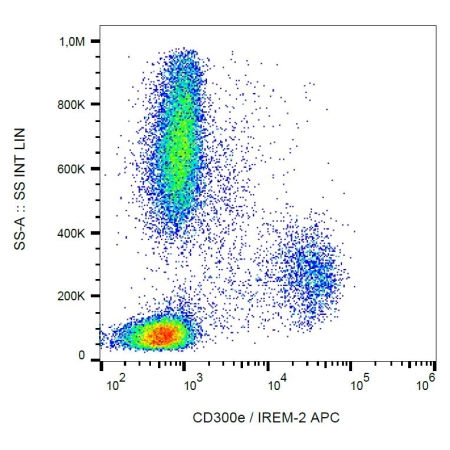
| Specificity | The mouse monoclonal antibody UP-H2 recognizes CD300e / IREM-2, a 32 kDa glycoprotein expressed by mature monocytes and peripheral blood myeloid dendritic cells. |
| Formulation | APC |
| Storage Buffer | The reagent is provided in phosphate buffered saline (PBS) containing 15 mM sodium azide and 0.2% (w/v) high-grade protease free Bovine Serum Albumin (BSA) as a stabilizing agent. |
| Reference | Brckalo T, Calzetti F, Pérez-Cabezas B, Borràs FE, Cassatella MA, López-Botet M: Functional analysis of the CD300e receptor in human monocytes and myeloid dendritic cells. Eur J Immunol. 2010 Mar;40(3):722-32. Aguilar H, Alvarez-Errico D, García-Montero AC, Orfao A, Sayós J, López-Botet M: Molecular characterization of a novel immune receptor restricted to the monocytic lineage. J Immunol. 2004 Dec 1;173(11):6703-11. Clark GJ, Ju X, Tate C, Hart DN: The CD300 family of molecules are evolutionarily significant regulators of leukocyte functions. Trends Immunol. 2009 May;30(5):209-17. |
|---|---|
| Gene Symbol | CD300E |
| Gene Full Name | CD300e molecule |
| Alias Symbols | CD300 antigen-like family member E, CD300e antigen, CD300LE, CLM-2, CLM2, CMRF35-A5, CMRF35-like molecule 2, immune receptor expressed on myeloid cells 2, IREM-2, IREM2, PIgR-2, PIgR2, poly-Ig receptor 2, polymeric immunoglobulin receptor 2. |
| NCBI Gene Id | 342510 |
| Protein Name | CMRF35-like molecule 2 |
| Description of Target | Probably acts as an activating receptor. |
| Uniprot ID | Q496F6 |
| Protein Accession # | NP_852114.2 |
| Nucleotide Accession # | NM_181449.2 |