


This kit is based on Competitive-ELISA detection method and takes 2h assay time. The microplate provided in this kit has been precoated with PRL. PRL in the sample or standard competes with a fixed amount of biotin-labeled PRL for sites on a pre-coated antibody specific to PRL. Free components are washed off. After adding HRP-Streptavidin Conjugate (SABC), biotin specifically binds with streptavidin to form immune complexes. Wash off unbound conjugate. Add TMB substrate solution. Then, TMB was catalyzed by HRP to produce a blue color product that turned yellow after adding a stop solution. Read the O.D. absorbance at 450nm in a microplate reader. Compare OD450 value of sample with the standard curve through curve fitting software to determine the concentration of PRL in the sample. The concentration of the target substance is inversely proportional to the OD450 value.
| Size | |
|---|---|
| 96T | Inquiry |
- Product Name
- Bovine PRL(Prolactin) ELISA Kit
- Alias
- Prl ELISA Kit, Prolactin ELISA Kit, Lactotrope ELISA Kit, LTH ELISA Kit, Luteotropic Hormone ELISA Kit
- Catalogue No.
- EB0013
- Size
- 48T/96T
- Species
- Bovine
- UniProt ID
- P01239
- Sample Type
- Serum, Plasma, Cell Culture Supernatant, cell or tissue lysate, Other liquid samples
- Detection Method
- Competitive ELISA, Coated with Antigen
- Detection Wavelength
- OD450
- Reaction Duration
- 2 hours
- Range
- 0.781-50ng/ml
- Sensitivity
- 0.469ng/ml
- Storage
- 2-8°C(Sealed), Don't cryopreserve.
- Specificity
- Specifically binds with PRL , no obvious cross reaction with other analogues.
- ELISA Kit Components
-
Kit Components Item Size(48T) Size(96T) Storage Condition for Opened Kit E001 ELISA Microplate(Dismountable) 8×6 8×12 Put the rest strips into a sealed foil bag with the desiccant. Stored for 1 month at 2-8°C; Stored for 12 month at -20°C E002 Lyophilized Standard 1vial 2vial Put the rest standards into a desiccant bag. Stored for 1 month at 2-8°C; Stored for 12 month at -20°C E003 Biotin-labeled Antibody(Concentrated, 100X) 30ul 60ul 2-8°C (Avoid Direct Light) E034 HRP-Streptavidin Conjugate(SABC, 100X) 60ul 120ul E024 TMB Substrate 5ml 10ml E039 Sample Dilution Buffer 10ml 20ml 2-8°C E040 Antibody Dilution Buffer 5ml 10ml E049 SABC Dilution Buffer 5ml 10ml E026 Stop Solution 5ml 10ml E038 Wash Buffer(Concentrated, 25X) 15ml 30ml E006 Plate Sealer 3 pieces 5 pieces E007 Product Description 1 copy 1 copy - Required Instruments and Reagents
-
- Microplate reader (wavelength: 450nm)
- 37°C incubator (CO2 incubator for cell culture is not recommenced.)
- Automated plate washer or multi-channel pipette/5ml pipettor (for manual washing purpose)
- Precision single (0.5-10μL, 5-50μL, 20-200μL, 200-1000μL) and multi-channel pipette with disposable tips(Calibration is required before use.)
- Sterile tubes and Eppendorf tubes with disposable tips
- Absorbent paper and loading slot
- Deionized or distilled water
- Assay Procedure Summary
-

- Step 1: Wash the plate twice before adding the standard and sample.
- Step 2: Add 50ul standard or sample into each well. Immediately add 50ul biotin-labeled antibody working solution into each well(The tip can't be reused after touching the liquid.), gently shake the plate for 1min, seal closely and statically incubate for 45 minutes at 37°C.
- Washing: Wash the plate three times and immerse for 1min each time.
- Step 3: Add 100ul HRP-Streptavidin Conjugate (SABC) working solution into each well, seal the plate and statically incubate for 30 minutes at 37°C.
- Washing: Wash the plate five times and immerse for 1min each time.
- Step 4: Add 90ul TMB substrate solution, seal the plate and statically incubate for 10-20 minutes at 37°C. (Accurate TMB visualization control is required.)
- Step 5: Add 50ul stop solution. Read at 450nm immediately and calculate.
- Standard Curve
-
This product is detected by QC department and meets performance required in the manual. (Laboratory Humidity: 20%-60%; Temperature: 18°C -25°C; Equilibrate TMB substrate to 37°C before staining. After adding into the ELISA wells, incubate for 15min at 37°C in dark.)
Due to different assay environments and operations, assay data below and standard curve are provided for reference. Experimenters should establish standard curve according to their own assay.
STD.(ng/ml) OD-1 OD-2 Average 0 2.084 2.144 2.114 0.781 1.754 1.804 1.779 1.563 1.448 1.49 1.469 3.125 1.059 1.089 1.074 6.25 0.584 0.6 0.592 12.5 0.417 0.429 0.423 25 0.233 0.239 0.236 50 0.139 0.143 0.141 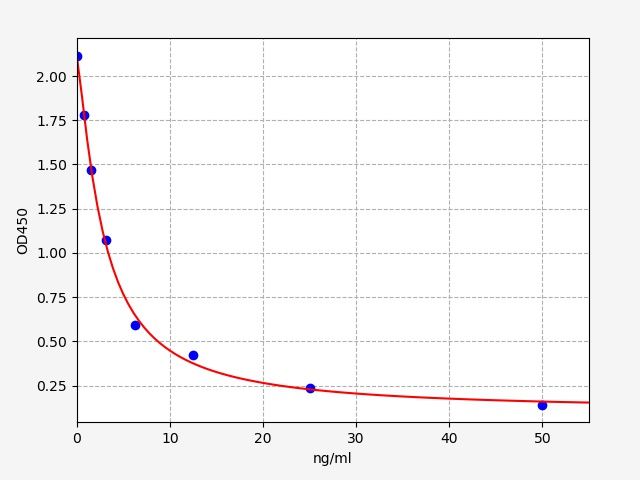
- Recovery
-
Add a certain amount of PRL into the sample. Calculate the recovery by comparing the measured value with the expected amount of PRL in the sample.
Sample Type Recovery Range(%) Average(%) serum(n=10) 90-105 96 EDTA plasma(n=10) 86-102 97 Heparin plasma(n=10) 85-105 96 - Linearity
-
Dilute the sample with a certain amount of PRL at 1:2, 1:4 and 1:8 to get the recovery range.
Sample Type 1:2 1:4 1:8 serum(n=10) 86-102% 89-104% 90-104% EDTA plasma(n=10) 82-97% 86-98% 91-101% Heparin plasma(n=10) 81-96% 93-100% 84-98% - Precision(%)
-
Intra-assay Precision: samples with low, medium and high concentration are tested 20 times on the same plate.
Inter-assay Precision: samples with low, medium and high concentration are tested 20 times on three different plates.
Item Intra-assay Precision Inter-assay Precision Sample 1 2 3 1 2 3 n 20 20 20 20 20 20 Mean (ng/ml) 1.62 5.78 23.65 1.47 6.17 25.18 Standard deviation 0.08 0.23 1 0.08 0.32 1.56 CV(%) 4.66 3.95 4.24 5.36 5.12 6.2 - Stability
-
Perform the stability test for the sealed kit at 37°C and 2-8°C and get relevant data.
ELISA kit(n=5) 37°C for 1 month 2-8°C for 6 months 2-8°C for 12 months Average(%) 80 95-100 85-98