AKR1B10 antibody - N-terminal region

Referência ARP42553_T100
Tamanho : 100ul
Marca : Aviva Systems Biology
Contactar o distribuidor local :

Telefone : +1 850 650 7790
AKR1B10 Antibody - N-terminal region (ARP42553_T100)
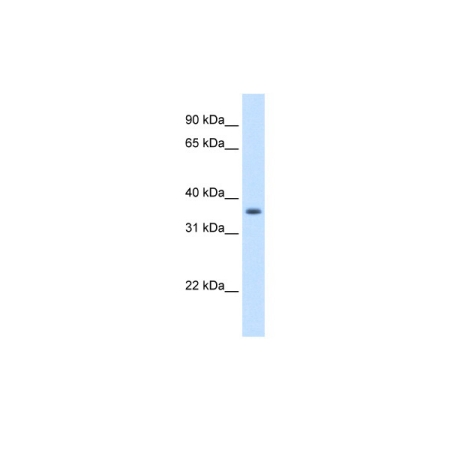
| Datasheets/Manuals | Printable datasheet for anti-AKR1B10 (ARP42553_T100) antibody |
|---|
| Tested Species Reactivity | Human |
|---|---|
| Predicted Species Reactivity | Human, Mouse, Rat, Cow, Dog, Guinea Pig, Horse, Rabbit, Yeast, Zebrafish |
| Product Format | Liquid. Purified antibody supplied in 1x PBS buffer with 0.09% (w/v) sodium azide and 2% sucrose. |
| Clonality | Polyclonal |
| Host | Rabbit |
| Application | WB |
| Reconstitution and Storage | For short term use, store at 2-8C up to 1 week. For long term storage, store at -20C in small aliquots to prevent freeze-thaw cycles. |
| Immunogen | The immunogen is a synthetic peptide directed towards the N terminal region of human AKR1B10 |
| Purification | Protein A purified |
| Predicted Homology Based on Immunogen Sequence | Cow: 93%; Dog: 100%; Guinea Pig: 79%; Horse: 100%; Human: 100%; Mouse: 100%; Rabbit: 100%; Rat: 93%; Yeast: 100%; Zebrafish: 100% |
| Peptide Sequence | Synthetic peptide located within the following region: NEHEVGEAIQEKIQEKAVKREDLFIVSKLWPTFFERPLVRKAFEKTLKDL |
| Concentration | 1.0 mg/ml |
| Blocking Peptide | For anti-AKR1B10 (ARP42553_T100) antibody is Catalog # AAP42553 (Previous Catalog # AAPP11040) |
| Sample Type Confirmation | AKR1B10 is supported by BioGPS gene expression data to be expressed in A549 |
| Reference | Lee,Y.S., (2005) Int. J. Biochem. Cell Biol. 37 (11), 2297-2309 |
|---|---|
| Gene Symbol | AKR1B10 |
| Gene Full Name | Aldo-keto reductase family 1, member B10 (aldose reductase) |
| Alias Symbols | HIS, HSI, ARL1, ARL-1, ALDRLn, AKR1B11, AKR1B12 |
| NCBI Gene Id | 57016 |
| Protein Name | Aldo-keto reductase family 1 member B10 |
| Description of Target | AKR1B10 is a member of the aldo/keto reductase superfamily, which consists of more than 40 known enzymes and proteins. This member can efficiently reduce aliphatic and aromatic aldehydes, and it is less active on hexoses. It is highly expressed in adrenal gland, small intestine, and colon, and may play an important role in liver carcinogenesis.This gene encodes a member of the aldo/keto reductase superfamily, which consists of more than 40 known enzymes and proteins. This member can efficiently reduce aliphatic and aromatic aldehydes, and it is less active on hexoses. It is highly expressed in adrenal gland, small intestine, and colon, and may play an important role in liver carcinogenesis. |
| Uniprot ID | O60218 |
| Protein Accession # | NP_064695 |
| Nucleotide Accession # | NM_020299 |
| Protein Size (# AA) | 316 |
| Molecular Weight | 35kDa |
| Protein Interactions | NOS2; TERF2IP; ACACA; |