


Inquiry
Dispatch Time: About 3 working days
- Product Name
- PerCP-Cy5.5 Anti-Human CD195/CCR5 Antibody(HEK/1/85a)
- Catalogue No.
- PCP55-30256
- Form
- liquid
- Conjugation
- PerCP-Cy5.5
- Conjugation Information
- PerCP-Cy5.5 is designed to be excited by the blue laser (488 nm) and detected using an optical filter centered near 675 nm (e.g., a 690/50 nm bandpass filter).
- Clonality
- Monoclonal
- Isotype
- IgG2a, κ
- Clone ID
- HEK/1/85a
- Storage
- PBS with 0. 1% sodium azide, 1%BSA, pH 7.3, 2-8℃ for 12 months (Avoid repeated freeze / thaw cycles.)
Immunogen
- Alternative Names
- CCR5|C-C chemokine receptor type 5|HIV-1 fusion co-receptor antibody
- UniProt ID
- P51681
Application
- Tested Applications
- FC
- Recommended dilution
- Volume per test: 5μL. Each lot of this antibody is quality control tested by flow cytometric analysis. The amount of the reagent is suggested to be used 5 µL of antibody per test (million cells in 100 µL staining volume or per 100 µL of whole blood). Please check your vial before the experiment. Since applications vary, the appropriate dilutions must be determined for individual use.
Validated Images
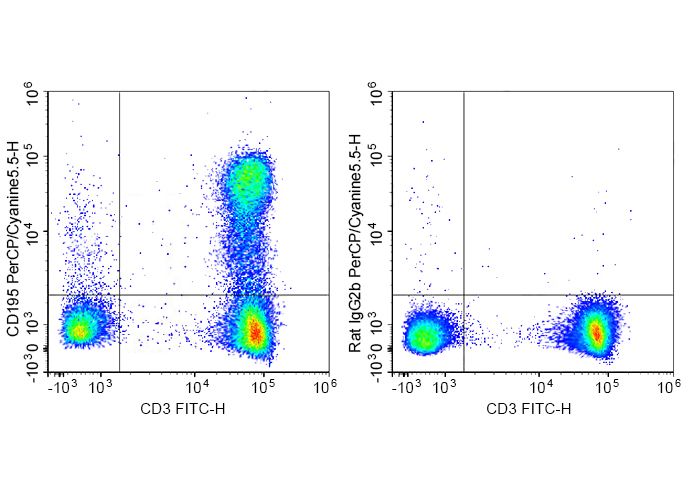 Staining of normal human peripheral blood cells with FITC Anti-Human CD3 Antibody and PerCP-Cy5.5 Anti-Human CD195 Antibody(HEK/1/85a/7a) (left) or PerCP-Cy5.5 Rat IgG2b, κ Isotype Control (right). Cells in the lymphocytes gate were used for analysis.
- Background
- CD195, also known as CCR5, is a 45 kD G protein-coupled seven transmembrane CC-chemokine receptor. It binds to MIP-1α, MIP-1β, and RANTES and is expressed on a subset of T cells and monocytes. CD195 mediates an intracellular signal thought to induce cell differentiation and proliferation. CCR5 has also been shown to act as a co-receptor for R5 HIV-1 cell entry; modification of CCR5 by sulfation contributes to the efficiency of HIV-1 entry. Recent studies have shown CCR5 to play a role in a variety of other human diseases, ranging from infectious and inflammatory diseases to cancer.