


Inquiry
Dispatch Time: About 3 working days
- Product Name
- FITC Anti-Mouse CD272/BTLA Antibody(PK18.6)
- Catalogue No.
- FITC-30275
- Form
- liquid
- Conjugation
- FITC
- Conjugation Information
- FITC is designed to be excited by the Blue laser (488 nm) and detected using an optical filter centered near 530 nm (e.g., a 525/40 nm bandpass filter).
- Clonality
- Monoclonal
- Isotype
- IgG1, κ
- Clone ID
- PK18.6
- Storage
- PBS with 0. 1% sodium azide, 1%BSA, pH 7.3, 2-8℃ for 12 months (Avoid repeated freeze / thaw cycles.)
Immunogen
- Alternative Names
- B- and T-lymphocyte attenuator|B- and T-lymphocyte-associated protein|Btla|CD272 antibody
- UniProt ID
- Q7TSA3
Application
- Tested Applications
- FC
- Recommended dilution
- Volume per test: 5μL. Each lot of this antibody is quality control tested by flow cytometric analysis. The amount of the reagent is suggested to be used 5 µL of antibody per test (million cells in 100 µL staining volume or per 100 µL of whole blood). Please check your vial before the experiment. Since applications vary, the appropriate dilutions must be determined for individual use.
Validated Images
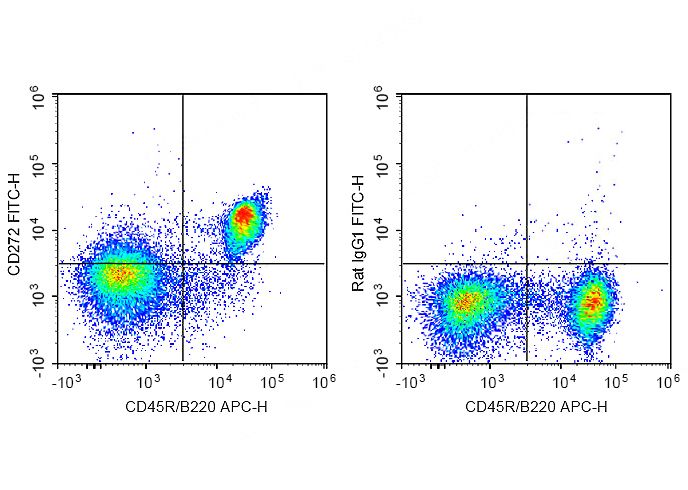 C57BL/6 murine splenocytes are stained with APC Anti-Mouse B220 Antibody and FITC Anti-Mouse CD272 Antibody (Left). Splenocytes are stained with APC Anti-Mouse B220 Antibody and FITC Rat IgG1,κ Isotype Control (Right).
- Background
- CD272, also known as B and T lymphocyte attenuator (BTLA), is an Ig superfamily co-inhitory receptor with structural similarity to programmed cell death 1 (PD-1) and CTLA-4. BTLA is expressed on B cells, T cells, macrophages, dendritic cells, NKT cells, and NK cells. Engagement of BTLA by its ligand herpes virus entry mediator (HVEM) is critical for negatively regulating immune response. The absence of BTLA with HVEM inhibitory interactions leads to increased experimental autoimmune encephalomyelitis severity, enhanced rejection of partially mismatched allografts, an increased CD8+ memory T cell population, increased severity of colitis, and reduced effectiveness of T regulatory cells. BTLA plays an important role in the induction of peripheral tolerance of both CD4+ and CD8+ T cells in vivo. Tolerant T cells have significantly higher expression of BTLA compared with effectors and naïve T cells. BTLA may cooperate with CTLA-4 and PD-1 to control T cell tolerance and autoimmunity. It was reported that BTLA may regulate T cell function by binding to B7-H4, but further studies are needed to confirm. The existence of three distinct BTLA alleles has been reported.