

Quimigen Portugal > Dnmt3L Antibody
Dnmt3L Antibody

Referencia OAAB07283
embalaje : 400ul
Contact local distributor :

Teléfono : +1 850 650 7790
Marca : Aviva Systems Biology
Contact local distributor :
Teléfono : +1 850 650 7790
Dnmt3L Antibody (OAAB07283)
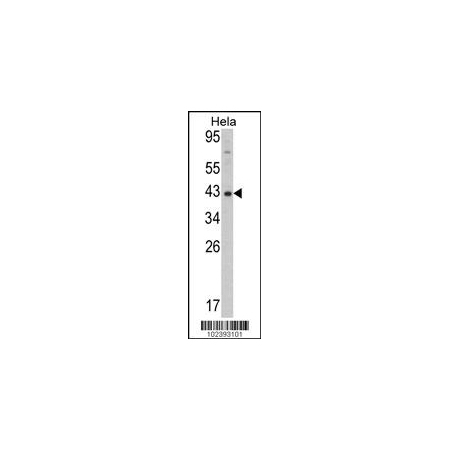
| Datasheets/Manuals | Printable datasheet for Dnmt3L Antibody (OAAB07283) |
|---|
| Predicted Species Reactivity | Human|Mouse|Rat |
|---|---|
| Product Format | Purified polyclonal antibody supplied in PBS with 0.09% (W/V) sodium azide. This antibody is prepared by Saturated Ammonium Sulfate (SAS) precipitation followed by dialysis against PBS. |
| Clonality | Polyclonal |
| Isotype | Ig |
| Host | Rabbit |
| Application | WB |
| Additional Information | Precautions: Mouse Dnmt3L Antibody is for research use only and not for use in diagnostic or therapeutic procedures. |
| :: | Function: Catalytically inactive regulatory factor of DNA methyltransferases. It is essential for the function of DNMT3A and DNMT3B. Activates DNMT3A and DNMT3B by binding to their catalytic domain. Accelerates the binding of DNA and AdoMet to the methyltransferases and dissociates from the complex after DNA binding to the methyltransferases |
| :: | Cellular Location: Nucleus (Probable). Tissue Location: Expressed in testis, thymus, ovary, and heart. |
| Reconstitution and Storage | Maintain refrigerated at 2-8C for up to 2 weeks. For long term storage store at -20C in small aliquots to prevent freeze-thaw cycles. |
| Immunogen | This Mouse Dnmt3L antibody is generated from rabbits immunized with a KLH conjugated synthetic peptide between 389-421 amino acids from mouse Dnmt3L. |
| Predicted Homology Based on Immunogen Sequence | Human; Mouse; Rat |
| Concentration | Approximately 0.5mg/ml. Actual concentration varies with each lot. |
| Application Info | WB: 1:1000 |
| Gene Symbol | Dnmt3l |
|---|---|
| Alias Symbols | D6Ertd14, D6Ertd14e, DNA (cytosine-5-)-methyltransferase 3-like, DNA (cytosine-5)-methyltransferase 3-like, ecat, ecat7. |
| NCBI Gene Id | 309680|54427 |
| Protein Name | DNA (cytosine-5)-methyltransferase 3-like|DNA (cytosine-5)-methyltransferase 3-like isoform 1 [Mus musculus] |
| Description of Target | Catalytically inactive regulatory factor of DNA methyltransferases that can either promote or inhibit DNA methylation depending on the context (PubMed:11719692, PubMed:15318244, PubMed:15671018, PubMed:24074865). Essential for the function of DNMT3A and DNMT3B: activates DNMT3A and DNMT3B by binding to their catalytic domain (PubMed:15671018). Acts by accelerating the binding of DNA and S-adenosyl-L-methionine (AdoMet) to the methyltransferases and dissociates from the complex after DNA binding to the methyltransferases (PubMed:15671018). Recognizes unmethylated histone H3 lysine 4 (H3K4me0) and induces de novo DNA methylation by recruitment or activation of DNMT3 (By similarity). Plays a key role in embryonic stem cells and germ cells (PubMed:11719692, PubMed:15318244, PubMed:24074865). In germ cells, required for the methylation of imprinted loci together with DNMT3A (PubMed:11719692). In male germ cells, specifically required to methylate retrotransposons, preventing their mobilization (PubMed:15318244). Plays a key role in embryonic stem cells (ESCs) by acting both as an positive and negative regulator of DNA methylation (PubMed:24074865). While it promotes DNA methylation of housekeeping genes together with DNMT3A and DNMT3B, it also acts as an inhibitor of DNA methylation at the promoter of bivalent genes (PubMed:24074865). Interacts with the EZH2 component of the PRC2/EED-EZH2 complex, preventing interaction of DNMT3A and DNMT3B with the PRC2/EED-EZH2 complex, leading to maintain low methylation levels at the promoters of bivalent genes (PubMed:24074865). Promotes differentiation of ESCs into primordial germ cells by inhibiting DNA methylation at the promoter of RHOX5, thereby activating its expression (PubMed:24074865).|Catalytically inactive regulatory factor of DNA methyltransferases that can either promote or inhibit DNA methylation depending on the context. Essential for the function of DNMT3A and DNMT3B: activates DNMT3A and DNMT3B by binding to their catalytic domain. Acts by accelerating the binding of DNA and S-adenosyl-L-methionine (AdoMet) to the methyltransferases and dissociates from the complex after DNA binding to the methyltransferases (By similarity). Recognizes unmethylated histone H3 lysine 4 (H3K4me0) and induces de novo DNA methylation by recruitment or activation of DNMT3 (By similarity). Plays a key role in embryonic stem cells and germ cells. In germ cells, required for the methylation of imprinted loci together with DNMT3A. In male germ cells, specifically required to methylate retrotransposons, preventing their mobilization. Plays a key role in embryonic stem cells (ESCs) by acting both as an positive and negative regulator of DNA methylation. While it promotes DNA methylation of housekeeping genes together with DNMT3A and DNMT3B, it also acts as an inhibitor of DNA methylation at the promoter of bivalent genes. Interacts with the EZH2 component of the PRC2/EED-EZH2 complex, preventing interaction of DNMT3A and DNMT3B with the PRC2/EED-EZH2 complex, leading to maintain low methylation levels at the promoters of bivalent genes. Promotes differentiation of ESCs into primordial germ cells by inhibiting DNA methylation at the promoter of RHOX5, thereby activating its expression (By similarity). |
| Uniprot ID | Q1LZ50|Q9CWR8 |
| Protein Accession # | https://www.ncbi.nlm.nih.gov/protein/NP_001075164.1,NP_062321.1 |
| Molecular Weight | 47993 |
-
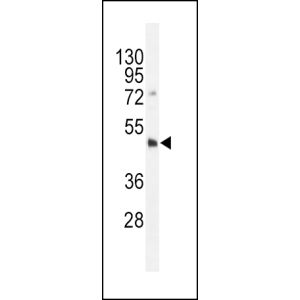 Dnmt3L Antibody - C-terminal region (OAAB07276)Catalog #: OAAB07276Application: IHC-P,WBFormat: Purified polyclonal antibody supplied in PBS with 0.09% (W/V) sodium azide. This antibody is prepared by Saturated Ammonium Sulfate (SAS) precipitation followed by dialysis against PBS.