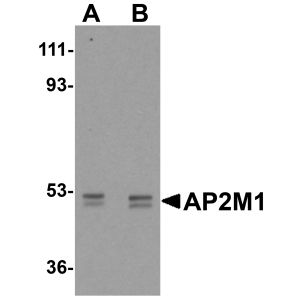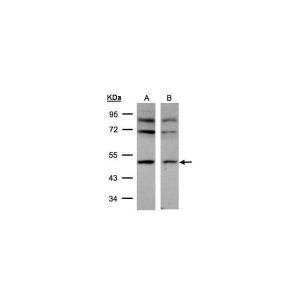

AP2M1 Antibody - C-terminal region

Referencia OAAB10967
embalaje : 400ul
Marca : Aviva Systems Biology
Contact local distributor :

Teléfono : +1 850 650 7790
AP2M1 Antibody - C-terminal region (OAAB10967)
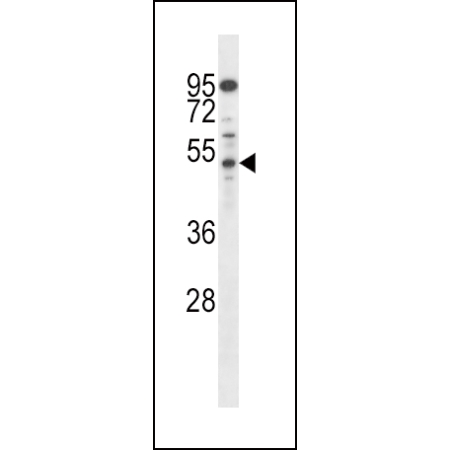
| Datasheets/Manuals | Printable datasheet for AP2M1 Antibody - C-terminal region (OAAB10967) |
|---|
| Tested Species Reactivity | Human, Mouse |
|---|---|
| Predicted Species Reactivity | Bovine|Caenorhabditis elegans|Chicken|Human|Mouse|Primate|Rat|Xenopus|Zebrafish |
| Product Format | LiquidPBS with 0.09% (W/V) sodium azide. |
| Clonality | Polyclonal |
| Isotype | Ig |
| Host | Rabbit |
| Application | FC,WB |
| Additional Information | Cellular Location: Cell membrane. Membrane, coated pit; Peripheral membrane protein; Cytoplasmic side. Note=AP-2 appears to be excluded from internalizing CCVs and to disengage from sites of endocytosis seconds before internalization of the nascent CCV |
| Reconstitution and Storage | Maintain refrigerated at 2-8C for up to 2 weeks. For long term storage store at -20C in small aliquots to prevent freeze-thaw cycles. |
| Immunogen | This AP2M1 antibody is generated from rabbits immunized with a KLH conjugated synthetic peptide between 387-415 amino acids from the C-terminal region of human AP2M1. |
| Purification | This antibody is purified through a protein A column, followed by peptide affinity purification. |
| Concentration | 0.5 mg/ml |
| Application Info | WB: 1:1000 FC: 1:10~50 |
| Gene Symbol | AP2M1 |
|---|---|
| Alias Symbols | adapter-related protein complex 2 mu subunit, adapter-related protein complex 2 subunit mu, adaptin-mu2, adaptor protein complex AP-2 subunit mu, adaptor protein complex AP-2, mu1, adaptor related protein complex 2 mu 1 subunit, adaptor related protein complex 2 mu 1 subunit L homeolog, adaptor related protein complex 2 subunit mu 1 S homeolog, adaptor-related protein complex 2 subunit mu, adaptor-related protein complex 2, mu 1 subunit, adaptor-related protein complex 2, mu 1 subunit, b, adaptor-related protein complex AP-2, mu1, AP-2 complex subunit mu, AP-2 complex subunit mu-1, AP-2 complex subunit mu-1-B, AP-2 complex subunit mu-B, AP-2 mu 2 chain, AP-2 mu chain, AP-2 mu-2 chain, AP-2 mu-2 chain B, AP-2 mu-B chain, ap2m1, ap2m1-a, ap2m1-b, AP50, CELE_R160.1, CLAPM1, clathrin adaptor complex AP2, mu subunit, clathrin assembly protein complex 2 medium chain, clathrin assembly protein complex 2 medium chain B, clathrin assembly protein complex 2 mu medium chain, clathrin assembly protein complex 2 mu-B medium chain, clathrin coat adaptor protein AP50, clathrin coat assembly protein AP50, clathrin coat assembly protein AP50-B, clathrin coat-associated protein AP50, clathrin coat-associated protein AP50-B, clathrin-associated AP-2, clathrin-associated/assembly/adaptor protein, medium 1, coat assembly protein complex 50 kD, HA2 50 kDA subunit, MRD60, mu2, mu2-adaptin, mu2-adaptin-B, plasma membrane adaptor AP-2 50 kDa protein, plasma membrane adaptor AP-2 50 kDa protein B, plasma membrane adaptor AP-2 50kDA protein, Protein dumpy-23, XELAEV_18027443mg, XELAEV_18029556mg, zgc:56643. |
| NCBI Gene Id | 102131193|116563|1173|11773|180713|380497|394001|432171|517446|770246 |
| Protein Name | AP-2 complex subunit mu|AP-2 complex subunit mu isoform a [Homo sapiens]|AP-2 complex subunit mu isoform b [Homo sapiens]|AP-2 complex subunit mu-B |
| Description of Target | Component of the adaptor complexes which link clathrin to receptors in coated vesicles (By similarity). Clathrin-associated protein complexes are believed to interact with the cytoplasmic tails of membrane proteins, leading to their selection and concentration (By similarity). AP50 is a subunit of the plasma membrane adaptor (By similarity). Essential wnt/egl-20 signaling protein that functions in wnt/egl-20-producing cells (PubMed:18160346, PubMed:18160347). Required for the AP-2 complex-mediated endocytosis of membrane proteins including wntless homolog mig-14 in egl-20-producing cells (PubMed:18160346, PubMed:18160347). During development, regulates the migration of HSN neurons and the left and right Q neuroblasts (QL and QR, respectively) and their descendants, possibly through hox gene and wnt/egl-20 gene target mab-5, and plays a role in establishing ALM and PLM neuronal cell polarity (PubMed:18160346). Required for the asymmetric divisions of V5 cells (PubMed:18160346).|Component of the adaptor complexes which link clathrin to receptors in coated vesicles. Clathrin-associated protein complexes are believed to interact with the cytoplasmic tails of membrane proteins, leading to their selection and concentration. AP50 is a subunit of the plasma membrane adaptor. The complex binds polyphosphoinositide-containing lipids (By similarity).|Component of the adaptor protein complex 2 (AP-2). Adaptor protein complexes function in protein transport via transport vesicles in different membrane traffic pathways. Adaptor protein complexes are vesicle coat components and appear to be involved in cargo selection and vesicle formation. AP-2 is involved in clathrin-dependent endocytosis in which cargo proteins are incorporated into vesicles surrounded by clathrin (clathrin-coated vesicles, CCVs) which are destined for fusion with the early endosome. The clathrin lattice serves as a mechanical scaffold but is itself unable to bind directly to membrane components. Clathrin-associated adaptor protein (AP) complexes which can bind directly to both the clathrin lattice and to the lipid and protein components of membranes are considered to be the major clathrin adaptors contributing the CCV formation. AP-2 also serves as a cargo receptor to selectively sort the membrane proteins involved in receptor-mediated endocytosis. AP-2 seems to play a role in the recycling of synaptic vesicle membranes from the presynaptic surface. AP-2 recognizes Y-X-X-[FILMV] (Y-X-X-Phi) and [ED]-X-X-X-L-[LI] endocytosis signal motifs within the cytosolic tails of transmembrane cargo molecules. AP-2 may also play a role in maintaining normal post-endocytic trafficking through the ARF6-regulated, non-clathrin pathway. The AP-2 mu subunit binds to transmembrane cargo proteins; it recognizes the Y-X-X-Phi motifs. The surface region interacting with to the Y-X-X-Phi motif is inaccessible in cytosolic AP-2, but becomes accessible through a conformational change following phosphorylation of AP-2 mu subunit at 'Tyr-156' in membrane-associated AP-2. The membrane-specific phosphorylation event appears to involve assembled clathrin which activates the AP-2 mu kinase AAK1 (By similarity). Plays a role in endocytosis of frizzled family members upon Wnt signaling (By similarity).|Component of the adaptor protein complex 2 (AP-2). Adaptor protein complexes function in protein transport via transport vesicles in different membrane traffic pathways. Adaptor protein complexes are vesicle coat components and appear to be involved in cargo selection and vesicle formation. AP-2 is involved in clathrin-dependent endocytosis in which cargo proteins are incorporated into vesicles surrounded by clathrin (clathrin-coated vesicles, CCVs) which are destined for fusion with the early endosome. The clathrin lattice serves as a mechanical scaffold but is itself unable to bind directly to membrane components. Clathrin-associated adaptor protein (AP) complexes which can bind directly to both the clathrin lattice and to the lipid and protein components of membranes are considered to be the major clathrin adaptors contributing the CCV formation. AP-2 also serves as a cargo receptor to selectively sort the membrane proteins involved in receptor-mediated endocytosis. AP-2 seems to play a role in the recycling of synaptic vesicle membranes from the presynaptic surface. AP-2 recognizes Y-X-X-[FILMV] (Y-X-X-Phi) and [ED]-X-X-X-L-[LI] endocytosis signal motifs within the cytosolic tails of transmembrane cargo molecules. AP-2 may also play a role in maintaining normal post-endocytic trafficking through the ARF6-regulated, non-clathrin pathway. The AP-2 mu subunit binds to transmembrane cargo proteins; it recognizes the Y-X-X-Phi motifs. The surface region interacting with to the Y-X-X-Phi motif is inaccessible in cytosolic AP-2, but becomes accessible through a conformational change following phosphorylation of AP-2 mu subunit at 'Tyr-156' in membrane-associated AP-2. The membrane-specific phosphorylation event appears to involve assembled clathrin which activates the AP-2 mu kinase AAK1 (By similarity). Plays a role in endocytosis of frizzled family members upon Wnt signaling. |
| Uniprot ID | P35603|P84091|P84092|Q3ZC13|Q4R706|Q5ZMP6|Q7ZW98|Q801Q8|Q96CW1 |
| Protein Accession # | https://www.ncbi.nlm.nih.gov/protein/NP_001020376.1,NP_004059.2 |
| Molecular Weight | 49655 |