

Optimize Cell & Tissue Handling from Culture to Storage
Reliable cell and tissue handling depends on maintaining suitable conditions across culture, transport, and storage. Solutions designed for each stage can help preserve sample quality and support reproducible downstream research.
Support cell and tissue workflows from culture to transport and storage, with Chick Embryo Extract for culture performance and specialized media for sample handling from Life Science Group.
Key Benefits & Applications
Chick Embryo Extract (CEE)
- Cell culture supplement used in selected growth media formulations.
- Source of essential growth factors for specialized cell culture applications.
- Available as lyophilized* or frozen liquid formulations.
- Supports the in vitro cultivation of rat neural crest stem cells (NCSCs) and other neural explants.
- Used for the expansion of selected stem cell types and investigated for its role in DNA demethylation.
- Produced from chick embryos (Bovans Goldline) sourced from registered flocks free from clinical signs of notifiable disease.
- Typically supplied with penicillin, streptomycin, and amphotericin.
- Sterility tested for bacteria, yeast, and fungi.
- Growth-promotion tested using mouse muscle cell growth and differentiation assays.
- Quality-assured: batch-specific results are provided on the Certificate of Analysis.
* Please note that during the lyophilisation process the material is uncapped so sterility cannot be assured.
T-Store® Transport Media
- Chemically defined, optimized medium for the storage and transport of mammalian tissues and cells.
- Mimics the basic composition of interstitial fluid, helping maintain tissue pH and homeostasis during storage.
- Supports tissue integrity, helping limit necrosis and apoptosis.
- Suitable for up to 72 h of tissue storage and transport while retaining morphological and molecular profiles.
- Broad tissue compatibility, including normal and malignant tissues.
- Stable pH buffering: pH 7.15–8.20 across +2°C to +37°C.
- Compatible with aerobic or anaerobic conditions.
- Xeno-free and DMSO-free, with no serum or animal/human proteins.
- Endotoxin level: ≤1.0 EU/mL.
- Aseptically produced and sterility tested; 0.2 µm filtered.
- With antibiotics: shelf life reduced to 1 month from antibiotic addition.
- Applications: tissue collection, transport and storage prior to histological, molecular, or other downstream analyses; storage of isolated or enriched cells before further processing.
CellShip® Transport Media
- Alternative to cryopreservation for mammalian cell transport and short-term storage.
- Ready-to-use, sterile, defined, xeno-free formulation with no serum or animal/human proteins.
- DMSO-free and contains a non-toxic additive to help protect cells from shear stress and maintain membrane integrity.
- Validated for up to 120 h of transport/storage at ambient temperature for selected cell lines and 72 h for primary canine MSCs.
- Minimal cell manipulation, helping streamline handling and reduce contamination risk.
- Logistical alternative to dry-ice shipment, potentially simplifying time-critical workflows.
- Endotoxin level: ≤1.0 EU/mL.
- Manufactured under ISO 13485 standards.
- Sterile-filtered: 0.2 µm.
- Applications: transport and short-term storage of mammalian cells; ongoing evaluation for additional primary cells, stable cell lines, and gene-silenced cell lines.
Informative Data
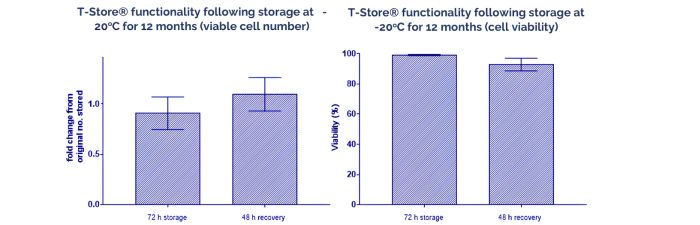
Figure 1. Following assessment of T-Store® functionality after being stored at -20oC for 12 months. Mean fold change for cells following 72 h at ambient was 0.91, following the 48-h recovery period the mean fold change in viable cell number was 1.1. Mean cell viability following storage was 99% and following the recovery period mean viability was 93% (n=5).
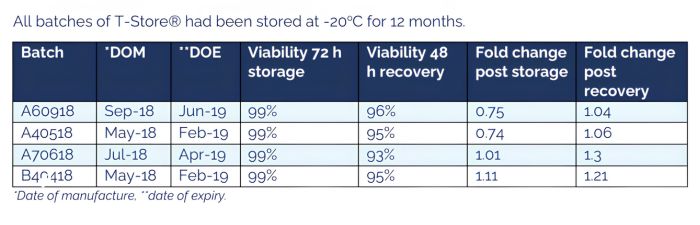 Figure 2. HEK293F cells were stored in T-Store® for 72 h at room temperature, followed by 48 h recovery under standard culture conditions. Cell viability and recovery were assessed before and after storage, with fold change >1 defined as a successful functional outcome.
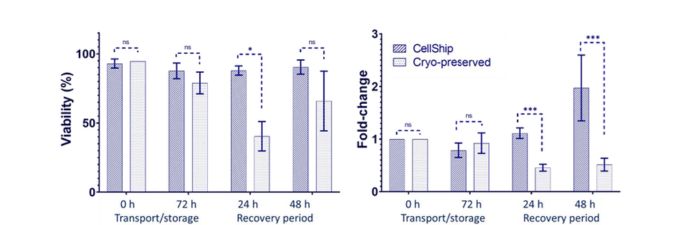 Figure 3. Jurkat cells transported/stored in CellShip® at ambient had returned to pre-transport numbers within 24 h of recovery and showed a 2-fold increase by 48 h. Cell viability was well maintained throughout the experiment (n=3).
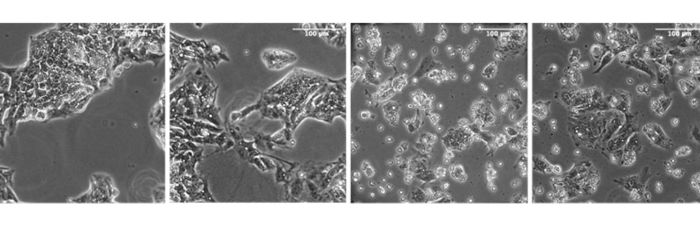 Figure 4. HepG2 cells were imaged following a 48-h recovery period. Prior to recovery, cells had been transported/stored for 72 h either cryopreserved in dry ice or at ambient in CellShip®. Within 48 h of recovery, cells transported in CellShip® were fully adherent and were displaying typical growth morphology (A & B). Cells recovered from cryopreservation had started to adhere but had not yet re-established typical HepG2 growth morphology (C & D).
Explore Life Science Group solutions designed to support cell culture and sample handling workflows.