

Quinacrine hydrochloride hydrate [6151-30-0]

Referencia NB-64-11669-10mg
embalaje : 10mg
Marca : Neo Biotech
Contact local distributor :
 Teléfono : +1 850 650 7790
Quinacrine Dihydrochloride Dihydrate (Synonyms: SN-390 hydrochloride hydrate, Quinacrine hydrochloride hydrate|...)
Catalog No. T22412 Copy Product Info
Quinacrine Dihydrochloride Dihydrate is an orally available antimalarial agent capable of crossing the blood-brain barrier. It exhibits anticancer activity by inhibiting WNT/TCF and topoisomerase, inducing autophagy and apoptosis, and activating p53. Quinacrine is an acridine dye derivative used for DNA and RNA staining in fixed cells (Ex/Em=436/525 nm).
Quinacrine Dihydrochloride Dihydrate
Copy Product InfoSynonyms SN-390 hydrochloride hydrate, Quinacrine hydrochloride hydrate, Mepacrine hydrochloride hydrate, Mepacrine Dihydrochloride Dihydrate
Quinacrine Dihydrochloride Dihydrate is an orally available antimalarial agent capable of crossing the blood-brain barrier. It exhibits anticancer activity by inhibiting WNT/TCF and topoisomerase, inducing autophagy and apoptosis, and activating p53. Quinacrine is an acridine dye derivative used for DNA and RNA staining in fixed cells (Ex/Em=436/525 nm).
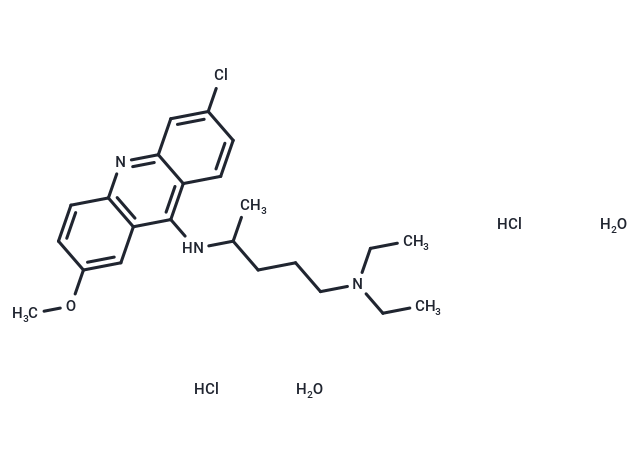
Cas No. 6151-30-0
Product Introduction
Bioactivity
Chemical Properties
Storage & Solubility Information
| Description | Quinacrine Dihydrochloride Dihydrate is an orally available antimalarial agent capable of crossing the blood-brain barrier. It exhibits anticancer activity by inhibiting WNT/TCF and topoisomerase, inducing autophagy and apoptosis, and activating p53. Quinacrine is an acridine dye derivative used for DNA and RNA staining in fixed cells (Ex/Em=436/525 nm). |
| In vitro | Quinacrine Dihydrochloride Dihydrate inhibits the growth of SGC-7901 cells at concentrations of 5-20 μM with an exposure time of 24 hours [1]. Quinacrine Dihydrochloride Dihydrate induces apoptosis in SGC-7901 cells at concentrations of 7.5 and 15 μM with an exposure time of 24 hours; this apoptotic process is associated with the mitochondrial-dependent signaling pathway and involves upregulation of p53 protein and activation of the caspase-3 protein pathway [1]. Treatment of cells with Quinacrine Dihydrochloride Dihydrate at a concentration of 15 μM for 24 hours significantly increases the levels of pro-apoptotic proteins (including cytochrome c, Bax protein, and p53 protein) while reducing the level of the anti-apoptotic protein Bcl-2, thereby shifting the Bax/Bcl-2 ratio in a direction favorable to apoptosis [1]. |
| In vivo | Quinacrine Dihydrochloride Dihydrate (100 mg/kg, administered via gavage, three times per week for two consecutive weeks) reduced the proportion of homo sapiens-derived tumor cells in female severe combined immunodeficiency (SCID) mice with acute myeloid leukemia (AML)-PS models to 2.2%, and extended the median survival time of the mice to 46 days [2]. |
| Synonyms | SN-390 hydrochloride hydrate, Quinacrine hydrochloride hydrate, Mepacrine hydrochloride hydrate, Mepacrine Dihydrochloride Dihydrate |
| Molecular Weight | 508.91 |
| Formula | C23H36Cl3N3O3 |
| Cas No. | 6151-30-0 |
| Smiles | ClC(C=CC1=C2NC(CCCN(CC)CC)C)=CC1=NC3=C2C=C(OC)C=C3.Cl.O.Cl.O |
| Relative Density. | no data available |
| Storage | Store at -20°C Shipping with blue ice/Shipping at ambient temperature. |