


Inquiry
Dispatch Time: About 3 working days
- Product Name
- PerCP-Cy5.5 Anti-Human CD57 Antibody(HNK-1)
- Catalogue No.
- PCP55-30288
- Form
- liquid
- Conjugation
- PerCP-Cy5.5
- Conjugation Information
- PerCP-Cy5.5 is designed to be excited by the blue laser (488 nm) and detected using an optical filter centered near 675 nm (e.g., a 690/50 nm bandpass filter).
- Clonality
- Monoclonal
- Isotype
- IgM, κ
- Clone ID
- HNK-1
- Storage
- PBS with 0. 1% sodium azide, 1%BSA, pH 7.3, 2-8℃ for 12 months (Avoid repeated freeze / thaw cycles.)
Immunogen
- Alternative Names
- HNK-1|Leu-7|NK-1 antibody
- UniProt ID
- Q9P2W7
Application
- Tested Applications
- FC
- Recommended dilution
- Volume per test: 5μL. Each lot of this antibody is quality control tested by flow cytometric analysis. The amount of the reagent is suggested to be used 5 µL of antibody per test (million cells in 100 µL staining volume or per 100 µL of whole blood). Please check your vial before the experiment. Since applications vary, the appropriate dilutions must be determined for individual use.
Validated Images
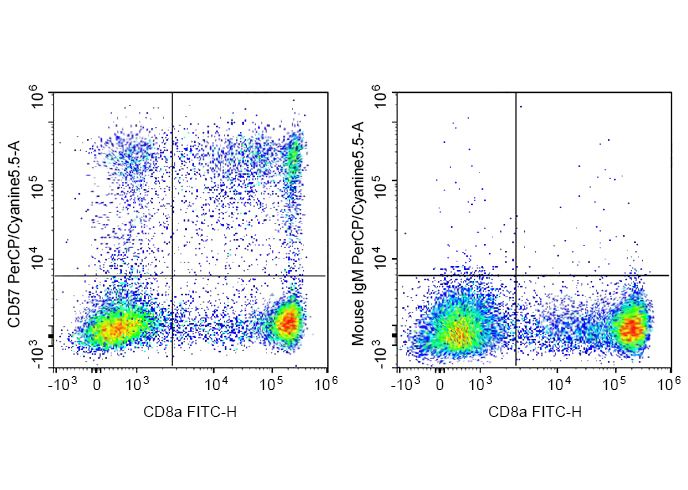 Staining of normal human peripheral blood cells with FITC Anti-Human CD8a Antibody(OKT-8) and PerCP-Cy5.5 Anti-Human CD57 Antibody(HNK-1) (left) or PerCP-Cy5.5 Mouse IgM, κ Isotype Control (right). Cells in the lymphocytes gate were used for analysis.
 - Background
- CD57, also known as HNK-1, NK-1, and Leu-7 is a 100-115 kD oligosaccharide antigenic determinant expressed on a variety of proteins, lipids, and chondroitin sulfate proteoglycans. CD57 is expressed on a subset of peripheral blood lymphocytes, including NK cells and CD8+ T cells, and is also expressed on neural cells and striated muscle. CD57 is not expressed on red blood cells, granulocytes, monocytes, or platelets. While the function of CD57 is unknown, binding to L-selectin, P-selectin, and a fragment of laminin suggests that CD57 may be involved in cell-matrix interactions. CD57 is increased in some disease states associated with CD4/CD8 imbalances (AIDS, autoimmune disease, viral infections, and allograft transplants).