


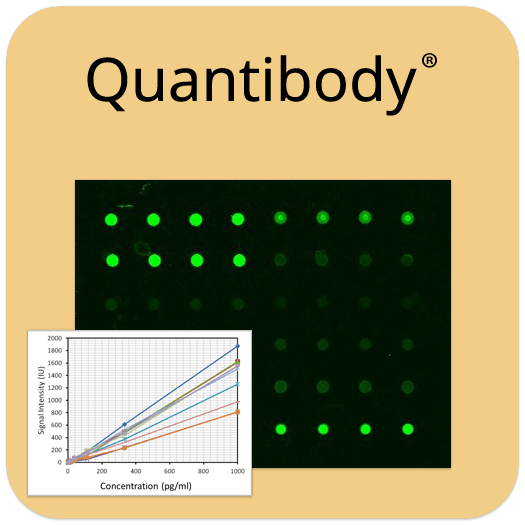
Quantibody® Mouse Chemokine Array 1 Kit. Detects 25 Mouse Chemokines. Suitable for all liquid sample types.
Mouse Chemokine Array Q1
Mouse Chemokine Array Q1
Contact Us for Bulk Request
Product Description
Specifications
| Size | 8 Sample Kit, 22 Sample Kit, 50 Sample Kit |
| Species | Mouse |
| Compatible Sample Types | Cell Culture Supernatants, Plasma, Serum, Tissue Lysates, Cell Lysates |
| Quantitative/Semi-Quantitative | Quantitative |
| Number of Targets Detected | 25 |
| Solid Support | Glass Slide |
| Design Principle | Sandwich-based |
| Method Of Detection | Fluorescence Laser Scanner |
| Research Area | Inflammation, Chemokine Biology |
| Shipping Type | Blue ice |
| Storage | -20°C |
Related Products
Mouse Cytokine Array Q4
As low as $840.00
Mouse Cytokine Array Q5
As low as $840.00
Mouse Cytokine Array Q6
As low as $840.00
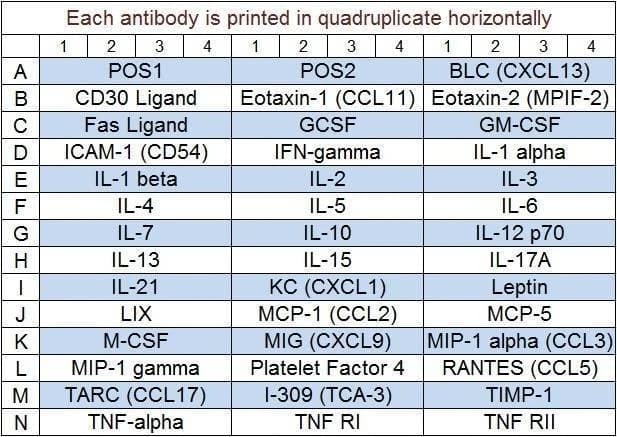
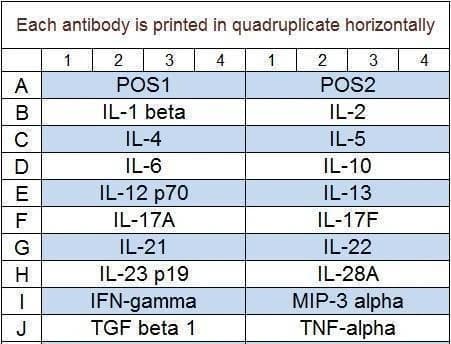
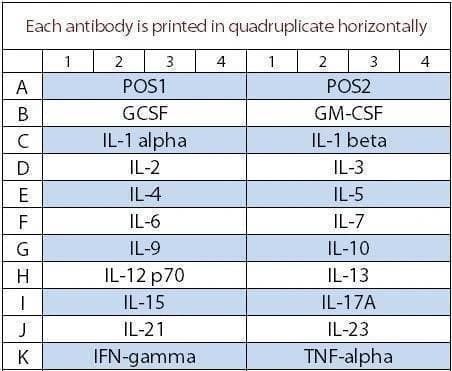
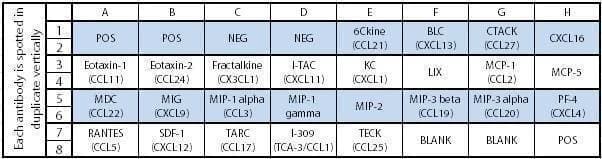
Product Features
- More cost-effective than traditional ELISA
- High specificity and system reproducibility
- Suitable for diverse sample types
- Low sample volume requirement: 50 µL or less
- Get results same day (6-hour processing time)
- Well-suited for high throughput assays
- Q Analyzer software provides one-step computation
Target Names
| Scroll over each target protein for more information | ||||
|---|---|---|---|---|
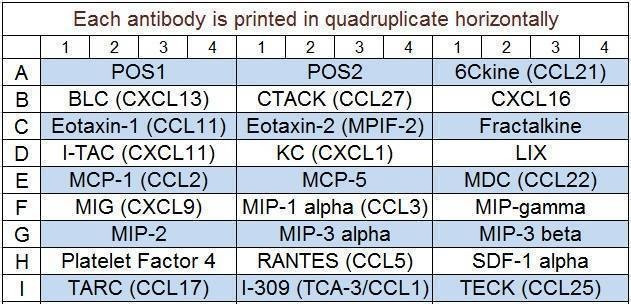
| 6Ckine (CCL21)
| BLC (CXCL13)
| CTACK (CCL27)
| CXCL16
| Eotaxin-1 (CCL11)
|
| Eotaxin-2 (MPIF-2/CCL24)
| Fractalkine (CX3CL1)
| I-309 (TCA-3/CCL1)
| I-TAC (CXCL11)
| KC (CXCL1)
|
| LIX
| MCP-1 (CCL2)
| MCP-5
| MDC (CCL22)
| MIG (CXCL9)
|
| MIP-1 alpha (CCL3)
| MIP-1 gamma
| MIP-2
| MIP-3 alpha (CCL20)
| MIP-3 beta (CCL19)
|
| Platelet Factor 4 (CXCL4)
| RANTES (CCL5)
| SDF-1 alpha (CXCL12 alpha)
| TARC (CCL17)
| TECK (CCL25)
|
Application Notes
Suggested Application
Multiplexed Protein Detection; Biomarker Screening; Identifying Key Factors; Confirming Biological Process; Biomarker Validation; Validation of Antibody Array Results; Quantitative Protein Detection; Establishing Normal Range
Kit Components
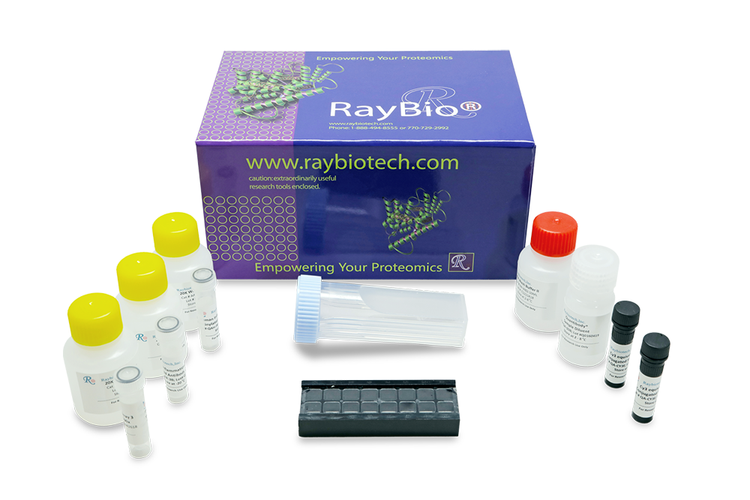
- Mouse Chemokine Array Q1 Slide(s)
- Blocking Buffer
- Wash Buffer 1
- Wash Buffer 2
- Lyophilized Standard Mix
- Biotinylated Detection Antibody Cocktail
- Streptavidin-Conjugated Fluor
- Slide Washer/Dryer
- Adhesive Plastic Strips
- Manual
Other Materials Required
- Distilled or deionized water
- Small plastic boxes or containers
- Pipettors, pipette tips and other common lab consumables
- Orbital shaker or oscillating rocker
- Aluminum foil
- Gene microarray scanner or similar laser fluorescence scanner
View Compatible Laser Scanners
Don't have a compatible scanner? RayBiotech now offers FREE scanning service for all RayBio glass slide antibody arrays! Learn More
Protocol Outline
- Dry the glass slide
- Prepare Standards
- Block array surface
- Incubate with Samples and Standards
- Incubate with Biotinylated Detection Antibody Cocktail
- Incubate with Streptavidin-Conjugated Fluor
- Disassemble the glass slide
- Scan with a gene microarray laser scanner
- Perform densitometry and analysis
Storage/Stability
For best results, store the entire kit frozen at -20°C upon arrival. Stored frozen, the kit will be stable for at least 6 months which is the duration of the product warranty period. Once thawed, store array slide(s), standard mix, detection antibody cocktail, and Cy3-Conjugated Streptavidin at -20°C and all other reagents undiluted at 4°C for no more than 3 months.
documents
GAL (GAL-QAM-CHE-1.gal)
Excel (QAM-CHE-1_Analysis_Tool.xls)
citations
Histone deacetylase inhibition induces an antitumor IRF8-dependent trained immunity-like status in macrophages
- Species:
- Mouse
- Sample Type:
- Cell Culture Supernatant (macrophage supernatants)
- Year:
- 2026
- Journal Name:
- Nature Communications
CD34+ PI16+ fibroblast progenitors aggravate neointimal lesions of allograft arteries via CCL11/CCR3-PI3K/AKT pathway
- Species:
- Mouse
- Sample Type:
- Cell Culture Supernatant (cell supernatant from CD34-positive, CD34-negative cells)
- Year:
- 2025
- Journal Name:
- Theranostics
- PubMed ID:
- 39990233
Targeting IL-17A enhances imatinib efficacy in Philadelphia chromosome-positive B-cell acute lymphoblastic leukemia
- Species:
- Mouse
- Sample Type:
- Serum (WT and BCR-ABLtTA mice)
- Year:
- 2024
- Journal Name:
- Nature Communications
- PubMed ID:
- 38172124
Fetal-derived PF4+ tissue-resident macrophages recruit neutrophils as a key mechanism underlying DENV-2-induced intrauterine growth restriction in mice
- Species:
- Mouse
- Sample Type:
- Other / Unspecified (placenta)
- Year:
- 2026
- Journal Name:
- Plos Pathogens
- PubMed ID:
- 42640962
Sphingosine Kinase 1 Aggravates Liver Fibrosis by Mediating Macrophage Recruitment and Polarization
- Species:
- Mouse
- Sample Type:
- Tissue Lysate / Homogenate (liver tissue homogenates)
- Year:
- 2024
- Journal Name:
- Cellular and Molecular Gastroenterology and Hepatology
- PubMed ID:
- 39305988
Optimized CAR-T therapy based on spatiotemporal changes and chemotactic mechanisms of MDSCs induced by hypofractionated radiotherapy
- Species:
- Mouse
- Sample Type:
- CT26 cell-Xenograft, serum
- Year:
- 2023
- Journal Name:
- Molecular Therapy
Huiyang Shengji decoction promotes wound healing in diabetic mice by activating the EGFR/PI3K/ATK pathway
- Species:
- Mouse
- Sample Type:
- Tissue Lysate / Homogenate (wound skin tissue lysates)
- Year:
- 2021
- Journal Name:
- Chinese Medicine
- PubMed ID:
- 34727961
Airborne lipid antigens mobilize resident intravascular NKT cells to induce allergic airway inflammation
- Species:
- Mouse
- Sample Type:
- Tissue Lysate (Lung Tissue Lysate)
- Year:
- 2011
- Journal Name:
- Journal of Experimental Medicine
Vibsanin B preferentially targets HSP90, inhibits interstitial leukocyte migration, and ameliorates experimental autoimmune encephalomyelitis
- Species:
- Mouse
- Sample Type:
- Tissue Lysate (Mouse Spinal cords during encephalomyelitis)
- Year:
- 2015
- Journal Name:
- Journal of Immunology
- PubMed ID:
- 25810397
Protective Role of the Inflammatory CCR2/CCL2 Chemokine Pathway through Recruitment of Type 1 Cytotoxic T Lymphocytes to Tumor Beds
- Species:
- Mouse
- Sample Type:
- Tissue Lysate (Tumor lysate from B16-F0 cells)
- Year:
- 2013
- Journal Name:
- Journal of Immunology
