
Human IL-3 Antibody : LE/AF

Referencia OASB01210
embalaje : 0.5mg
Marca : Aviva Systems Biology
Contact local distributor :
 Teléfono : +1 850 650 7790
Human IL-3 Antibody : LE/AF (OASB01210)
| Datasheets/Manuals | Printable datasheet for Human IL-3 Antibody : LE/AF (OASB01210) |
|---|
| Tested Species Reactivity | Human |
|---|---|
| Predicted Species Reactivity | Human |
| Clonality | Monoclonal |
| Clone | BVD8-3G11 |
| Isotype | IgG1 |
| Host | Rat |
| Conjugation | LE: Low Endotoxin, AF: Azide Free |
| Application | WB, IP |
| Reconstitution and Storage | Store at -20C |
| Immunogen | Yeast-expressed human IL-3 |
| Concentration | 0.5 mg/mL |
| Specificity | IL-3 |
| Characterization | To ensure acceptable performance, each batch of product is tested in a sandwich ELISA to conform tocharacteristics of a standard reference reagent. |
| Warning | Reagents contain sodium azide. Sodium azide is very toxic if ingested or inhaled. Avoid contact withskin, eyes, or clothing. Wear eye or face protection when handling. If skin or eye contact occurs, washwith copious amounts of water. If ingested or inhaled, contact a physician immediately. Sodium azideyields toxic hydrazoic acid under acidic conditions. Dilute azide- containing compounds in running waterbefore discarding to avoid accumulation of potentially explosive deposits in lead or copper plumbing. |
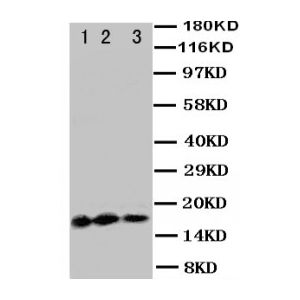
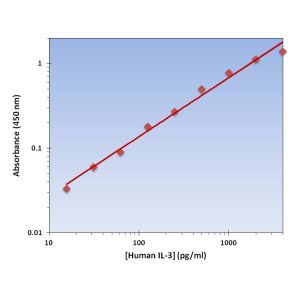
| Application Info | ELISA Capture: Purified BVD8-3G11 monoclonal antibody is the preferred capture antibody in a sandwich ELISA for quantifying human IL-3 protein levels. 1-3 The purified BVD8-3G11 antibody should be paired with biotinylated BVD3-1F9 antibody (OASB01212) as the detection antibody, with purified recombinant human IL-3 as the standard. Western Blotting: The purified BVD8-3G11 antibody is also useful for Western blotting applications. A concentration of 1-5ug/mL (in conjunction with AP-labeled Goat Anti-Rat-Ig, OASB01897) has been found to enable detection of <= 100 ng/lane of recombinant human IL-3 under reducing conditions. Neutralization: The LE/AF form of BVD8-3G11 can be used for neutralizing human IL-3 bioactivity. A suitable LE/AF Rat IgG1 (OASB00095) should be used as an isotype control. Since applications vary, each investigator should determine the optimal concentration appropriate for individual applications. |
| Storage | - The purified (UNLB) antibody is supplied as 0.5 mg purified immunoglobulin in 1.0 mL of 100 mMborate buffered saline, pH 8.2. No preservatives or amine- containing buffer salts added. Store at 2- 8 C - The low endotoxin, azide- free (LE/AF) antibody is supplied as 0.5 mg purified immunoglobulin in 1.0 mLof PBS. Aliquot and store at or below - 20 C - Protect conjugated forms from light. Aliquot and freeze the low endotoxin, azide- free product at - 20 Cimmediately upon receipt. Each reagent is stable for the period shown on the bottle label if stored asdirected. |
| Reference | 1. Abrams, J.S., M.- G. Roncarolo, H.. Yssel, U. Andersson, G.J. Gleich, and J.E., Silver. 1992. Immunol. Rev. 127:5 2. Abrams, J., J. Silver, R. van Dyke, and G. Gleich. 1994. Eosinophil- active cytokines in human disease: Development and use ofmonoclonal antibodies to IL- 3- , IL- 5, GM- CSF. In Eosinophils in Allergy and Inflammation (A. Kay and G. Gleich, eds). Marcel Dekker,New York, pp. 133 3. Abrams, J. 1995. Immunoenzymetric assay of mouse and human cytokines using NIP- labeled anti- cytokine antibodies. In CurrentProtocols in Immunology (J. Coligamn, A. Kruisbeek, D. Margulies, E. Shevach, W. Strober, eds.). John Wiley and Sons, New York. Unit6.20 4. Kaushansky, K. 1992. J. Clin. Invest. 90:1879. |
|---|---|
| Gene Symbol | IL3 |
| Gene Full Name | Interleukin-3 |
| Alias Symbols | IL-3, MCGF, MULTI-CSF |
| NCBI Gene Id | 3562 |
| Protein Name | interleukin-3 |
| Description of Target | The protein encoded by this gene is a potent growth promoting cytokine. This cytokine is capable of supporting the proliferation of a broad range of hematopoietic cell types. It is involved in a variety of cell activities such as cell growth, differentiation and apoptosis. This cytokine has been shown to also possess neurotrophic activity, and it may be associated with neurologic disorders. |
| Uniprot ID | P08700 |
| Protein Accession # | NP_000579.2 |
| Nucleotide Accession # | NM_000588.3 |