


- A micro ELISA plate --- The 96-well plate has been pre-coated with an anti-human ECP antibody. This dismountable microplate can be divided into 12 x 8 strip plates.
- Two vials lyophilized standard --- Dilute a bottle of the standard at dilution series, read the OD values, and then draw a standard curve.
- One vial Biotin-labeled ECP antibody (100 x concentrate) (120 μl/bottle) ---Act as the detection antibody.
- One vial HRP-avidin (100 x concentrate) (120 μl/bottle) --- Bind to the detection antibody and react with the TMB substrate to make the solution chromogenic.
- One vial Biotin-antibody Diluent (15 ml/bottle) ---Dilute the high concentration Biotin-antibody to an appropriate working solution.
- One vial HRP-avidin Diluent (15 ml/bottle) ---Dilute the high concentration HRP-avidin solution to an appropriate solution.
Human eosinophil cationic protein,ECP ELISA Kit
Referencia CSB-E11729h-96T
embalaje : 96T
Marca : Cusabio
Contact local distributor :

Teléfono : +1 850 650 7790
 SDS
| Size | 96T,5×96T,10×96T |
Product Details
Target Name
eosinophil cationic protein,ECP
Associated names
Cytotoxic ribonuclease ELISA Kit; ECP ELISA Kit; ECP_HUMAN ELISA Kit; Eosinophil cationic protein ELISA Kit; OTTHUMP00000164017 ELISA Kit; Ribonuclease 3 ELISA Kit; Ribonuclease; RNase A family; 3 ELISA Kit; RNase 3 ELISA Kit; RNASE3 ELISA Kit; RNS3 ELISA Kit
Abbreviation
ECP
Uniprot No.
Species
Homo sapiens (Human)
Sample Types
serum, plasma, tissue homogenates
Detection Range
1.56 ng/mL-100 ng/mL
Sensitivity
0.39 ng/mL
Assay Time
1-5h
Sample Loading Volume
50-100ul
Detection Wavelength
450 nm
Research Area
Others
Assay Principle
quantitative
Measurement
Sandwich
Precision
| Intra-assay Precision (Precision within an assay): CV%<8% | ||||||
| Three samples of known concentration were tested twenty times on one plate to assess. | ||||||
| Inter-assay Precision (Precision between assays): CV%<10% | ||||||
| Three samples of known concentration were tested in twenty assays to assess. | ||||||
Linearity
| To assess the linearity of the assay, samples were spiked with high concentrations of human ECP in various matrices and diluted with the Sample Diluent to produce samples with values within the dynamic range of the assay. | ||||||
| Sample | Serum(n=4) | |||||
| 1:1 | Average % | 93 | ||||
| Range % | 88-98 | |||||
| 1:2 | Average % | 97 | ||||
| Range % | 92-103 | |||||
| 1:4 | Average % | 100 | ||||
| Range % | 94-108 | |||||
| 1:8 | Average % | 108 | ||||
| Range % | 103-112 | |||||
Recovery
| The recovery of human ECP spiked to levels throughout the range of the assay in various matrices was evaluated. Samples were diluted prior to assay as directed in the Sample Preparation section. | ||||||
| Sample Type | Average % Recovery | Range | ||||
| Serum (n=5) | 90 | 87-95 | ||||
| EDTA plasma (n=4) | 92 | 89-95 | ||||
Typical Data
| These standard curves are provided for demonstration only. A standard curve should be generated for each set of samples assayed. | |||||||||||||||||||||||||||||||||||||||||||||||||||||||||||||||
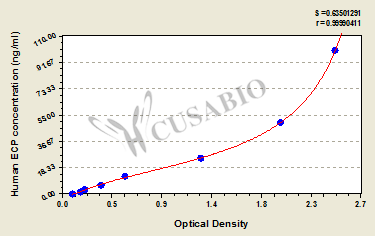
| |||||||||||||||||||||||||||||||||||||||||||||||||||||||||||||||
Materials provided
Materials not provided
- A microplate reader capable of measuring absorbance at 450 nm, with the correction wavelength set at 540 nm or 570 nm.
- An incubator that can provide stable incubation conditions up to 37°C±5°C.
- Centrifuge
- Vortex
- Squirt bottle, manifold dispenser, or automated microplate washer
- Absorbent paper for blotting the microtiter plate
ELISA Data Analysis
Troubleshooting
and FAQs
and FAQs
Storage
Store at 2-8°C. Please refer to protocol.
Shelf Life
6 months
Description
This Human ECP ELISA Kit was designed for the quantitative measurement of Human ECP protein in serum, plasma, tissue homogenates. It is a Sandwich ELISA kit, its detection range is 1.56 ng/mL-100 ng/mL and the sensitivity is 0.39 ng/mL.
Citations
- LS Stoyanov, EM Kaneva, IA Angelov,Iranian Journal of Parasitology,2026
- J Domínguez-Ortega, G Leon-Zambrana,Journal of Asthma and Allergy,2026
- J Li, T Shang, K Guan, J Yin,International Journal of Molecular Sciences,2026
- U Park, JH Lee, U Kim, K Jeon, Y Kim,Journal of Medical Virology,2024
- X Zhou,/,2024
- The Efficacy of Budesonide, Levocabastine, and Their Combination in Treatment of Vasomotor Rhinitis RTY Menga,ORL; journal for oto-rhino-laryngology and its related specialties,2023
- HC Chuang,Arthritis & rheumatology,2023
- MA Keyali Kuskghazi,Nature communications,2024
- AP Krückel - 2023 - opus4.kobv.de,/,2023
- SA Wendlinger,/,2023
Customer Reviews and Q&A
There are currently no reviews for this product.
■ Q&A
Q:
I am interested in your Human eosinophil Cationic protein, ECP ELISA Kit (CSB-E11729h). However, I will test other markers and need advide for collection/preparation for this kit as stated below:
“I am hoping to get some information about the collection/preparation of serum prior to analysis. My lab will be analyzing serum samples for a variety of markers. the other markers all state to allow clotting for 30 minutes prior to centrifugation. The ECP (human) kit that I am interested in states to allow clotting for 2 hours. I was wondering if you could tell me if it needs to sit for two hours, or if 30 minutes if suffice. We are trying to avoid needed to process two separate samples so i'm hoping you can help me!”
A:
Thanks for your inquiry.
CSB-E11729h
This kit can test serum and plasma samples. For serum samples, usually we will keep it static for 2 hours and then collect it. In this way more samples can be precipitated. What's more, if the static time is enough, the fibrin can timely trap hematocyte and then shrink and sink. Then if we treat it by centrifugation, the fibrin will not stay...
Target Background
Function
(From Uniprot)
(From Uniprot)
Cytotoxin and helminthotoxin with low-efficiency ribonuclease activity. Possesses a wide variety of biological activities. Exhibits antibacterial activity, including cytoplasmic membrane depolarization of preferentially Gram-negative, but also Gram-positive strains. Promotes E.coli outer membrane detachment, alteration of the overall cell shape and partial loss of cell content.
Gene References into Functions
- measuring serum ECP levels is helpful for assessing the efficacy of inhaled corticosteroids therapy in bronchial asthma children.
- Data suggest that radioactive I(131) therapy leads to down-regulation of secretion of ECP from Th2 cells (helper-inducer T-lymphocytes) in post-thyroidectomy patients treated for differentiated thyroid cancer; in this study, ECP levels in serum were analyzed before, 3 days after, and 7 days after radiotherapy with I(131).
- our data add new insights into the pathophysiology of AD, suggesting that BDNF which correlates with disease severity and ECP levels contributes to the regulation of inflammation in an eosinophil-, but not Th2-dependent manner.
- High circulating levels of eosinophil cationic protein are associated with increased incidence of ischemic stroke.
- Studies mapped the structural determinants required for the eosinophil cationic protein (ECP)-bacterial lipopolysaccharide (LPS) interaction by nuclear magnetic resonance.
- Increased MRP8/14 levels suggest the instability of the atherosclerotic plaque. ECP reflects the severity of coronary arteries stenosis, predicting atherosclerosis burden. They may become the new biomarkers of CAD.
- Children in the acute-phase group showed higher ECP mRNA expression level than those in the stable-phase and healthy control groups, while the level in the stable-phase was markedly higher than that in the healthy control group.
- drug eluting stent polymers increase eosinophil cationic protein levels following percutaneous coronary intervention independently of C-reactive protein
- Around half of all variance in serum ECP is explained by genetic factors. Serum ECP is influenced by sex, BMI, and airway responsiveness. Serum ECP and airway responsiveness seem not to share genetic variance.
- eosinophil cationic protein levels can be used to diagnosis atopic dermatitis but cannot distinguish between intrinsic and extrinsic disease.
- The antimicrobial protein, Rnase 3, contributes to the host immune response against mycobacteria.
- ECP was elevated in nasal discharge of patients with nasal polyps compared to controls and those with allergic rhinitis or rhinosinusitis.
- report the prevalence of a common SNP in the eosinophil protein x/eosinophil-derived neurotoxin (EPX/EDN, RNase2) and the association with the cellular contents of EPX/EDN and ECP
- Eosinophil cationic protein is not cytotoxic but enhances the growth of normal human dermal fibroblasts
- Effects of omalizumab on eosinophil cationic peptide, 25-hydroxyvitamin-D, IL-1beta and sCD200 in cases of Samter's syndrome
- Eosinophil activation occurred in early and late responses after L-ASA NPT in upper airway mucosa of AERD patients, where ApoA1, alpha2M and CP as well as CysLT may be involved in eosinophilic inflammation.
- Eosinophil cationic protein is a major granule-derived protein with cytotoxic activity found in eosinophils and has been known as a useful marker of allergic inflammation.
- Polymorphisms of EPX and ECP are associated to inflammatory bowel disease in an age and gender dependent manne.
- novel insights to identify functional regions of hRNase3 that may have implications for all hRNaseA superfamily members.
- This study also suggests that eosinophils and eosinophil cationic protein take part in the pathogenesis of nonallergic rhinitis.
- Lower ECP levels in the active phase of the disease may be a result of decreased production due to the activation of Th1 cytokines.
- A fraction of native ECP is stored in a non-cytotoxic form, which can be converted into a cytotoxic form by N-deglycosylation, whereas another fraction is stored as a highly cytotoxic form carrying different post-translational modifications
- Eosinophil cationic protein might induce mesoderm differentiation through fibroblast growth factor signaling pathway and enhance subsequent cardiomyocyte differentiation in concert with dimethyl sulfoxide in P19CL6 cells.
- a marker of asthma severity within an asthmatic paediatric population
- Results reveal the structural basis for the high affinity of ECP for glycosaminoglycans.
- biological and genetic characteristics of ECP
- 371G allele of RNASE3 is associated with susceptibility to cerebral malaria and forms part of a risk associated haplotype GGA defined by the markers
- Total serum IgE, ECP and eosinophil percentage are strong predictors of allergic rhinitis.
- The data suggests presence of relationship between development of restenosis and elevated blood plasma Eosinophilic cation protein level in patients with IHD after revascularization.
- ECP heparin binding affinity depends on its RNase catalytic site
- basal ECP levels are associated with major advemse cardiac evemts after bare metal stent implantation, suggesting that an allergic-mediated inflammation against the metal could explain some adverse reactions occurring after coronary stenting.
- Arg22, Arg34, Arg61, Arg77 and His64 of ECP are crucial for eosinophil cationic proteins's membrane destabilization activity, which appears to be the underlying mechanism of its cytotoxic, antibacterial and antiparasitic activities.
- The expression level of ECP mRNA was up-regulated in nasal polyps.
- the shortest ECP minimized version that would retain its antimicrobial properties
- ECP is present in the middle ear effusion of otitis media of effusion. There was a positive correlation between ECP level and IgE level.
- Among mite-allergic patients T-bet expression was down-regulated, which had no relation to ECP concentration and allergic symptoms.
- elevated levels in nasal lavage in allergic asthmatics
- Eosinophil cationic protein may have a role in coronary atherosclerosis
- There are associations of symptoms of allergy and asthma to ECP-genotypes, but also to smoking habits. ECP may be involved in impairment of lung functions in disease.
- Serum levels of ECP, IL-5, -6, -8 and -10, G-CSF, MCP-1, IL-1 ra and IP-10 were significantly elevated in acute compared with stable childhhood asthma.
- Results showed that OSCC patients with intense TATE and at least one C allele had a higher frequency of bilateral neck dissection, local recurrence, vascular embolization, involved resection margins, and postoperative radiotherapy.
- Our study suggests that RNase3 polymorphisms are potentially associated with susceptibility to allergic rhinitis.
- The eosinophil cationic protein increased TNF-alpha production in BEAS-2B cells and triggered apoptosis by caspase-8 activation through mitochondria-independent pathway.
- The mean of serum ECP was significantly higher in patients with respiratory tract diseases (asthma, COPD, interstitial lung disease, and respiratory infections) compared with healthy volunteers.
- Data show that conformational diversity of ECP is observed for the loop segments 17-22, 65-68, and 92-95 and most exposed sidechains.
- Measurement of ECP polymorphism is a significant indicator for the disease activity in asthmatic patient.
- serum levels elevated in asthmatic patients during acute attack
- results suggest a differential release of ECP by the serum eosinophil, depending on the disease status and asthma exacerbation severity
- Presence of ECP in human milk is associated with development of cow milk allergy and atopic dermatitis in the breast-fed infant, but has no direct association with the maternal atopy.
- ECP contributes to surfactant dysfunction in asthma, which in turn could lead to airway obstruction.
Subcellular Location
Secreted. Note=Located in the matrix of eosinophil large specific granule, which are released following activation by an immune stimulus.
Protein Families
Pancreatic ribonuclease family
Database Links
HGNC:
OMIM:
KEGG:
STRING:
UniGene: