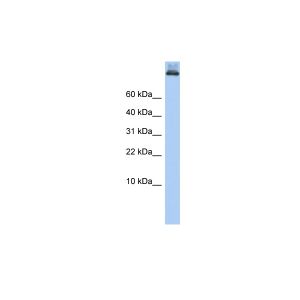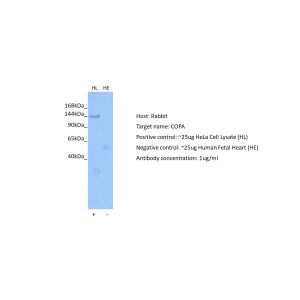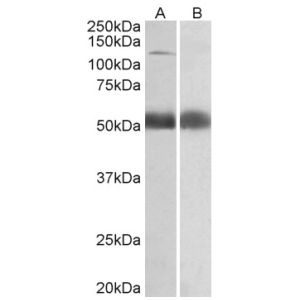

COPA Antibody - N-terminal region - Biotin

Referencia ARP51893_P050-Biotin
embalaje : 100ul
Marca : Aviva Systems Biology
Contact local distributor :
 Teléfono : +1 850 650 7790
COPA Antibody - N-terminal region : Biotin (ARP51893_P050-Biotin)
| Datasheets/Manuals | Printable datasheet for anti-COPA (ARP51893_P050-Biotin) antibody |
|---|
| Publications | Ting, C.-H. et al. The spinal muscular atrophy disease protein SMN is linked to the Golgi network. PLoS One 7, e51826 (2012). WB, ICC/IF, Zebrafish, Rat, Dog, Pig, Horse, Mouse, Rabbit, Guinea pig, Human, Bovine, Yeast, Goat 23284781 |
|---|---|
| Predicted Species Reactivity | Human, Mouse, Rat, Cow, Dog, Goat, Guinea Pig, Horse, Rabbit, Yeast, Zebrafish |
| Product Format | Liquid. Purified antibody supplied in 1x PBS buffer. |
| Clonality | Polyclonal |
| Host | Rabbit |
| Conjugation | Biotin |
| Application | WB |
| Reconstitution and Storage | All conjugated antibodies should be stored in light-protected vials or covered with a light protecting material (i.e. aluminum foil). Conjugated antibodies are stable for at least 12 months at 4C. If longer storage is desired (24 months), conjugates may be diluted with up to 50% glycerol and stored at -20C to -80C. Freezing and thawing conjugated antibodies will compromise enzyme activity as well as antibody binding. |
| Immunogen | The immunogen is a synthetic peptide directed towards the N terminal region of human COPA |
| Purification | Affinity Purified |
| Predicted Homology Based on Immunogen Sequence | Cow: 100%; Dog: 100%; Goat: 86%; Guinea Pig: 100%; Horse: 100%; Human: 100%; Mouse: 100%; Rabbit: 100%; Rat: 100%; Yeast: 93%; Zebrafish: 100% |
| Peptide Sequence | Synthetic peptide located within the following region: PWILTSLHNGVIQLWDYRMCTLIDKFDEHDGPVRGIDFHKQQPLFVSGGD |
| Concentration | 0.5 mg/ml |
| Blocking Peptide | For anti-COPA (ARP51893_P050-Biotin) antibody is Catalog # AAP51893 (Previous Catalog # AAPP40072) |
| Sample Type Confirmation | COPA is strongly supported by BioGPS gene expression data to be expressed in HeLa |
| Subunit | alpha |
| Reference | Olsen,J.V., (2006) Cell 127 (3), 635-648 |
|---|---|
| Gene Symbol | COPA |
| Gene Full Name | Coatomer protein complex, subunit alpha |
| Alias Symbols | AILJK, HEP-COP, alpha-COP |
| NCBI Gene Id | 1314 |
| Protein Name | Coatomer subunit alpha |
| Description of Target | In eukaryotic cells, protein transport between the endoplasmic reticulum and Golgi compartments is mediated in part by non-clathrin-coated vesicular coat proteins (COPs). Seven coat proteins have been identified, and they represent subunits of a complex known as coatomer. The subunits are designated alpha-COP, beta-COP, beta-prime-COP, gamma-COP, delta-COP, epsilon-COP, and zeta-COP. The alpha-COP, encoded by COPA, shares high sequence similarity with RET1P, the alpha subunit of the coatomer complex in yeast. Also, the N-terminal 25 amino acids of alpha-COP encode the bioactive peptide, xenin, which stimulates exocrine pancreatic secretion and may act as a gastrointestinal hormone.In eukaryotic cells, protein transport between the endoplasmic reticulum and Golgi compartments is mediated in part by non-clathrin-coated vesicular coat proteins (COPs). Seven coat proteins have been identified, and they represent subunits of a complex known as coatomer. The subunits are designated alpha-COP, beta-COP, beta-prime-COP, gamma-COP, delta-COP, epsilon-COP, and zeta-COP. The alpha-COP, encoded by COPA, shares high sequence similarity with RET1P, the alpha subunit of the coatomer complex in yeast. Also, the N-terminal 25 amino acids of alpha-COP encode the bioactive peptide, xenin, which stimulates exocrine pancreatic secretion and may act as a gastrointestinal hormone. Alternative splicing results in multiple splice forms encoding distinct isoforms. |
| Uniprot ID | P53621 |
| Protein Accession # | NP_004362 |
| Nucleotide Accession # | NM_004371 |
| Protein Size (# AA) | 1224 |
| Molecular Weight | 135kDa |
| Protein Interactions | UBC; SUMO2; SMN1; STAU1; NUDCD1; SUMO1; NEDD8; RPA3; RPA2; RPA1; SUZ12; RNF2; COPZ1; DHX38; COPB2; CCT3; TCP1; SEPT2; ARCN1; UBD; VCAM1; ITGA4; COPB1; COPG2; COPG1; COPE; SEPT9; SEC23A; SEC24C; UBXN6; FBXO6; LMAN1; SACM1L; DDX20; TMED10; GEMIN2; COPA; CDK |