

Chitosan (MW 150000) [9012-76-4]

Referencia NB-64-08097-1g
embalaje : 1g
Marca : Neo Biotech
Contact local distributor :
 Teléfono : +1 850 650 7790
Chitosan (MW 150000) (Synonyms: Poly(D-glucosamine), Deacetylated chitin, Chitosan)
Catalog No. T1715 Copy Product Info
Chitosan (MW 150000) (Deacetylated chitin) is a linear polysaccharide made up of randomly distributed β-(1-4)-linked D-glucosamine (deacetylated unit) and N-acetyl-D-glucosamine.
Chitosan (MW 150000)
Copy Product InfoSynonyms Poly(D-glucosamine), Deacetylated chitin, Chitosan
Chitosan (MW 150000) (Deacetylated chitin) is a linear polysaccharide made up of randomly distributed β-(1-4)-linked D-glucosamine (deacetylated unit) and N-acetyl-D-glucosamine.
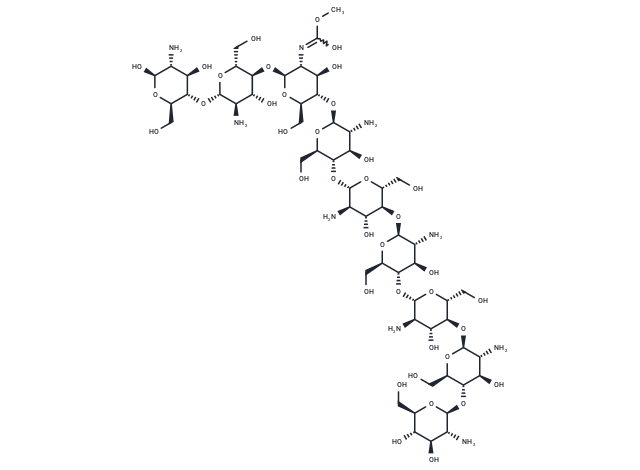
Cas No. 9012-76-4
Product Introduction
Bioactivity
Chemical Properties
Storage & Solubility Information
| Description | Chitosan (MW 150000) (Deacetylated chitin) is a linear polysaccharide made up of randomly distributed β-(1-4)-linked D-glucosamine (deacetylated unit) and N-acetyl-D-glucosamine. |
| In vitro | Chitosans are recognized as versatile biomaterials because of their non-toxicity, low allergenicity, biocompatibility and biodegradability. Chitosan is reported to have other biological properties, such as antitumor, antimicrobial, and antioxidant activities. It can be used in water treatment, wound-healing materials, pharmaceutical excipient or drug carrier, obesity treatment and as a scaffold for tissue engineering[1]. Antimicrobial activity of chitosan has been demonstrated against many bacteria, filamentous fungi and yeasts. Chitosan has wide spectrum of activity and high killing rate against Gram-positive and Gram-negative bacteria, but lower toxicity toward mammalian cells[2]. Chitosan exhibits antitumor activity against different types of cancer. For example, chitosan decreases adhesion of primary melanoma A375 cell line and decreases proliferation of primary melanoma SKMEL28 cell line, it has potent pro-apoptotic effects against RPMI7951, a metastatic melanoma cell line[3]. Chitosan and its derivatives act as antioxidants by scavenging oxygen radicals such as hydroxyl, superoxide, alkyl as well as highly stable DPPH radicals in vitro[4]. |
| In vivo | Chitosan treatment dramatically increases lifespan and inhibits tumor metastasis especially in treatment groups of the low-molecular weight compound[5]. Chitosan has some apparent treatment effects on rat PCP by reducing HSP70 mRNA expression and lung inflammation, increasing the concentrations of IL-10 and IFN-γ as well as CD4(+) T-lymphocyte numbers, reducing the CD8(+) T-lymphocyte numbers and the concentration of TNF-α and inducing significant ultrastructural damage to P. carinii[6]. |
| Synonyms | Poly(D-glucosamine), Deacetylated chitin, Chitosan |
| Molecular Weight | 340.329 |
| Formula | C12H24N2O9 |
| Cas No. | 9012-76-4 |
| Smiles | COC(O)=N[C@@H]1[C@@H](O)[C@H](O[C@@H]2O[C@H](CO)[C@@H](O[C@@H]3O[C@H](CO)[C@@H](O[C@@H]4O[C@H](CO)[C@@H](O[C@@H]5O[C@H](CO)[C@@H](O[C@@H]6O[C@H](CO)[C@@H](O[C@@H]7O[C@H](CO)[C@@H](O)[C@H](O)[C@H]7N)[C@H](O)[C@H]6N)[C@H](O)[C@H]5N)[C@H](O)[C@H]4N)[C@H](O)[C@H]3N)[C@H](O)[C@H]2N)[C@@H](CO)O[C@H]1O[C@@H]1[C@@H](CO)O[C@@H](O[C@@H]2[C@@H](CO)O[C@@H](O)[C@H](N)[C@H]2O)[C@H](N)[C@H]1O |
| Relative Density. | 0.15-0.3g/cm3 |
| Storage | Powder: -20°C for 3 years | In solvent: -80°C for 1 year | ||||||||||
| Solubility Information | DMSO: Slightly soluble  0.1M HCl: 0.6 mg/mL (1.76 mM), Sonication and heating are recommended. | ||||||||||
Solution Preparation Table | |||||||||||
0.1M HCl
Note : The dilution table applies only to solid products. For liquid products, please calculate the stock solution based on the stated concentration and/or density. | |||||||||||