
SPN Antibody

Cat# OAEE00864
Size : 100tests(T100)
Brand : Aviva Systems Biology
Contact local distributor :
 Phone : +1 850 650 7790
| Datasheets/Manuals | Printable datasheet for SPN Antibody |
|---|
| Predicted Species Reactivity | Human |
|---|---|
| Product Format | Stabilizing phosphate buffered saline (PBS), pH 7.4, 15 mM sodium azide |
| Clonality | Monoclonal |
| Clone | MEM-59 |
| Isotype | IgG1 |
| Host | Mouse |
| Conjugation | FITC |
| Application | FC |
| Reconstitution and Storage | 2°C to 8°C |
| Immunogen | Human T lymphocytes. |
| Purification | Purified by size-exclusion chromatography |
| Concentration | 20 ul / test |
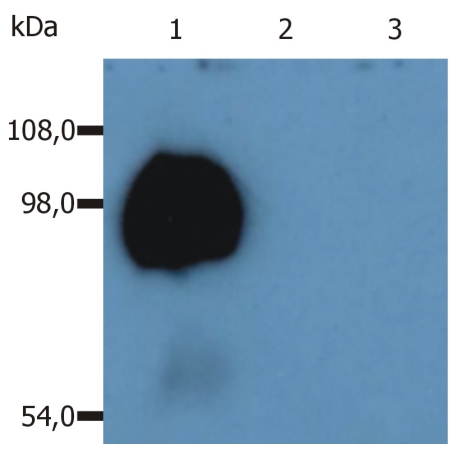
| Specificity | The antibody MEM-59 recognizes neuraminidase-sensitive epitope on CD43 (Leukosialin), a 95-135 kDa type I transmembrane glycoprotein (mucin-type) which is involved in lymphocyte activation. CD43 is expressed by platelets and at high levels on the surface of all leukocytes; it is negative on resting B lymphocytes and erythrocytes. HLDA IV; WS Code NL 604 HLDA V; WS Code AS S290 |
| Formulation | FITC |
| Storage Buffer | The reagent is provided in phosphate buffered saline (PBS) containing 15 mM sodium azide and 0.2% (w/v) high-grade protease free Bovine Serum Albumin (BSA) as a stabilizing agent. |
| Reference | Filatov AV, Krotov GI, Zgoda VG, Volkov Y: Fluorescent immunoprecipitation analysis of cell surface proteins: a methodology compatible with mass-spectrometry. J Immunol Methods. 2007 Jan 30;319(1-2):21-33. Cermak L, Simova S, Pintzas A, Horejsi V, Andera L: Molecular mechanisms involved in CD43-mediated apoptosis of TF-1 cells. Roles of transcription Daxx expression, and adhesion molecules. J Biol Chem. 2002 Mar 8;277(10):7955-61. Simova S, Klima M, Cermak L, Sourkova V, Andera L: Arf and Rho GAP adapter protein ARAP1 participates in the mobilization of TRAIL-R1/DR4 to the plasma membrane. Apoptosis. 2008 Mar;13(3):423-36. Alvarado M, Klassen C, Cerny J, Horejsi V, Schmidt RE: MEM-59 monoclonal antibody detects a CD43 epitope involved in lymphocyte activation. Eur J Immunol. 1995 Apr;25(4):1051-5. Stefanova I, Hilgert I, Angelisova P, Kristofova H, Horejsi V: Characterization of a 95 kDa human leucocyte sialoglycoprotein: its identity with CD43, gpL115, leukosialin and sialophorin. Folia Biol (Praha). 1988;34(4):255-65. Leukocyte Typing VI., Kishimoto T. et al. (Eds.), Garland Publishing Inc. (1997). Leukocyte Typing V., Schlossman S. et al. (Eds.), Oxford University Press (1995). Leukocyte Typing IV., Knapp W. et al. (Eds.), Oxford University Press (1989). Stefanova I, Hilgert I, Kristofova H, Brown R, Low MG, Horejsi V: Characterization of a broadly expressed human leucocyte surface antigen MEM-43 anchored in membrane through phosphatidylinositol. Mol Immunol. 1989 nFeb;26(2):153-61. Mody PD, Cannon JL, Bandukwala HS, Blaine KM, Schilling AB, Swier K, Sperling AI: Signaling through CD43 regulates CD4 T-cell trafficking. Blood. 2007 Oct 15;110(8):2974-82. Kadaja-Saarepuu L, Laos S, Jääger K, Viil J, Balikova A, Lõoke M, Hansson GC, Maimets T: CD43 promotes cell growth and helps to evade FAS-mediated apoptosis innon-hematopoietic cancer cells lacking the tumor suppressors p53 or ARF. Oncogene. 2007 Sep 24 Khunkaewla P, Schiller HB, Paster W, Leksa V, Cermák L, Anděra L, Hořejší V, Stockinger H: LFA-1-mediated leukocyte adhesion regulated by interaction of CD43 with LFA-1 and CD147. Mol Immunol. 2007 Nov 8 Kadaja L, Laos S, Maimets T: Overexpression of leukocyte marker CD43 causes activation of the tumor suppressor proteins p53 and ARF. Oncogene. 2004 Apr 1;23(14):2523-30. |
|---|---|
| Gene Symbol | SPN |
| Gene Full Name | sialophorin |
| Alias Symbols | CD43, galactoglycoprotein, GALGP, GPL115, leukocyte sialoglycoprotein, leukosialin, LSN, Sialophorin, sialophorin (gpL115, leukosialin, CD43). |
| NCBI Gene Id | 6693 |
| Protein Name | Leukosialin |
| Description of Target | Predominant cell surface sialoprotein of leukocytes which regulates multiple T-cell functions, including T-cell activation, proliferation, differentiation, trafficking and migration. Positively regulates T-cell trafficking to lymph-nodes via its association with ERM proteins (EZR, RDX and MSN) (By similarity). Negatively regulates Th2 cell differentiation and predisposes the differentiation of T-cells towards a Th1 lineage commitment. Promotes the expression of IFN-gamma by T-cells during T-cell receptor (TCR) activation of naive cells and induces the expression of IFN-gamma by CD4(+) T-cells and to a lesser extent by CD8(+) T-cells (PubMed:18036228). Plays a role in preparing T-cells for cytokine sensing and differentiation into effector cells by inducing the expression of cytokine receptors IFNGR and IL4R, promoting IFNGR and IL4R signaling and by mediating the clustering of IFNGR with TCR (PubMed:24328034). Acts as a major E-selectin ligand responsible for Th17 cell rolling on activated vasculature and recruitment during inflammation. Mediates Th17 cells, but not Th1 cells, adhesion to E-selectin. Acts as a T-cell counter-receptor for SIGLEC1 (By similarity). |
| Uniprot ID | P16150 |
| Protein Accession # | NP_001025459.1; NP_003114.1 |
| Nucleotide Accession # | NM_001030288.2; NM_003123.4 |