


Use code ELISA25-262 for 25% off all ELISAs through November.
25% off all ELISA kits

Neuropeptide Y ELISA Kit
Neuropeptide Y ELISA Kit
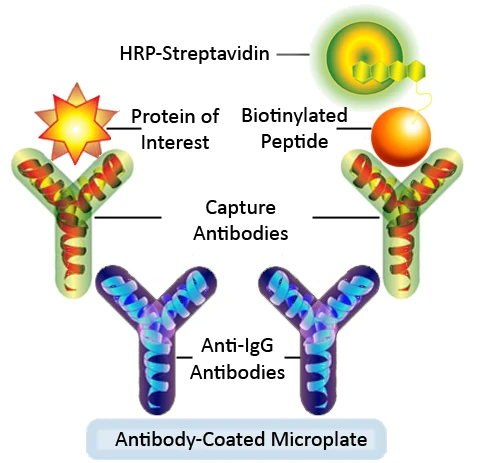
RayBio® Human/Mouse/Rat Neuropeptide Y EIA Kit optimized for serum, plasma and cell culture supernatants. Competition-based ELISA on a 96-well strip plate.
Contact Us for Bulk Request
Product Description
Specifications
| Size | 1 Plate Kit, 2 Plate Kit, 5 Plate Kit |
| Species | Human, Mouse, Rat |
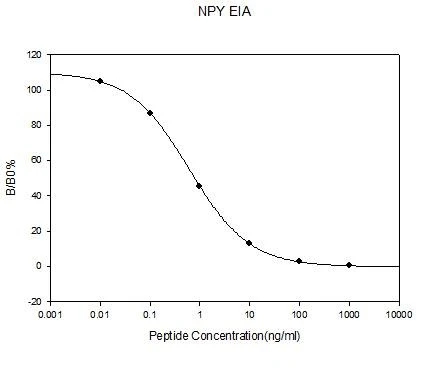
| Sensitivity | 0.2 ng/ml |
| Detection Range | 0.1-1,000 ng/ml |
| Specificity | This EIA kit is designed to detect human, mouse, and rat active NPY (1-36). |
| Compatible Sample Types | Plasma, Serum |
| Recommended Dilution (Serum/Plasma) | Human: 2X / Mouse: 2X / Rat: 8X |
| Accession Number | P01303 |
| Gene Id | 4852 |
| Gene Symbols | NPY |
| Protein Name / Synonyms | Pro-neuropeptide Y [Cleaved into: Neuropeptide Y (Neuropeptide tyrosine) (NPY) C-flanking peptide of NPY (CPON)] |
| Quantitative/Semi-Quantitative | Quantitative |
| Solid Support | 96-well Microplate |
| Design Principle | Competition-based |
| Method Of Detection | Colorimetric |
| Research Area | Neuroscience, Inflammation, Obesity & Metabolic Disease |
| Shipping Type | Blue ice |
| Storage | -20°C |
Introduction
Neuropeptide Y (NPY) is a 36 amino acid peptide hormone found in the neural system and has an important role in obesity.
The main effect of Neuropeptide Y is increased food intake and decreased physical activity. It also increases the proportion of energy stored as fat and blocks nociceptive signals to the brain. In addition to its role in obesity, Neuropeptide Y has been associated with a number of other physiologic processes in the brain, including the regulation of energy balance, memory and learning, and epilepsy.
Animal studies strongly demonstrate that the stimulation of Neuropeptide Yergic activity via the administration of certain Neuropeptide Y agonists increases food intake compared to control animals. The effects of Neuropeptide Yergic activity on food intake is also demonstrated by the blockade of certain Neuropeptide Y receptors (Y1 and Y5 receptors), which expectedly inhibited Neuropeptide Yergic activity; thus, decreases food intake. For its role in obesity, an increase in Neuropeptide Y is caused by high levels of glucocorticosteriods through directly activating type II glucocorticosteriods receptors and indirectly, by abolishing the negative feedback of CRF on Neuropeptide Y synthesis and release. Meanwhile, obesity-induced insulin resistance and the mutation of the leptin receptor (ObRb) results in the abolishment of other negative feedback mechanisms to regulate Neuropeptide Yergic activity and ultimately food intake. High levels of Neuropeptide Y were also found in the cerebrospinal fluid of patients with anorexia nervosa.
The 291 bp coding sequence of the NPY gene synthesizes the pre-pro form of NPY, a 97 aa precursor peptide (see diagram below). Cleavage of the n-terminal 29 aa results in pro-NPY (69 aa), which then undergoes a further cleavage, yielding NPY 1-39 along with the 30-aa C-terminal peptide known as C-flanking peptide of NPY (CPON). NPY 1-39 is further processed to the mature form (NPY 1-36). The function of CPON is not currently understood. This EIA kit is designed to detect active NPY (1-36).
The main effect of Neuropeptide Y is increased food intake and decreased physical activity. It also increases the proportion of energy stored as fat and blocks nociceptive signals to the brain. In addition to its role in obesity, Neuropeptide Y has been associated with a number of other physiologic processes in the brain, including the regulation of energy balance, memory and learning, and epilepsy.
Animal studies strongly demonstrate that the stimulation of Neuropeptide Yergic activity via the administration of certain Neuropeptide Y agonists increases food intake compared to control animals. The effects of Neuropeptide Yergic activity on food intake is also demonstrated by the blockade of certain Neuropeptide Y receptors (Y1 and Y5 receptors), which expectedly inhibited Neuropeptide Yergic activity; thus, decreases food intake. For its role in obesity, an increase in Neuropeptide Y is caused by high levels of glucocorticosteriods through directly activating type II glucocorticosteriods receptors and indirectly, by abolishing the negative feedback of CRF on Neuropeptide Y synthesis and release. Meanwhile, obesity-induced insulin resistance and the mutation of the leptin receptor (ObRb) results in the abolishment of other negative feedback mechanisms to regulate Neuropeptide Yergic activity and ultimately food intake. High levels of Neuropeptide Y were also found in the cerebrospinal fluid of patients with anorexia nervosa.
The 291 bp coding sequence of the NPY gene synthesizes the pre-pro form of NPY, a 97 aa precursor peptide (see diagram below). Cleavage of the n-terminal 29 aa results in pro-NPY (69 aa), which then undergoes a further cleavage, yielding NPY 1-39 along with the 30-aa C-terminal peptide known as C-flanking peptide of NPY (CPON). NPY 1-39 is further processed to the mature form (NPY 1-36). The function of CPON is not currently understood. This EIA kit is designed to detect active NPY (1-36).
Product Features
- Strip plates and additional reagents allow for use in multiple experiments
- Quantitative protein detection
- Establishes normal range
- The best products for confirmation of antibody array data
Application Notes
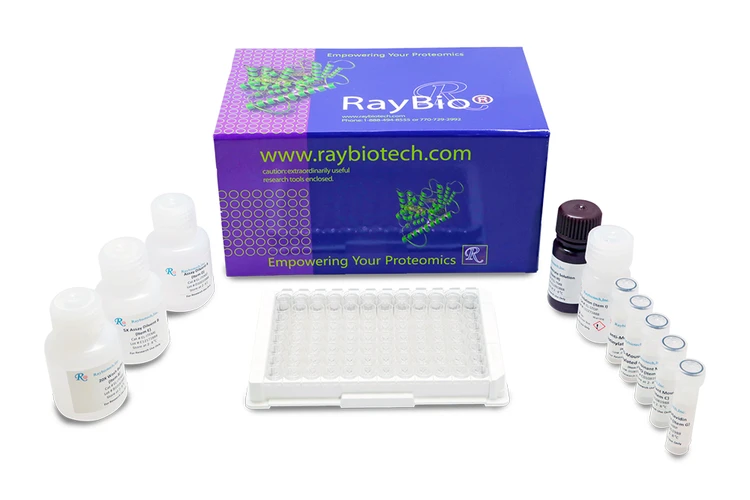
Kit Components
- Pre-Coated 96-well Strip Microplate
- Wash Buffer
- Standard Peptide
- Assay Diluent(s)
- Biotinylated Peptide
- HRP-Streptavidin
- TMB One-Step Substrate
- Stop Solution
- Assay Diagram
- Positive Control Sample
- Capture Antibody
- User Manual
Other Materials Required
- Distilled or deionized water
- Precision pipettes to deliver 2 µl to 1 ml volumes
- Adjustable 1-25 ml pipettes for reagent preparation
- 100 ml and 1 liter graduated cylinders
- Tubes to prepare standard and sample dilutions
- Orbital shaker
- Aluminum foil
- Saran Wrap
- Absorbent paper
- Microplate reader capable of measuring absorbance at 450nm
- SigmaPlot software (or other software that can perform four-parameter logistic regression models)
Protocol Outline
- Prepare all reagents, samples and standards as instructed.
- Add 100 µl detection antibody to each well.
- Incubate 1.5 h at RT or O/N at 4°C.
- Add 100 µl standard or sample to each well.
- Incubate 2.5 h at RT.
- Add 100 µl prepared streptavidin solution.
- Incubate 45 min at RT.
- Add 100 µl TMB One-Step Substrate Reagent to each well.
- Incubate 30 min at RT.
- Add 50 µl Stop Solution to each well.
- Read plate at 450 nm immediately.
Storage/Stability
Standard, biotinylated peptide, and positive control should be stored at -20°C after arrival. Avoid multiple freeze-thaws. The remaining kit components may be stored at 4°C. Opened Microplate Wells and antibody (Item N) may be stored for up to 1 month at 2° to 8°C. Return unused wells to the pouch containing desiccant pack and reseal along entire edge.
citations
FTO promotes weight gain via altering Kif1a splicing and axonal vesicle trafficking in AgRP neurons
- Species:
- Rat
- Sample Type:
- Cell Culture Supernatant (differentiated PC12 cells expressing Kif1a isoforms)
- Year:
- 2025
- Journal Name:
- EMBO Journal
- PubMed ID:
- 40634669
Regulation of colonic neuropeptide Y expression by the gut microbiome in patients with ulcerative colitis and its association with anxiety- and depression-like behavior in mice
- Species:
- Mouse
- Sample Type:
- Plasma (UC-FMT and bacteria-treated mice)
- Year:
- 2024
- Journal Name:
- Gut Microbes
- PubMed ID:
- 38404132
Restoring neuropetide Y levels in the hypothalamus ameliorates premature aging phenotype in mice
- Species:
- Mouse
- Sample Type:
- Serum (premature aging mice)
- Year:
- 2025
- Journal Name:
- Geroscience
- PubMed ID:
- 40011349
Oral Peroxisome Proliferator–Activated Receptor-α Agonist Enhances Corneal Nerve Regeneration in Patients With Type 2 Diabetes
- Species:
- Human
- Sample Type:
- Plasma
- Year:
- 2022
- Journal Name:
- Diabetes
The influence of parental high-fat high-sugar diet on the gut-brain axis in male offspring
- Species:
- Rat
- Sample Type:
- Serum
- Year:
- 2022
- Journal Name:
- Food Research International
Saxagliptin Cardiotoxicity in Chronic Heart Failure: The Role of DPP4 in the Regulation of Neuropeptide Tone
- Species:
- Human
- Sample Type:
- interventricular septum samples
- Year:
- 2022
- Journal Name:
- Biomedicines
Upregulation of neuropeptide Y in cardiac sympathetic nerves induces stress (Takotsubo) cardiomyopathy
- Species:
- Rat
- Sample Type:
- Serum
- Year:
- 2022
- Journal Name:
- Frontiers in Neuroscience
Chronic Escitalopram Treatment Does Not Alter the Effects of Neonatal Stress on Hippocampal BDNF Levels, 5-HT1A Expression and Emotional Behaviour of Male and Female Adolescent Rats
- Species:
- Rat
- Sample Type:
- Cell Lysate (Wistar male rats)
- Year:
- 2020
- Journal Name:
- Molecular Neurobiology
- PubMed ID:
- 33063280
Decreased Level of Neuropeptide Y Is Associated With Gastroparesis in Male Diabetic Rats
- Species:
- Rat
- Sample Type:
- Serum (STZ-diabetic rats with/without gastroparesis)
- Year:
- 2020
- Journal Name:
- Gastroenterology Research
- PubMed ID:
- 33447303
Rabbit Annulus Fibrosus Cells Express Neuropeptide Y, Which Is Influenced by Mechanical and Inflammatory Stress
- Species:
- Rabbit
- Sample Type:
- Cell Culture Supernatant (culture media from annulus fibrosus cells)
- Year:
- 2020
- Journal Name:
- Neurospine
- PubMed ID:
- 32252156
