

Mouse Triggering receptor expressed on myeloid cells 2(TREM2) ELISA kit

Cat# CSB-EL024405MO-96T
Size : 96T
Brand : Cusabio
Contact local distributor :

Phone : +1 850 650 7790
 SDS
| Size | 96T,5×96T,10×96T |
Product Details
Target Name
triggering receptor expressed on myeloid cells 2
Associated names
Trem2 ELISA Kit; Trem2a ELISA Kit; Trem2b ELISA Kit; Trem2c ELISA Kit; Triggering receptor expressed on myeloid cells 2 ELISA Kit; TREM-2 ELISA Kit; Triggering receptor expressed on monocytes 2 ELISA Kit
Abbreviation
Uniprot No.
Species
Mus musculus (Mouse)
Sample Types
serum, plasma, tissue homogenates
Detection Range
0.156 ng/mL-10 ng/mL
Sensitivity
0.039 ng/mL
Assay Time
1-5h
Sample Loading Volume
50-100ul
Detection Wavelength
450 nm
Research Area
Immunology
Assay Principle
quantitative
Measurement
Sandwich
Precision
| Intra-assay Precision (Precision within an assay): CV%<8% | |||||||
| Three samples of known concentration were tested twenty times on one plate to assess. | |||||||
| Inter-assay Precision (Precision between assays): CV%<10% | |||||||
| Three samples of known concentration were tested in twenty assays to assess. | |||||||
Linearity
| To assess the linearity of the assay, samples were spiked with high concentrations of mouse TREM2 in various matrices and diluted with the Sample Diluent to produce samples with values within the dynamic range of the assay. | |||||||
| Sample | Serum(n=4) | ||||||
| 1:1 | Average % | 84 | |||||
| Range % | 81-89 | ||||||
| 1:2 | Average % | 102 | |||||
| Range % | 98-107 | ||||||
| 1:4 | Average % | 85 | |||||
| Range % | 80-90 | ||||||
| 1:8 | Average % | 101 | |||||
| Range % | 96-105 | ||||||
Recovery
| The recovery of mouse TREM2 spiked to levels throughout the range of the assay in various matrices was evaluated. Samples were diluted prior to assay as directed in the Sample Preparation section. | |||||||
| Sample Type | Average % Recovery | Range | |||||
| Serum (n=5) | 89 | 85-93 | |||||
| EDTA plasma (n=4) | 107 | 103-110 | |||||
Typical Data
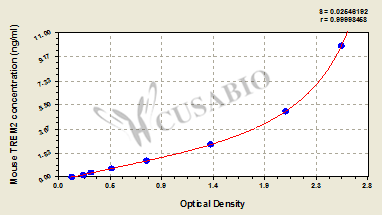
| These standard curves are provided for demonstration only. A standard curve should be generated for each set of samples assayed. | |||||||||||||||||||||||||||||||||||||||||||||||||||||||||||||||||||||||
| |||||||||||||||||||||||||||||||||||||||||||||||||||||||||||||||||||||||
ELISA Data Analysis
Troubleshooting
and FAQs
and FAQs
Storage
Store at 2-8°C. Please refer to protocol.
Shelf Life
6 months
Description
This Mouse TREM2 ELISA Kit was designed for the quantitative measurement of Mouse TREM2 protein in serum, plasma, tissue homogenates. It is a Sandwich ELISA kit, its detection range is 0.156 ng/mL-10 ng/mL and the sensitivity is 0.039 ng/mL.
Citations
- S Hu, X Liu, L Zhang, S Zhong, Z Liang,British Journal of Pharmacology,/
Customer Reviews and Q&A
There are currently no reviews for this product.
Target Background
Function
(From Uniprot)
(From Uniprot)
Forms a receptor signaling complex with TYROBP which mediates signaling and cell activation following ligand binding. Acts as a receptor for amyloid-beta protein 42, a cleavage product of the amyloid-beta precursor protein APP, and mediates its uptake and degradation by microglia. Binding to amyloid-beta 42 mediates microglial activation, proliferation, migration, apoptosis and expression of pro-inflammatory cytokines, such as IL6R and CCL3, and the anti-inflammatory cytokine ARG1. Acts as a receptor for lipoprotein particles such as LDL, VLDL, and HDL and for apolipoproteins such as APOA1,...
Gene References into Functions
- The present study provide novel evidence that overexpression of TREM2 protects against MPTP-induced PD progression via modulation of microglial function through inhibiting TRAF6/TLR4-mediated activation of the MAPK and NF-kappaB signaling pathways.
- Our data establish a critical link between oAbeta1-42, a major pathological component of Alzheimer's disease and TREM2
- These data suggest that the Alzheimer's disease-associated TREM2 R47H variant increases risk for Alzheimer's disease by conferring a loss of TREM2 function and enhancing neuritic dystrophy around plaques.
- Data indicate a novel role for PS1 in regulating TREM2 intracellular trafficking and pathophysiological function.
- whereas complete TREM2 deficiency protected against tau-mediated microglial activation and atrophy, TREM2 haploinsufficiency elevated expression of proinflammatory markers and exacerbated atrophy at a late stage of disease. The differential effects of partial and complete loss of TREM2 on microglial function and tau pathology
- TREM2 plays a crucial role in altering the proinflammatory M1 microglia to M2 phenotype and has beneficial effects in the immune pathogenesis of Parkinson's disease.
- Overexpression of TREM2 downregulated the levels of IL-1beta, ameliorated T396 expression, inhibited the activity of GSK-3beta, and improved sickness behavior. Increased Arg1 expression and a high level of synaptophysin were also observed in the transgenic mice following TREM2 overexpression.
- These studies of the role of TREM2 in neuroinflammation and neurodegeneration suggest that impairing microglial TREM2 signaling reduces pure tauopathy.
- This article suggests a potential explanation of why TREM2-deficient microglia are unable to respond to neurotoxic plaques in the Alzheimer's disease brain and highlight a further need to understand microglial biology.
- TREM2 protects against cerebral ischemia/reperfusion injury through the aspect of post-ischemic inflammatory response and neuronal apoptosis.
- Results suggest that TREM2 plays a critical role in inflammation and neuronal cell survival and in neurogenesis. Study showed that TREM2 is a soluble protein transported by macrophages through ventricle walls and choroid plexus, and then enters the brain parenchyma via radial glial cells. TREM2 protein is essential for neuroplasticity and myelination. A lack of TREM2 protein may accelerate aging.
- TREM2 deficiency influences both acute and chronic responses to traumatic brain injury, with altered macrophage response early on and improved functional outcome at later time points.
- A central role of TREM2 is in the regulation of microglia response to acute neurotoxic insults.
- Loss of TREM2 reduces the ability of microglia to engulf amyloid beta-peptide.
- TREM2 and TREML2 play opposite roles in microglia activation.
- Our study suggests that Vps35/retromer is responsible for recycling of Trem2 in the regulation of microglial function such as proinflammatory responses, whereas R47H mutation impairs Trem2 trafficking, which might contribute to Alzheimer disease.
- sTREM2 plays a crucial role in regulating microglial cell survival and inflammatory responses.
- Microglia in Alzheimer's disease (AD) patients carrying TREM2 risk variants and TREM2-deficient mice with AD-like pathology have abundant autophagic vesicles, as do TREM2-deficient macrophages under growth-factor limitation or endoplasmic reticulum (ER) stress. Study concludes that TREM2 enables microglial responses during AD by sustaining cellular energetic and biosynthetic metabolism.
- This study demonstrate a critical role of TREM2-mediated Wnt/beta-catenin pathway in microglial viability and suggest that modulating this pathway therapeutically may help to combat the impaired microglial survival.
- Triggering receptor expressed on myeloid cells 2 (TREM2) is an immunoglobulin-like receptor of the TREM family and is expressed on activated macrophages, immature dendritic cells, osteoclasts, and microglia.
- TREM2 deficiency may disrupt the formation of a neuroprotective microglia barrier that regulates amyloid compaction and insulation
- TREM2 deficiency has opposing effects on Alzheimer's disease-related pathologies at early and late stages of disease progression.
- TREM2 protects from Alzheimer's disease by enabling microglia to surround and alter Abeta plaque structure, thereby limiting neuritic damage.
- Recent studies have revealed that activated microglia in the spinal dorsal horn exacerbate neuropathic pain, which has suggested that suppression of microglial activity should be considered as a therapeutic target. However, only a few molecules have been identified as regulators of microglial activity. In this study, we focused on a receptor complex of TREM2 and DAP12, both of which are expressed by microglia and have bee
- The authors demonstrate that a TREM2 loss-of-function mutation causes brain-wide metabolic alterations pointing toward a possible function of microglia in regulating brain glucose metabolism.
- flow cytometry analyses indicated significantly lower surface expression of T66M TREM2 variant than wild type or other TREM2 variants
- Study found that TREM2 was upregulated in the brain of P301S mice, an animal model of tau pathology, during disease progression and showed that TREM2 overexpression rescued spatial cognitive impairments and ameliorated neuropathologies including neuronal and synaptic loss as well as tau hyperphosphorylation.
- This study showed that TREM-2 deficiency restricts the inflammatory response, thereby decreasing organ damage and mortality.
- TREM2 attenuates tau kinase activity through restriction of neuroinflammation, and thus protects against tau pathology.
- TREM2 is involved in prion-induced microglial activation but does not noticeably modulate the pathogenesis of experimental prion infections.
- These findings provide a novel interpretation of Brucella intracellular growth through inhibition of NO production produced by TREM-2-mediated activated macrophages.
- TREM-1/TREM-3 macrophage expression improved host defense against Klebsiella-derived pneumosepsis, whereas TREM-2 did not have a role.
- These findings place TREM2 as a key regulator of microglia activation in vivo in response to tissue damage
- TREM-2 has a protective effect on inflammatory response of endotoxin-induced acute lung injury in mice.
- results support a role of DAP12 in stabilizing TREM2-CTF, thereby protecting against excessive pro-inflammatory responses.
- Corpus callosum microglia normally expand with age, but aged Trem2(-/-) mice had fewer microglia with an abnormal morphology which failed to amplify transcripts indicative of activation, phagocytosis, and lipid catabolism in response to myelin damage.
- Data (including data from studies using knockout mice) suggest that TREM2 is expressed on alveolar macrophages and lung mucosa and plays role innate immunity during pneumococcal pneumonia; knockout of TREM2 increases phagocytosis and survival.
- viral replication increases lung macrophage levels of intracellular and cell surface TREM-2, and this action prevents macrophage apoptosis
- TREM2 knockdown reduced microglial activation, decreased phagocytosis of injured neurons and worsened stroke damage.
- Upon infection with Escherichia coli, the otherwise beneficial effect of an exaggerated early immune response in TREM-2(-/-) animals was counteracted by a 50% reduction in bacterial phagocytosis.
- important role for TREM2 in inflammatory macrophages and neuroinflammation
- TREM2 detects damage-associated lipid patterns associated with neurodegeneration, sustaining the microglial response to beta-amyloid accumulation.
- TREM2 promotes adipogenesis and diet-induced obesity by upregulating adipogenic regulators in conjunction with inhibiting the Wnt10b/beta-catenin signaling pathway.
- It may play a protective role against aging-related neuroinflammation and cognitive impairment.
- These data suggest that TREM2 is important for the microglial response to Amyloid-beta deposition
- Results suggest that an epigenetic mechanism involving an aluminum-triggered, NF-kB-sensitive, miRNA-34a-mediated down-regulation of triggering receptor expressed in myeloid cells 2 (TREM2) expression may impair phagocytic responses.
- TREM-2-mediated bacterial killing is dependent on the activation of PI3K/Akt signaling.
- TREM2 protein is expressed only in microglia/macrophages and is developmentally downregulated in a region-dependent manner.
- TREM2 governs Kupffer cell activation and explains belr1 genetic resistance to malaria liver stage infection.
- Trem-2 plays an important role in the host defense response to sepsis by enhancing bacterial clearance.
Subcellular Location
[Isoform 1]: Cell membrane; Single-pass type I membrane protein.; [Isoform 2]: Secreted.
Tissue Specificity
Expressed in the brain, specifically in microglia (at protein level). Expressed in macrophages (at protein level). Expressed at higher levels in the CNS, heart and lung than in lymph nodes or in other non-lymphoid tissues such as kidney, liver and testis.
Database Links
KEGG:
STRING:
UniGene: