HMGA2 antibody - N-terminal region

Cat# ARP38356_T100
Size : 100ul
Brand : Aviva Systems Biology
Contact local distributor :

Phone : +1 850 650 7790
HMGA2 Antibody - N-terminal region (ARP38356_T100)
| Datasheets/Manuals | Printable datasheet for anti-HMGA2 (ARP38356_T100) antibody |
|---|
| Tested Species Reactivity | Human |
|---|---|
| Predicted Species Reactivity | Human, Mouse, Rat, Cow, Dog, Goat, Guinea Pig, Horse, Rabbit, Yeast, Zebrafish |
| Product Format | Liquid. Purified antibody supplied in 1x PBS buffer with 0.09% (w/v) sodium azide and 2% sucrose. |
| Clonality | Polyclonal |
| Host | Rabbit |
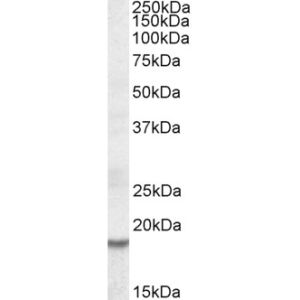
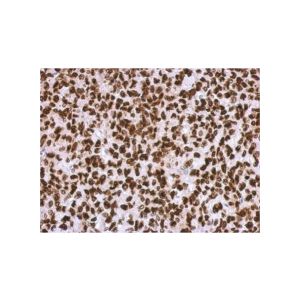
| Application | WB |
| Reconstitution and Storage | For short term use, store at 2-8C up to 1 week. For long term storage, store at -20C in small aliquots to prevent freeze-thaw cycles. |
| Immunogen | The immunogen is a synthetic peptide directed towards the N terminal region of human HMGA2 |
| Purification | Protein A purified |
| Predicted Homology Based on Immunogen Sequence | Cow: 100%; Dog: 100%; Goat: 100%; Guinea Pig: 100%; Horse: 100%; Human: 100%; Mouse: 100%; Rabbit: 100%; Rat: 100%; Yeast: 92%; Zebrafish: 100% |
| Peptide Sequence | Synthetic peptide located within the following region: PSTSAQGQPAAPAPQKRGRGRPRKQQQEPTGEPSPKRPRGRPKGSKNKSP |
| Concentration | 1.0 mg/ml |
| Blocking Peptide | For anti-HMGA2 (ARP38356_T100) antibody is Catalog # AAP38356 (Previous Catalog # AAPP20543) |
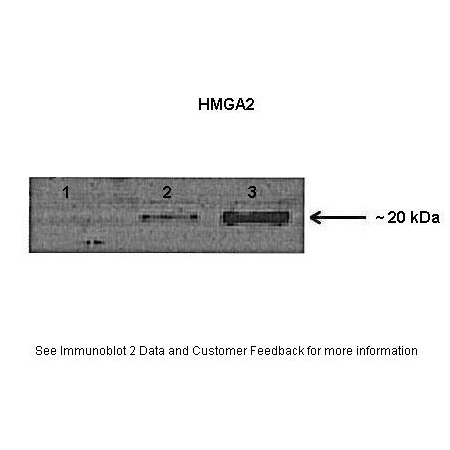
| Sample Type Confirmation | HMGA2 is supported by BioGPS gene expression data to be expressed in HEK293T |
| Reference | Kubo,T., (2006) Biochem. Biophys. Res. Commun. 340 (2), 476-481 |
|---|---|
| Gene Symbol | HMGA2 |
| Gene Full Name | High mobility group AT-hook 2 |
| Alias Symbols | BABL, LIPO, SRS5, HMGIC, HMGI-C, STQTL9 |
| NCBI Gene Id | 8091 |
| Protein Name | High mobility group protein HMGI-C |
| Description of Target | HMGA2 belongs to the non-histone chromosomal high mobility group (HMG) protein family. HMG proteins function as architectural factors and are essential components of the enhancesome. This protein contains structural DNA-binding domains and may act as a transcriptional regulating factor. It may be play a role in adipogenesis, mesenchymal differentiation and diet-induced obesity.This gene encodes a protein that belongs to the non-histone chromosomal high mobility group (HMG) protein family. HMG proteins function as architectural factors and are essential components of the enhancesome. This protein contains structural DNA-binding domains and may act as a transcriptional regulating factor. Identification of the deletion, amplification, and rearrangement of this gene that are associated with myxoid liposarcoma suggests a role in adipogenesis and mesenchymal differentiation. A gene knock out study of the mouse counterpart demonstrated that this gene is involved in diet-induced obesity. Alternate transcriptional splice variants, encoding different isoforms, have been characterized. |
| Uniprot ID | P52926 |
| Protein Accession # | NP_003474 |
| Nucleotide Accession # | NM_003483 |
| Protein Size (# AA) | 109 |
| Molecular Weight | 12kDa |
| Protein Interactions | PSIP1; SYNCRIP; PTBP1; PCBP2; PA2G4; NPM1; XRCC6; APEX1; HDGF; UBC; PRKCA; SMAD9; SMAD5; SMAD1; PRMT6; RB1; PIAS3; SMAD3; RELA; NFKB1; CDK1; CSNK2A2; CSNK2A1; |