DDOST antibody - N-terminal region

Cat# ARP46585_T100
Size : 100ul
Brand : Aviva Systems Biology
Contact local distributor :

Phone : +1 850 650 7790
DDOST Antibody - N-terminal region (ARP46585_T100)
Click here to learn more about Aviva's By-Request Conjugation Service.
| Datasheets/Manuals | Printable datasheet for anti-DDOST (ARP46585_T100) antibody |
|---|
| Tested Species Reactivity | Human |
|---|---|
| Predicted Species Reactivity | Human, Mouse, Rat, Cow, Dog, Guinea Pig, Horse, Rabbit, Sheep, Zebrafish |
| Product Format | Liquid. Purified antibody supplied in 1x PBS buffer with 0.09% (w/v) sodium azide and 2% sucrose. |
| Clonality | Polyclonal |
| Host | Rabbit |
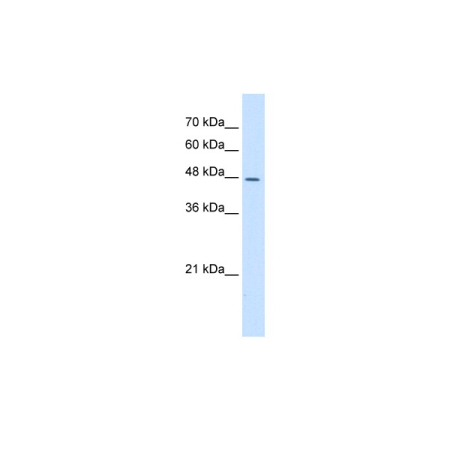
| Application | WB |
| Reconstitution and Storage | For short term use, store at 2-8C up to 1 week. For long term storage, store at -20C in small aliquots to prevent freeze-thaw cycles. |
| Immunogen | The immunogen is a synthetic peptide directed towards the N terminal region of human DDOST |
| Purification | Protein A purified |
| Predicted Homology Based on Immunogen Sequence | Cow: 100%; Dog: 100%; Guinea Pig: 100%; Horse: 100%; Human: 100%; Mouse: 100%; Rabbit: 100%; Rat: 100%; Sheep: 100%; Zebrafish: 100% |
| Peptide Sequence | Synthetic peptide located within the following region: SPSVEDFGGNINVETISAFIDGGGSVLVAASSDIGDPLRELGSECGIEFD |
| Concentration | 1.0 mg/ml |
| Blocking Peptide | For anti-DDOST (ARP46585_T100) antibody is Catalog # AAP46585 (Previous Catalog # AAPS19508) |
| Reference | Shibatani,T., (2005) Biochemistry 44 (16), 5982-5992 |
|---|---|
| Gene Symbol | DDOST |
| Gene Full Name | Dolichyl-diphosphooligosaccharide--protein glycosyltransferase |
| Alias Symbols | OST, WBP1, AGER1, CDG1R, GATD6, OST48, OKSWcl45 |
| NCBI Gene Id | 1650 |
| Protein Name | Dolichyl-diphosphooligosaccharide--protein glycosyltransferase 48 kDa subunit |
| Description of Target | DDOST is a component of the oligosaccharyltransferase complex which catalyzes the transfer of high-mannose oligosaccharides to asparagine residues on nascent polypeptides in the lumen of the rough endoplasmic reticulum. The protein complex co-purifies with ribosomes. DDOST is also implicated in the processing of advanced glycation endproducts (AGEs), which form from non-enzymatic reactions between sugars and proteins or lipids and are associated with aging and hyperglycemia. |
| Uniprot ID | Q5VWA5 |
| Protein Accession # | NP_005207 |
| Nucleotide Accession # | NM_005216 |
| Protein Size (# AA) | 456 |
| Molecular Weight | 46kDa |
| Protein Interactions | HUWE1; VAPB; UBC; FAF1; STAU1; ASB11; TRIM13; SUZ12; EED; CLN3; NXT1; SRSF11; FN1; ATF2; STT3B; MAGT1; ZMPSTE24; VDAC2; SSR4; SSR3; SLC25A3; ILF2; KRTCAP2; FBXO6; UBD; AMFR; AUP1; TMEM173; UNC93B1; MAPK6; HDAC5; AGO3; BRCC3; GSTK1; TMBIM4; PGRMC1; SAP18; |