

Quimigen Portugal > ARG1 antibody - N-terminal region
ARG1 antibody - N-terminal region

Cat# ARP45672_T100
Size : 100ul
Contact local distributor :

Phone : +1 850 650 7790
Brand : Aviva Systems Biology
Contact local distributor :
Phone : +1 850 650 7790
ARG1 Antibody - N-terminal region (ARP45672_T100)
| Datasheets/Manuals | Printable datasheet for anti-ARG1 (ARP45672_T100) antibody |
|---|
| Publications | Hu, Z. et al. Quantitative liver-specific protein fingerprint in blood: a signature for hepatotoxicity. Theranostics 4, 215-28 (2014). 24465277 |
|---|---|
| Tested Species Reactivity | Human |
| Predicted Species Reactivity | Human, Mouse, Rat, Cow, Dog, Goat, Guinea Pig, Horse, Pig, Rabbit |
| Product Format | Liquid. Purified antibody supplied in 1x PBS buffer with 0.09% (w/v) sodium azide and 2% sucrose. |
| Clonality | Polyclonal |
| Host | Rabbit |
| Application | IHC, WB |
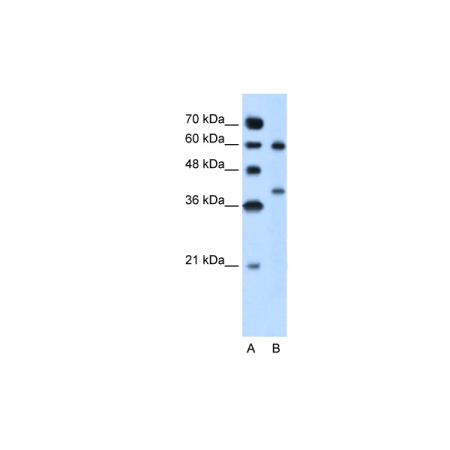
| Additional Information | IHC Information: Lane A: Marker. Lane B: Jurkat cell lysate. Antibody concentration: 5.0 ug/ml. Gel concentration: 12%. |
| Reconstitution and Storage | For short term use, store at 2-8C up to 1 week. For long term storage, store at -20C in small aliquots to prevent freeze-thaw cycles. |
| Immunogen | The immunogen is a synthetic peptide directed towards the N terminal region of human ARG1 |
| Purification | Protein A purified |
| Predicted Homology Based on Immunogen Sequence | Cow: 100%; Dog: 100%; Goat: 100%; Guinea Pig: 93%; Horse: 100%; Human: 100%; Mouse: 93%; Pig: 100%; Rabbit: 86%; Rat: 100% |
| Peptide Sequence | Synthetic peptide located within the following region: HSLAIGSISGHARVHPDLGVIWVDAHTDINTPLTTTSGNLHGQPVSFLLK |
| Concentration | 1.0 mg/ml |
| Blocking Peptide | For anti-ARG1 (ARP45672_T100) antibody is Catalog # AAP45672 (Previous Catalog # AAPP25826) |
| Reference | Orellana,M.S., (2002) Arch. Biochem. Biophys. 403 (2), 155-159 |
|---|---|
| Gene Symbol | ARG1 |
| Gene Full Name | Arginase, liver |
| NCBI Gene Id | 383 |
| Protein Name | Arginase-1 |
| Description of Target | Arginase catalyzes the hydrolysis of arginine to ornithine and urea. The type I isoform of ARG1, is a cytosolic enzyme and expressed predominantly in the liver as a component of the urea cycle. Inherited deficiency of this enzyme results in argininemia, an autosomal recessive disorder characterized by hyperammonemia.Arginase catalyzes the hydrolysis of arginine to ornithine and urea. At least two isoforms of mammalian arginase exist (types I and II) which differ in their tissue distribution, subcellular localization, immunologic crossreactivity and physiologic function. The type I isoform encoded by this gene, is a cytosolic enzyme and expressed predominantly in the liver as a component of the urea cycle. Inherited deficiency of this enzyme results in argininemia, an autosomal recessive disorder characterized by hyperammonemia. |
| Uniprot ID | P05089 |
| Protein Accession # | NP_000036 |
| Nucleotide Accession # | NM_000045 |
| Protein Size (# AA) | 322 |
| Molecular Weight | 35kDa |
| Protein Interactions | RPA3; RPA2; RPA1; SUZ12; EZH2; BMI1; ALDH4A1; ESR1; RAD21; UBC; UCHL5; ATG101; USP53; FLOT1; NOS1; ARG2; |
Protein interactions
| Name | # of Products |
|---|---|
| ARG2 | 6 |
| C12orf44 | 79 |
| FLOT1 | 34 |
| NOS1 | 71 |
| UBC | 7030 |
| UCHL5 | 365 |
| USP53 | 36 |
Biological pathways
| Name | # of Products |
|---|---|
| Arginine catabolic process | 43 |
| Urea cycle | 32 |
Biological process
| Name | # of Products |
|---|---|
| Arginine catabolic process | 10 |
| Cellular nitrogen compound metabolic process | 173 |
| Cellular response to dexamethasone stimulus | 16 |
| Cellular response to glucagon stimulus | 22 |
| Cellular response to hydrogen peroxide | 38 |
| Cellular response to lipopolysaccharide | 64 |
| Cellular response to transforming growth factor beta stimulus | 27 |
| Collagen biosynthetic process | 12 |
| Liver development | 83 |
| Lung development | 105 |
| Mammary gland involution | 12 |
| Maternal process involved in female pregnancy | 19 |
| Positive regulation of endothelial cell proliferation | 68 |
| Protein homotrimerization | 19 |
| Regulation of L-arginine import | 3 |
| Response to amino acid stimulus | 29 |
| Response to axon injury | 34 |
| Response to cadmium ion | 22 |
| Response to drug | 323 |
| Response to herbicide | 11 |
| Response to manganese ion | 12 |
| Response to methylmercury | 16 |
| Response to peptide hormone stimulus | 76 |
| Response to selenium ion | 9 |
| Response to steroid hormone stimulus | 26 |
| Response to vitamin A | 14 |
| Response to vitamin E | 15 |
| Response to zinc ion | 32 |
| Small molecule metabolic process | 825 |
| Urea cycle | 15 |
Cellular components
| Name | # of Products |
|---|---|
| Cytoplasm | 4549 |
| Cytosol | 1868 |
| Extracellular space | 884 |
| Neuron projection | 94 |
| Neuronal cell body | 203 |
Protein function
| Name | # of Products |
|---|---|
| Arginase activity | 14 |
| Hydrolase activity | 1739 |
| Manganese ion binding | 78 |
| Metal ion binding | 5514 |
Diseases
| Name | # of Products |
|---|---|
| Disease mutation | 5332 |
-
 ARG1 Antibody - N-terminal region (ARP45671_P050)Catalog #: ARP45671_P050Species Tested: HumanApplication: WB, IHCFormat: Liquid. Purified antibody supplied in 1x PBS buffer with 0.09% (w/v) sodium azide and 2% sucrose.
-
 ARG1 Antibody (OAEB02142)Catalog #: OAEB02142Application: ELISA|FC|IF|IHC|WBFormat: Supplied at 0.5 mg/ml in Tris saline, 0.02% sodium azide, pH7.3 with 0.5% bovine serum albumin.
-
 ARG1 Antibody (OAGA00750)Catalog #: OAGA00750Conjugation: UnconjugatedApplication: ELISA|ELISA-Sandwich|FACS|ICC|IF|IHC-Fr|IHC-P|IP|WBFormat: Liquid
-
 ARG1 ELISA Kit (Human) : 96 Wells (OKEH00785)Catalog #: OKEH00785Application: ELISA-SandwichKit Range: 3.12-200ng/mLSensitivity: 1 ng/mL
-
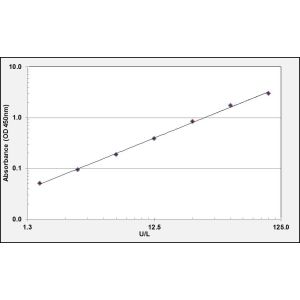 ARG1 ELISA Kit (Mouse) : 96 Wells (OKEH00786)Catalog #: OKEH00786Application: ELISA-SandwichKit Range: 1.56-100U/LSensitivity: 0.78U/L