


Erythrose is a naturally occurring tetrose monosaccharide with the chemical formula C4H8O4 and a molar mass of approximately 120.1 g/mol. It belongs to the aldose family, characterized by having an aldehyde functional group at the carbon-1 position, which distinguishes it as an aldotetrose. Erythrose typically appears as a light yellow syrup that is highly soluble in water, demonstrating mutarotation properties when in solution.
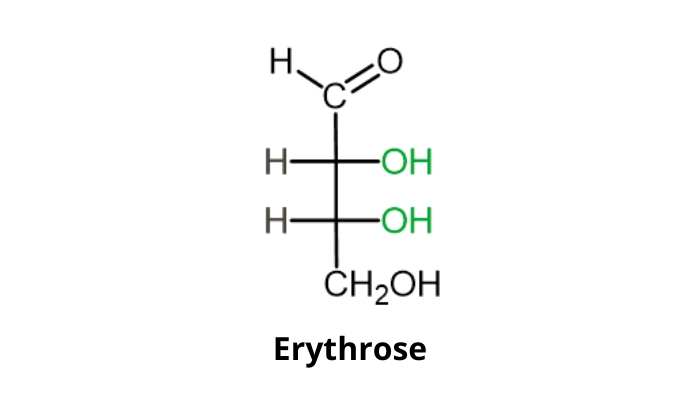
The biologically relevant form is the D-enantiomer, D-erythrose, which possesses two chiral centers at carbon atoms 2 and 3. Its stereochemistry is designated as (2R,3R)-2,3,4-trihydroxybutanal. This specific configuration defines its role as a natural metabolite in plants and other organisms.
Biochemical Role
Erythrose plays a significant role in cellular metabolism, notably through its phosphorylated derivative, erythrose 4-phosphate. This compound serves as a key intermediate in the pentose phosphate pathway and the Calvin cycle. These pathways are essential for maintaining cellular function by providing reducing power (NADPH) and synthesizing nucleotides and aromatic amino acids. Moreover, erythrose 4-phosphate is a crucial substrate in the shikimate pathway, leading to the biosynthesis of aromatic compounds and secondary metabolites in plants and microorganisms.
Chemical Properties
Chemically, erythrose readily undergoes reduction to erythritol, a sugar alcohol. It can participate in reactions typical of aldehydes, although the reactivity may vary depending on experimental conditions. Erythrose is known for its slow reduction of cold Fehling's solution and for not undergoing fermentation by most yeasts, due to its structural characteristics.
Applications
Beyond its biological importance, erythrose and its derivatives find use in synthetic organic chemistry and biotechnology. They serve as intermediates in the synthesis of nucleic acid-related compounds and as potential precursors in the design of artificial genetic systems. Recent studies have explored erythrose-based compounds for their potential in cancer inhibition and cellular viability enhancement, underscoring its emerging value in biomedical research.
In summary, erythrose is a tetrose aldose monosaccharide with essential functions as a metabolic intermediate in key biochemical pathways. Its defined stereochemistry, versatile chemical reactivity, and growing applications in synthetic biology and medicine make it a molecule of notable scientific interest.
