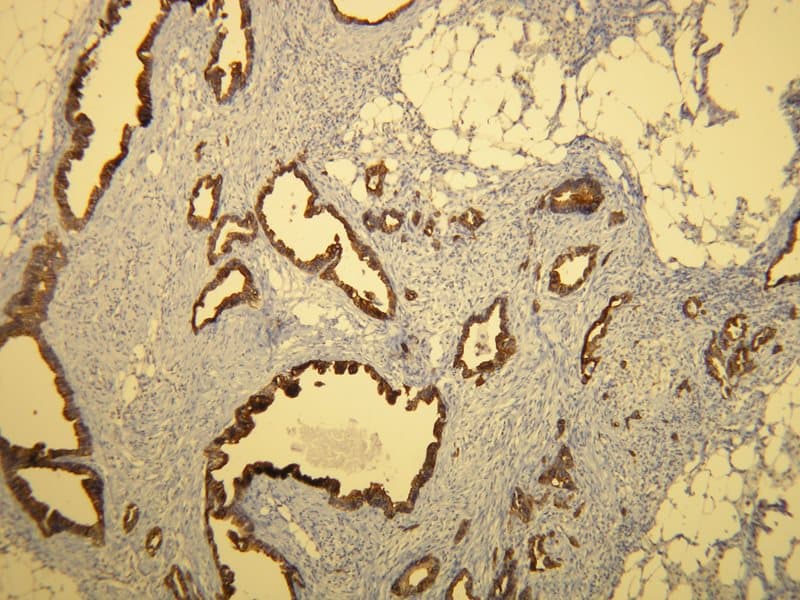


Cytokeratins are structural intermediate filament proteins that form the cytoskeleton of epithelial cells, contributing to mechanical stability, cellular integrity, and tissue architecture. Cytokeratin 7 (CK7), a type II cytokeratin, is expressed in many glandular and ductal epithelia, including bile ducts, pancreatic ducts, and portions of the gastric and small intestinal mucosa. In contrast, normal colonic mucosa is typically CK7-negative, making this protein a useful reference marker in gastrointestinal (GI) pathology.
Biological Significance of Cytokeratin 7
Aberrant CK7 expression has been observed in subsets of gastrointestinal neoplasms, including some colorectal, gastric, and small bowel adenocarcinomas. In these contexts, CK7 immunoreactivity may reflect alterations in epithelial differentiation and lineage, and in certain studies, CK7-positive colorectal carcinomas have been associated with mucinous or high-grade histological features. While CK7 is not universally prognostic, its expression provides insight into tumor biology and can aid in characterizing histopathological subtypes.
Diagnostic Utility in Gastrointestinal Pathology
CK7 immunohistochemistry, particularly when used in combination with CK20, is a well-established tool for distinguishing primary GI tumors from metastatic lesions and for subtype characterization. Typical expression profiles include:
- Colorectal adenocarcinoma: CK7−/CK20+
- Upper GI adenocarcinomas (stomach, small bowel): frequently CK7+/CK20 variable
- Metastatic lesions from non-GI sites (lung, ovary, breast): CK7+
These differential expression patterns help pathologists determine tumor origin, particularly in metastatic disease of unknown primary. In addition, CK7 can be expressed in dysplastic or premalignant colonic epithelium, such as in the setting of inflammatory bowel disease, providing an adjunctive marker to conventional morphology. Expression in dysplasia is typically patchy, emphasizing its role as a supportive rather than standalone diagnostic marker.
Key Features of Anti-Cytokeratin 7 CE/IVD Antibodies
Commercially available Anti-CK7 antibodies designed for clinical diagnostics are validated for use on formalin-fixed, paraffin-embedded (FFPE) tissues and optimized for immunohistochemistry (IHC) workflows. CE/IVD certification ensures compliance with European regulatory standards, guaranteeing reproducibility, sensitivity, specificity, and traceability across clinical laboratories. Key characteristics of high-quality Anti-CK7 CE/IVD antibodies include:
- High specificity for CK7: Minimizes cross-reactivity with other keratins, ensuring accurate interpretation.
- Compatibility with FFPE IHC protocols: Optimized for common antigen retrieval methods and automated staining platforms.
- Robust performance in multiplex panels: Enhances diagnostic accuracy when combined with markers such as CK20 and lineage-specific transcription factors (e.g., CDX2) in GI, pancreatobiliary, and metastatic carcinoma evaluation.
- Regulatory compliance and reproducibility: CE/IVD validation provides consistent performance metrics across batches and laboratories.
Together, these features position Anti-Cytokeratin 7 CE/IVD antibodies as essential tools for immunohistochemical assessment in gastrointestinal pathology, supporting precise tumor classification, aiding differential diagnosis, and contributing to effective patient management informed by protein expression patterns.
|
Ductal pancreatic adenocarcinoma |