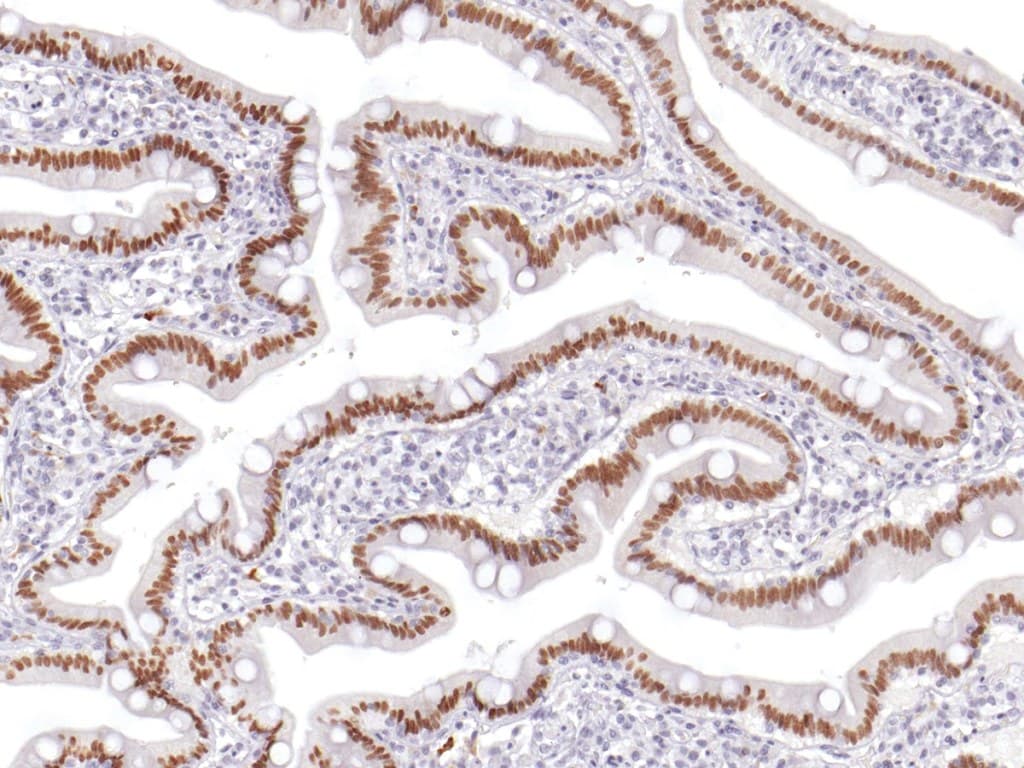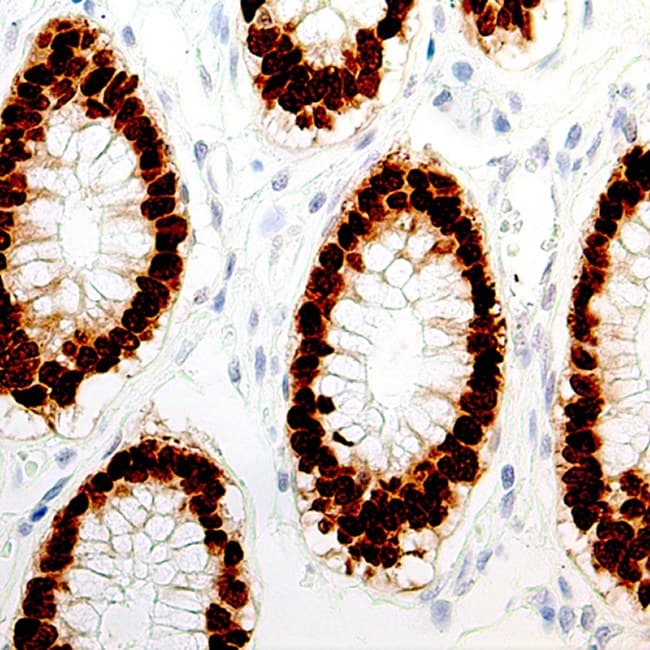

Caudal-type homeobox transcription factor 2 (CDX-2) is a nuclear, homeobox domain–containing transcription factor belonging to the caudal-related gene family. It plays a fundamental role in intestinal development, epithelial differentiation, and maintenance of intestinal identity. CDX-2 functions as a transcriptional regulator of multiple genes involved in intestinal epithelial differentiation, cell adhesion, polarity, and barrier function, thereby contributing to intestinal epithelial homeostasis. In adult tissues, CDX-2 is expressed in the nuclei of epithelial cells throughout the small intestine and colon, extending from the duodenum to the distal colon. This continuous and lineage-restricted expression underlies its widespread use as a marker of intestinal differentiation in both normal tissue and neoplastic conditions.
Biological Significance of CDX-2
CDX-2 is essential for establishing and maintaining intestinal identity during embryonic development. It contributes to anterior–posterior patterning of the gastrointestinal tract and is required for commitment to intestinal epithelial lineage. Disruption or loss of CDX-2 expression impairs normal intestinal differentiation and promotes a less differentiated epithelial phenotype.
In adult intestinal epithelium, CDX-2 regulates key biological processes including epithelial cell proliferation, differentiation, adhesion, and apoptosis, supporting tissue renewal and structural integrity. Strong nuclear CDX-2 expression is a characteristic feature of mature intestinal epithelial cells and is preserved in most colorectal adenomas and well-differentiated colorectal adenocarcinomas, reflecting its role as a master regulator of intestinal phenotype.
CDX-2 expression is also closely associated with intestinal metaplasia. It is detected in intestinal metaplasia of the stomach and in Barrett’s esophagus, where it marks intestinal lineage commitment and may be present before fully developed morphological features such as goblet cell differentiation become apparent. These observations support its involvement in early metaplastic transformation within the gastrointestinal tract.
Diagnostic Utility in Gastrointestinal Pathology
Immunohistochemical detection of CDX-2 is widely used in surgical pathology for the classification and diagnosis of gastrointestinal neoplasms. In colorectal carcinoma, nuclear CDX-2 expression is observed in a high proportion of tumors, providing sensitive evidence of intestinal origin. This is particularly valuable in the evaluation of metastatic adenocarcinomas of unknown primary site.
CDX-2 immunohistochemistry is frequently integrated into diagnostic panels with cytokeratin markers such as CK7 and CK20 to improve diagnostic accuracy. Expression is commonly retained in metastatic colorectal carcinoma, supporting tumor lineage identification in secondary sites. However, reduced or absent CDX-2 expression may be observed in poorly differentiated, high-grade, or advanced colorectal carcinomas, and this limitation must be considered during diagnostic interpretation.
Although CDX-2 is strongly associated with intestinal differentiation, it is not absolutely specific. Expression may occur in subsets of non-intestinal adenocarcinomas, particularly those exhibiting intestinal-type differentiation. Consequently, CDX-2 staining results should always be interpreted in conjunction with histomorphology, clinical information, and additional immunohistochemical markers.
Key Features of Anti-CDX-2 Antibodies for Immunohistochemistry
Anti-CDX-2 antibodies validated for immunohistochemistry enable reliable detection of nuclear CDX-2 protein in formalin-fixed, paraffin-embedded tissue sections. These antibodies produce reproducible nuclear staining patterns consistent with the biological function of CDX-2 as a transcription factor. Key characteristics include:
- Strong nuclear reactivity in normal intestinal epithelium and in the majority of colorectal adenocarcinomas, including mucinous variants.
- High sensitivity for identifying intestinal differentiation when used within multiparametric immunohistochemical panels.
- Established relevance in routine gastrointestinal pathology workflows, supporting accurate tumor classification and diagnostic confidence.