

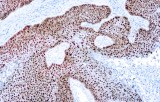
p63 is a nuclear transcription factor encoded by the TP63 gene and a member of the p53 protein family. Through multiple isoforms, particularly the predominant epithelial isoform ΔNp63, p63 regulates epidermal morphogenesis, epithelial stem cell maintenance, progenitor cell proliferation and survival, and stratified epithelial differentiation. Genetic and experimental studies have demonstrated that p63 is indispensable for the development, maintenance, and regenerative capacity of the epidermis and its adnexal structures, including hair follicles and sweat glands. In normal skin, p63 expression is largely restricted to basal keratinocytes and other epithelial progenitor cell populations.
Diagnostic Utility of p63 in Dermatopathology
Anti-p63 immunohistochemistry is an established marker of squamous and basal epithelial differentiation and is widely incorporated into dermatopathology diagnostic panels.
Key applications include:
- Identification of cutaneous squamous cell carcinoma (SCC) and adnexal tumors showing squamous differentiation.
- Demonstration of basal epithelial differentiation in basal cell carcinoma (BCC) and other basaloid cutaneous neoplasms.
- Characterization of cutaneous adnexal neoplasms, including tumors with myoepithelial or basal cell differentiation.
- Contribution to the distinction between primary cutaneous epithelial neoplasms and selected metastatic carcinomas within an appropriate immunohistochemical panel.
- Assessment of the basal and myoepithelial cell layer in diagnostically challenging lesions and biphasic neoplasms.
Key Features of CE/IVD Anti-p63 Antibodies
Typical properties described in CE/IVD instructions for use (IFUs) and technical datasheets include:
- Recognition of an epitope shared by the major p63 isoforms, including TAp63 and ΔNp63 variants.
- Distinct nuclear staining pattern in positive cells.
- Validation for use on formalin-fixed paraffin-embedded (FFPE) tissues.
- Availability in both ready-to-use (RTU) and concentrated formulations.
- Compatibility with automated and manual immunohistochemistry staining platforms.
- CE-marked performance for in vitro diagnostic (IVD) applications in clinical pathology laboratories.