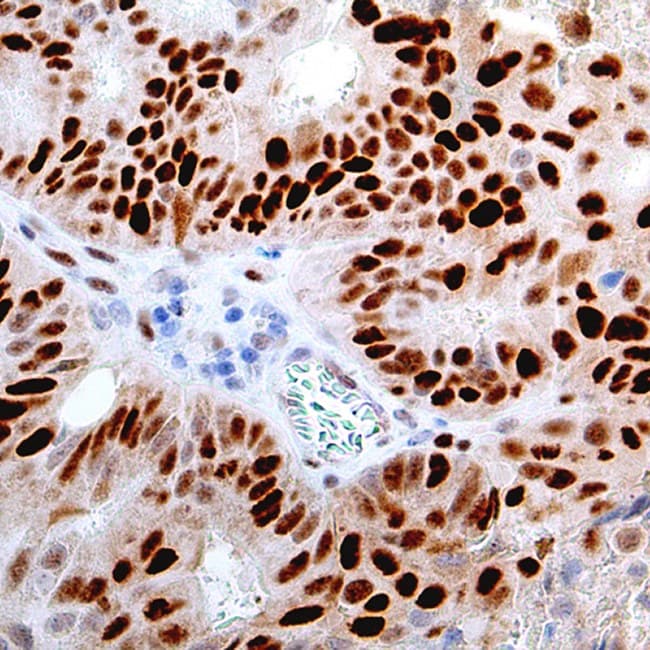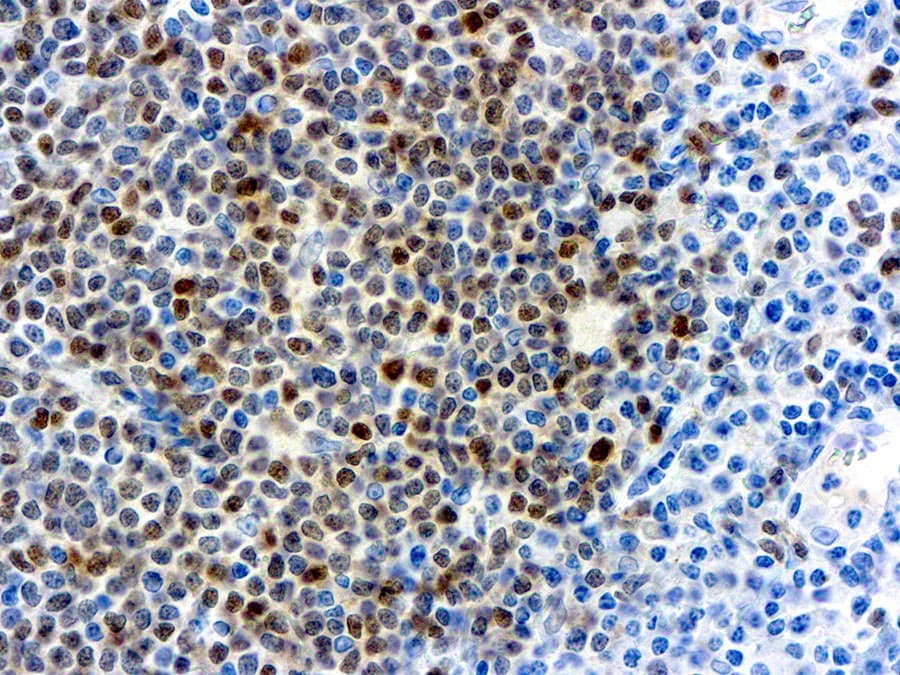

Anti-Cyclin D1 (PRAD1, BCL-1) CE/IVD antibodies for immunohistochemistry (IHC) are essential reagents in hematopathology, enabling sensitive detection of cyclin D1 overexpression in formalin-fixed, paraffin-embedded tissues. These antibodies are widely used in lymphoma diagnostics, particularly for mantle cell lymphoma (MCL), where cyclin D1 serves as a key molecular and immunophenotypic biomarker.
Biological Significance of Cyclin D1 (PRAD1, BCL-1)
Cyclin D1, encoded by CCND1 (also known as PRAD1/BCL-1), is a critical regulator of the cell cycle, promoting G1-to-S phase transition through activation of cyclin-dependent kinases (CDK4/6).
- Functions as a proto-oncogene involved in cell proliferation and tumor progression.
- Overexpressed due to the characteristic t(11;14)(q13;q32) translocation involving IGH and CCND1 in mantle cell lymphoma.
- Leads to dysregulated cell cycle control and oncogenesis in B-cell neoplasms.
- Not expressed in normal mature B lymphocytes, supporting its diagnostic relevance.
Diagnostic Utility in Hematopathology
- Highly sensitive marker for mantle cell lymphoma, showing diffuse nuclear staining in most cases.
- Enables distinction of MCL from other small B-cell lymphomas (e.g., CLL, follicular lymphoma).
- Useful adjunct in bone marrow biopsies and extranodal disease evaluation.
- Expression may occur in other lymphoid neoplasms and non-hematologic tumors; therefore, interpretation requires correlation with morphology and a broader immunophenotypic panel.
- Rare cyclin D1-negative MCL cases highlight the need for complementary markers (e.g., SOX11).
Key Features of Cyclin D1 CE/IVD Antibodies (IHC)
- Optimized for formalin-fixed, paraffin-embedded (FFPE) tissues.
- Predominantly nuclear staining pattern in positive tumor cells.
- High sensitivity for mantle cell lymphoma with strong, diffuse nuclear labeling.
- Compatibility with heat-induced epitope retrieval methods.
- Suitable for routine diagnostic workflows in hematopathology laboratories.