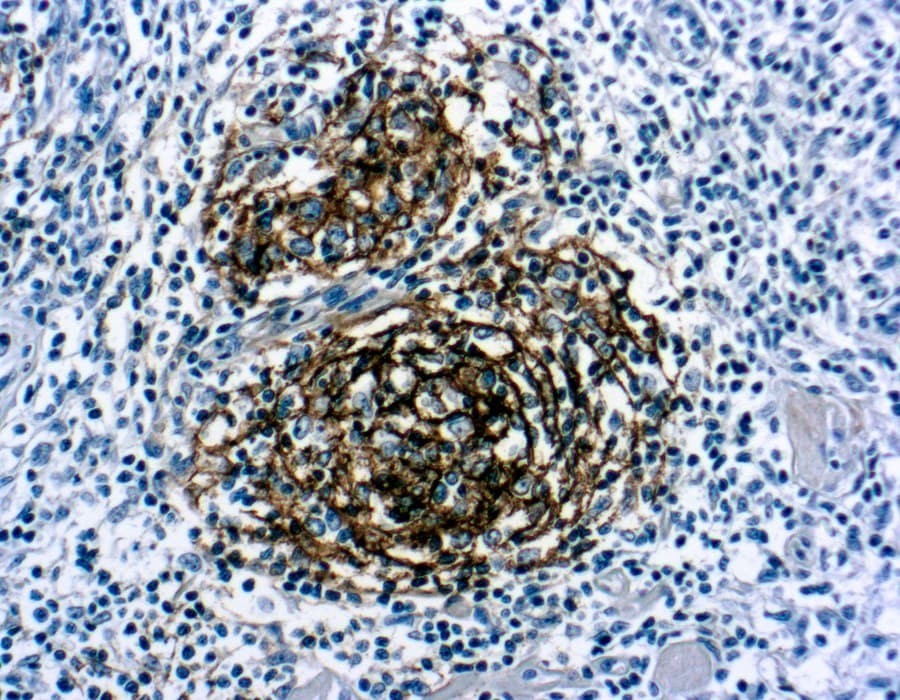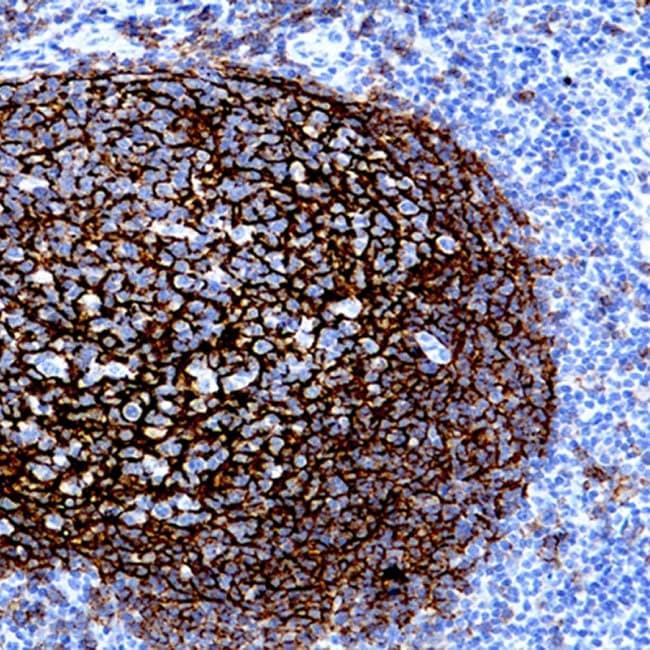

Accurate identification of B-cell subsets and follicular dendritic cell networks is critical for precise hematopathology diagnostics. Anti-CD21 CE/IVD antibodies enable reliable immunohistochemical detection to support both research and clinical decision-making.
Biological Significance of Cluster of Differentiation 21 (CD21)
- Receptor identity & expression: CD21, also known as complement receptor 2 (CR2), is a transmembrane glycoprotein expressed on mature B lymphocytes and follicular dendritic cells (FDCs). It binds complement fragments C3d, C3dg, and iC3b, linking innate complement recognition to adaptive B-cell function.
- Co-receptor function: CD21 forms a complex with CD19 and CD81, enhancing B-cell receptor (BCR) signaling and promoting humoral immune responses.
- Immune architecture: Engagement of CD21 by complement-tagged antigens facilitates antigen retention and presentation within germinal centers, supporting B-cell maturation and affinity selection.
Diagnostic Utility of CD21 in Hematopathology
- FDC network delineation: Anti-CD21 antibodies reliably highlight FDC meshworks in formalin-fixed paraffin-embedded (FFPE) tissues, aiding the evaluation of reactive versus neoplastic lymphoid structures.
- Lymphoma classification: CD21 immunohistochemistry assists in subclassifying hematologic malignancies, distinguishing follicular lymphoma from mantle cell and marginal zone lymphomas, and identifying FDC involvement in angioimmunoblastic T-cell lymphoma.
- Rare tumor identification: CD21 expression supports diagnosis of follicular dendritic cell sarcoma and related neoplasms.
Key Features of CD21 CE/IVD Antibodies (IHC)
- CE/IVD designation: Validated for in vitro diagnostic use in FFPE human tissues, ensuring consistent and accurate immunohistochemical detection.
- Application & specificity: Optimized for qualitative visualization of membrane-associated CD21 on FDCs and selected B-cell subsets, with recommended positive and negative controls.
- Performance considerations: Reliable staining requires validated antigen retrieval protocols and expert morphologic interpretation.