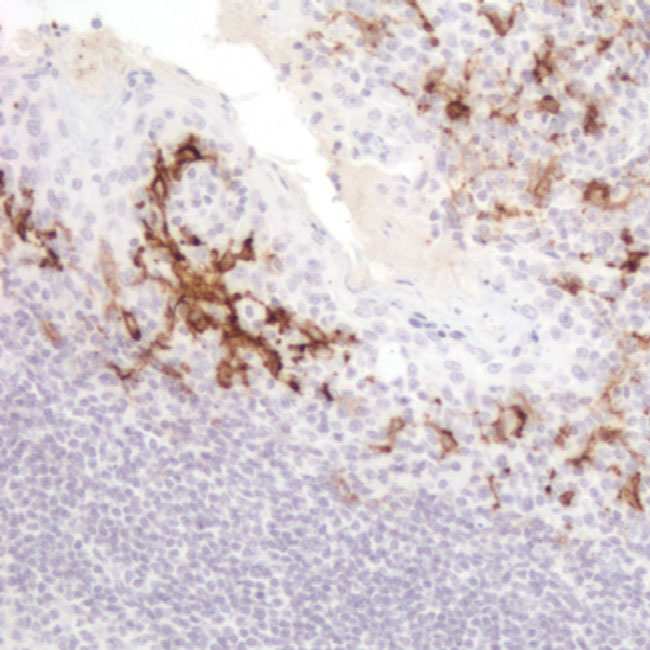

CD16 (FcγRIII) antibodies enable precise detection of CD16‑expressing cells in FFPE tissues, supporting accurate immunophenotyping and diagnostic evaluation of hematologic malignancies.
Biological Significance of CD16 (FcγRIII)
- Low‑affinity Fc gamma receptor binding IgG, expressed on NK cells, monocytes/macrophages, neutrophils, and subsets of T cells.
- Two isoforms: CD16a (FcγRIIIA) on NK/monocytes and CD16b (FcγRIIIB) on neutrophils.
- Mediates antibody‑dependent cellular cytotoxicity (ADCC), cytokine release, and innate immune activation.
- Key role in clearance of infected or transformed cells and regulation of immune effector functions.
Diagnostic Utility of CD16 in Hematopathology
- IHC detection of CD16 in FFPE tissues aids lineage assignment and differentiation of NK, γδ T‑cell, and myeloid neoplasms.
- Altered CD16 expression patterns help identify dysgranulopoiesis and distinguish specific leukemia and lymphoma subtypes.
- Supports integration with multi‑marker panels for accurate hematologic malignancy subtyping.
Key Features of CD16 CE/IVD Antibodies for IHC
- Specificity for human CD16 antigen: Validated binding to FcγRIII ensures accurate detection of membrane and cytoplasmic CD16 in FFPE samples.
- CE/IVD conformity: Designed for clinical in vitro diagnostic use in immunohistochemistry, supporting routine pathology workflows with standardized performance and interpretation by qualified specialists; intended to be used with appropriate controls and antigen retrieval.
- Compatibility with automated IHC systems: Optimized reagent formulations enable use on automated staining platforms, enhancing reproducibility across specimens.
- Useful in multi‑marker panels: Works synergistically with other lineage and activation markers (e.g., CD3, CD20) to refine hematologic diagnoses.