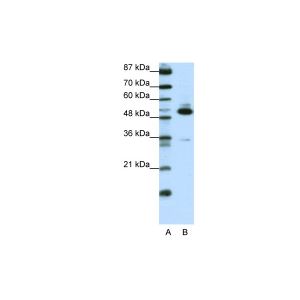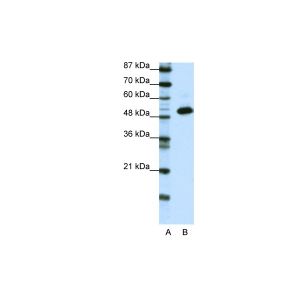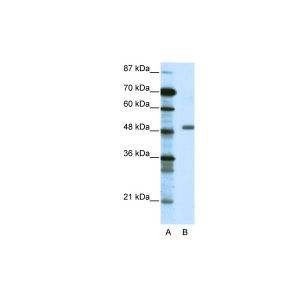

TADA3L Antibody - middle region - HRP

Cat# ARP31479_P050-HRP
Size : 100ul
Brand : Aviva Systems Biology
Contact local distributor :

Phone : +1 850 650 7790
TADA3L Antibody - middle region : HRP (ARP31479_P050-HRP)

Click here to learn more about Aviva's By-Request Conjugation Service.
| Datasheets/Manuals | Printable datasheet for anti-TADA3 (ARP31479_P050-HRP) antibody |
|---|
| Predicted Species Reactivity | Human, Mouse, Rat, Cow, Dog, Guinea Pig, Horse, Rabbit, Zebrafish |
|---|---|
| Product Format | Liquid. Purified antibody is supplied in high phosphate PBS, 100 mm phosphate, 150 mM NaCl, pH 7.6. |
| Clonality | Polyclonal |
| Host | Rabbit |
| Conjugation | HRP: Horseradish Peroxidase |
| Application | WB |
| Reconstitution and Storage | All conjugated antibodies should be stored in light-protected vials or covered with a light protecting material (i.e. aluminum foil). Conjugated antibodies are stable for at least 12 months at 4C. If longer storage is desired (24 months), conjugates may be diluted with up to 50% glycerol and stored at -20C to -80C. Freezing and thawing conjugated antibodies will compromise enzyme activity as well as antibody binding. |
| Immunogen | The immunogen is a synthetic peptide directed towards the middle region of human TADA3L |
| Purification | Affinity Purified |
| Predicted Homology Based on Immunogen Sequence | Cow: 100%; Dog: 100%; Guinea Pig: 100%; Horse: 100%; Human: 100%; Mouse: 100%; Rabbit: 100%; Rat: 100%; Zebrafish: 79% |
| Peptide Sequence | Synthetic peptide located within the following region: ASVEPYCADITSEEVRTLEELLKPPEDEAEHYKIPPLGKHYSQRWAQEDL |
| Concentration | 0.5 mg/ml |
| Blocking Peptide | For anti-TADA3 (ARP31479_P050-HRP) antibody is Catalog # AAP31479 (Previous Catalog # AAPS21701) |
| Reference | Rual,J.F., et al., (2005) Nature 437 (7062), 1173-1178 |
|---|---|
| Gene Symbol | TADA3 |
| Gene Full Name | Transcriptional adaptor 3 |
| Alias Symbols | ADA3, NGG1, hADA3, STAF54, TADA3L |
| NCBI Gene Id | 10474 |
| Protein Name | Transcriptional adapter 3 |
| Description of Target | Adaptor proteins are usually required for transcriptional activation, possibly to acetylate and destabilize nucleosomes, thereby relieving chromatin constraints at the promoter.TADA3L is a transcriptional activator adaptor and has been found to be part of the PCAF histone acetylase complex. In addition, it associates with the tumor suppressor protein p53 and is required for full activity of p53 and p53-mediated apoptosis.Many DNA-binding transcriptional activator proteins enhance the initiation rate of RNA polymerase II-mediated gene transcription by interacting functionally with the general transcription machinery bound at the basal promoter. Adaptor proteins are usually required for this activation, possibly to acetylate and destabilize nucleosomes, thereby relieving chromatin constraints at the promoter. The protein encoded by this gene is a transcriptional activator adaptor and has been found to be part of the PCAF histone acetylase complex. In addition, it associates with the tumor suppressor protein p53 and is required for full activity of p53 and p53-mediated apoptosis. At least four alternatively spliced variants have been found for this gene, but the full-length nature of some variants has not been determined. |
| Uniprot ID | O75528 |
| Protein Accession # | NP_006345 |
| Nucleotide Accession # | NM_006354 |
| Protein Size (# AA) | 432 |
| Molecular Weight | 49kDa |
| Protein Interactions | HEXIM2; CCDC101; CCNC; TP53; USP22; KDM1A; TADA2A; KAT2B; TAF5L; NUP205; SUPT3H; YEATS2; MBIP; WDR5; MAP3K7; DR1; PIAS4; MAGEH1; ING5; XRCC6; SUMO2; SREBF1; TXNRD2; NR1I2; RARA; ESR1; AR; KAT2A; EP300; CTNNB1; ANKRD12; ATXN7; TAF10; FAM107B; ADPGK; HSPA8; |