SMAD2 antibody - N-terminal region

Cat# ARP38694_T100
Size : 100ul
Brand : Aviva Systems Biology
Contact local distributor :

Phone : +1 850 650 7790
SMAD2 Antibody - N-terminal region (ARP38694_T100)
| Datasheets/Manuals | Printable datasheet for anti-SMAD2 (ARP38694_T100) antibody |
|---|
| Tested Species Reactivity | Human, Rat |
|---|---|
| Predicted Species Reactivity | Human, Mouse, Rat, Cow, Dog, Guinea Pig, Horse, Rabbit, Sheep, Zebrafish |
| Product Format | Liquid. Purified antibody supplied in 1x PBS buffer with 0.09% (w/v) sodium azide and 2% sucrose. |
| Clonality | Polyclonal |
| Host | Rabbit |
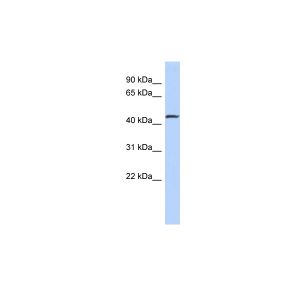
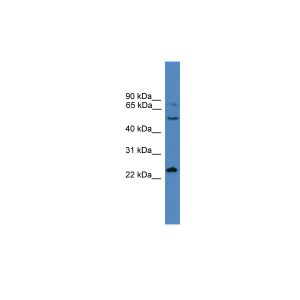
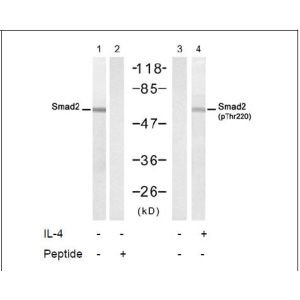
| Application | WB |
| Reconstitution and Storage | For short term use, store at 2-8C up to 1 week. For long term storage, store at -20C in small aliquots to prevent freeze-thaw cycles. |
| Immunogen | The immunogen is a synthetic peptide directed towards the N terminal region of human SMAD2 |
| Purification | Protein A purified |
| Predicted Homology Based on Immunogen Sequence | Cow: 100%; Dog: 100%; Guinea Pig: 100%; Horse: 100%; Human: 100%; Mouse: 100%; Rabbit: 100%; Rat: 100%; Sheep: 100%; Zebrafish: 100% |
| Peptide Sequence | Synthetic peptide located within the following region: VVKRLLGWKKSAGGSGGAGGGEQNGQEEKWCEKAVKSLVKKLKKTGRLDE |
| Concentration | 1.0 mg/ml |
| Blocking Peptide | For anti-SMAD2 (ARP38694_T100) antibody is Catalog # AAP38694 (Previous Catalog # AAPP20883) |
| Reference | Zheng,X., (2006) EMBO J. 25 (3), 615-627 |
|---|---|
| Gene Symbol | SMAD2 |
| Gene Full Name | SMAD family member 2 |
| Alias Symbols | JV18, MADH2, MADR2, JV18-1, hMAD-2, hSMAD2 |
| NCBI Gene Id | 4087 |
| Protein Name | Mothers against decapentaplegic homolog 2 |
| Description of Target | SMAD2 belongs to the SMAD, a family of proteins similar to the gene products of the Drosophila gene 'mothers against decapentaplegic' (Mad) and the C. elegans gene Sma. SMAD proteins are signal transducers and transcriptional modulators that mediate multiple signaling pathways. SMAD2 mediates the signal of the transforming growth factor (TGF)-beta, and thus regulates multiple cellular processes, such as cell proliferation, apoptosis, and differentiation. SMAD2 is recruited to the TGF-beta receptors through its interaction with the SMAD anchor for receptor activation (SARA) protein. In response to TGF-beta signal, SMAD2 is phosphorylated by the TGF-beta receptors. The phosphorylation induces the dissociation of this protein with SARA and the association with the family member SMAD4. The association with SMAD4 is important for the translocation of this protein into the nucleus, where it binds to target promoters and forms a transcription repressor complex with other cofactors. This protein can also be phosphorylated by activin type 1 receptor kinase, and mediates the signal from the activin.The protein encoded by this gene belongs to the SMAD, a family of proteins similar to the gene products of the Drosophila gene 'mothers against decapentaplegic' (Mad) and the C. elegans gene Sma. SMAD proteins are signal transducers and transcriptional modulators that mediate multiple signaling pathways. This protein mediates the signal of the transforming growth factor (TGF)-beta, and thus regulates multiple cellular processes, such as cell proliferation, apoptosis, and differentiation. This protein is recruited to the TGF-beta receptors through its interaction with the SMAD anchor for receptor activation (SARA) protein. In response to TGF-beta signal, this protein is phosphorylated by the TGF-beta receptors. The phosphorylation induces the dissociation of this protein with SARA and the association with the family member SMAD4. The association with SMAD4 is important for the translocation of this protein into the nucleus, where it binds to target promoters and forms a transcription repressor complex with other cofactors. This protein can also be phosphorylated by activin type 1 receptor kinase, and mediates the signal from the activin. Alternatively spliced transcript variants encoding the same protein have been observed. |
| Uniprot ID | Q15796 |
| Protein Accession # | NP_005892 |
| Nucleotide Accession # | NM_005901 |
| Protein Size (# AA) | 467 |
| Molecular Weight | 51kDa |
| Protein Interactions | HDAC2; UBC; SMAD4; SKIL; ANP32B; TUBA1B; SYT1; SOD1; ANP32E; PTMS; NEFM; JUN; ATP5I; RHOA; OTUB1; ZFYVE9; PPARG; TP53; TGFBR1; TRIM33; HCVgp1; TSC2; FHL3; FHL2; FHL1; CSNK1D; KLF5; SH2D2A; SKI; LCK; IRF7; IRF3; RNF111; LEMD3; PIK3CA; ST13; ST5; SRI; SPTBN |