

Quimigen Portugal > Rat ANTI Human CD3 Antibody
Rat ANTI Human CD3 Antibody

Cat# OASA11552
Size : 25ug
Contact local distributor :
 Phone : +1 850 650 7790
Brand : Aviva Systems Biology
Contact local distributor :
Phone : +1 850 650 7790
Rat anti-Human CD3 Antibody (OASA11552)

| Datasheets/Manuals | Printable datasheet for Rat anti-Human CD3 Antibody (OASA11552) |
|---|
| Predicted Species Reactivity | Human |
|---|---|
| Product Format | Liquid. Phosphate buffered saline |
| Clonality | Monoclonal |
| Clone | CD3-12 |
| Isotype | IgG1 |
| Host | Rat |
| Application | FC|IF|IHC-Fr|IHC-P |
| Additional Information | Histology Positive Control Tissue: Tonsil Carrier Free: Yes |
| Reconstitution and Storage | -20°C |
| Immunogen | Synthetic peptide sequence derived from cytoplasmic epitope of CD3 (Glu-Arg-Pro-Pro-Pro-Val-Pro-Asn-Pro-Asp-Tyr-Glu-Pro-Cys) (ERPPPVPNPDYEPC ) |
| Purification | Purified IgG prepared from tissue culture supernatant |
| Predicted Homology Based on Immunogen Sequence | Bovine, dog, horse, Rhesus monkey, pig, chicken, mouse, duck, koala, Harbour porpoise, alpaca, Cynomolgus monkey, spotted hyena, sea lion, cat, Amazon parrot, raccoon, great horned-owl, bullfrog, xenopus, rabbit. Based on sequence similarity, is expected to react with: mammals, birds, amphibia. Antibody reactivity and working conditions may vary between species. Antibody reactivity and working conditions may vary between species. |
| Concentration | 1 mg/ml |
| Specificity | Rat anti Human CD3, clone CD3-12 raised against a peptide representing an invariant cytoplasmic sequence within the CD3-epilson chain recognizes human CD3-epsilon. As this product has been specifically raised against an epitope within the epsilon peptide chain, highly conserved among species clone CD3-12 has a very broad species crossreactivity for the CD3 marker. |
| Application Info | FC: 1/50-1/100. Membrane permeabilization is required for this application IHC-F: 1/100 IHC-P: 1/100. This product requires antigen retrieval using heat treatment prior to staining of paraffin sections. Tris/EDTA buffer (pH 9.0) is recommended for this purpose. |
| Publications | Lack of Major Histocompatibility Complex Class I Upregulation and Restrictive Infection by JC Virus Hamper Detection of Neurons by T Lymphocytes in the Central Nervous System Authors: Wüthrich, C., Batson, S., et al. Journal: J Neuropathol Exp Neurol. 74, 791-803 (2015) Natalizumab-associated progressive multifocal leukoencephalopathy in a patient with multiple sclerosis: a postmortem study Authors: Wüthrich, C., Popescu, B. F., et al. Journal: J Neuropathol Exp Neurol. 72, 1043-51 (2013) |
| Description |
| Reference | 1. Jones, M. et al. (1993). Detection of T and B cells in many animal species using cross-reactive anti-peptide antibodies. J. Immunol. 150 (12): 5429-5435. 2. Alterio, M. et al. (1998). Control of cytomeglavirus in bone marrow transplantation chimeras lacking the prevailing antigen-presenting molecule in recipient tissues rest primarily on recipient- derived CD8 T cells. J. Virol. 72 (10): 7733 - 7744 3. Burundi, E. et al. (2002). Regulation of indoeamine 2, 3-diooxygenase expression in Simian Immunodefiency Virus-infected monkey brains. J. Virol. 76 (3): 12233 - 12241. |
|---|---|
| Alias Symbols | CD3-epsilon, CD3e antigen, epsilon polypeptide (TiT3 complex), CD3e molecule, epsilon (CD3-TCR complex), IMD18, T-cell antigen receptor complex, epsilon subunit of T3, T-cell surface antigen T3/Leu-4 epsilon chain, T-cell surface glycoprotein CD3 epsilon chain, T3E, TCRE. |
| NCBI Gene Id | 916 |
| Protein Name | T-cell surface glycoprotein CD3 epsilon chain |
| Description of Target | CD3 is a multimeric protein complex composed of four distinct polypeptide chains (epsilon, gamma, delta, zeta) that assemble and function as three pairs of dimers (epsilon-gamma, epsilon-delta, zeta-zeta). The CD3 complex serves as a T-cell co-receptor that associates non-covalently with the T-cell receptor (TCR). CD3 is a defining feature of cells belonging to the T cell lineage and can therefore be used as a T-cell marker. |
| Uniprot ID | P07766 |
| Protein Accession # | NP_000724.1 |
Protein interactions
| Name | # of Products |
|---|---|
| CD3D | 100 |
| CD3EAP | 39 |
| CD3G | 51 |
| CD79B | 88 |
| JAK3 | 169 |
| LCK | 537 |
| NCK1 | 212 |
| NCK2 | 111 |
| NCL | 142 |
| PIK3R1 | 517 |
| PTPN22 | 55 |
| SHC1 | 492 |
| SYK | 252 |
| TOP2B | 36 |
| TRAT1 | 51 |
| UNC119 | 185 |
| ZAP70 | 252 |
Biological pathways
| Name | # of Products |
|---|---|
| G-protein coupled receptor signaling pathway | 315 |
| Signal complex assembly | 40 |
| T cell costimulation | 425 |
| T cell receptor signaling pathway | 453 |
| Transmembrane receptor protein tyrosine kinase signaling pathway | 153 |
Biological process
| Name | # of Products |
|---|---|
| Cell surface receptor signaling pathway | 179 |
| G-protein coupled receptor signaling pathway | 262 |
| Induction of apoptosis by extracellular signals | 104 |
| Negative regulation of smoothened signaling pathway | 15 |
| Negative thymic T cell selection | 23 |
| Positive regulation of alpha-beta T cell proliferation | 25 |
| Positive regulation of calcium-mediated signaling | 36 |
| Positive regulation of interferon-gamma production | 61 |
| Positive regulation of interleukin-2 biosynthetic process | 29 |
| Positive regulation of interleukin-4 production | 18 |
| Positive regulation of peptidyl-tyrosine phosphorylation | 112 |
| Positive regulation of T cell anergy | 5 |
| Positive regulation of T cell proliferation | 93 |
| Protein complex assembly | 100 |
| Regulation of apoptotic process | 223 |
| Regulation of immune response | 89 |
| Response to nutrient | 95 |
| Signal complex assembly | 8 |
| T cell activation | 68 |
| T cell costimulation | 87 |
| T cell differentiation in thymus | 33 |
| T cell receptor signaling pathway | 90 |
| Transmembrane receptor protein tyrosine kinase signaling pathway | 67 |
Cellular components
| Name | # of Products |
|---|---|
| Alpha-beta T cell receptor complex | 6 |
| External side of plasma membrane | 261 |
| Immunological synapse | 24 |
| Integral to plasma membrane | 817 |
| Plasma membrane | 2678 |
| T cell receptor complex | 14 |
Protein function
| Name | # of Products |
|---|---|
| Protein heterodimerization activity | 1132 |
| Protein kinase binding | 1101 |
| Receptor activity | 3624 |
| Receptor signaling complex scaffold activity | 46 |
| Receptor signaling protein activity | 171 |
| SH3 domain binding | 272 |
| T cell receptor binding | 25 |
| Transmembrane signaling receptor activity | 687 |
-
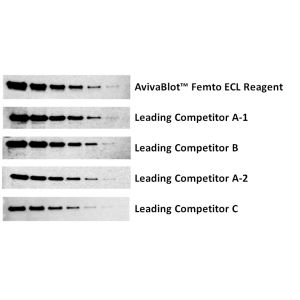 AvivaBlot Femto ECL Reagent (OKCF00002)Catalog #: OKCF00002Application: WBFormat: LiquidSize: 250 mL
 -
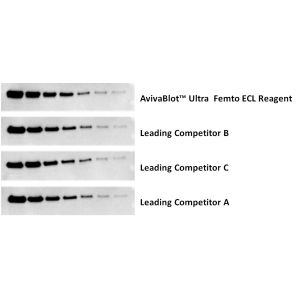
-
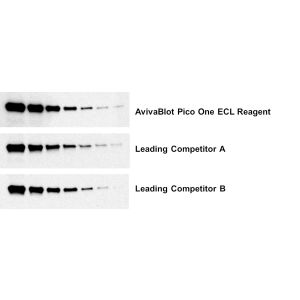 AvivaBlot Pico One ECL Reagent (OKCF00001)Catalog #: OKCF00001Application: WBFormat: LiquidSize: 250 mL