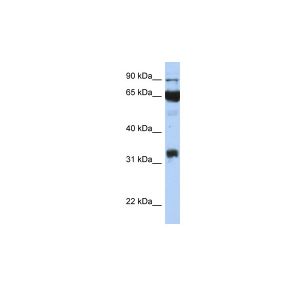
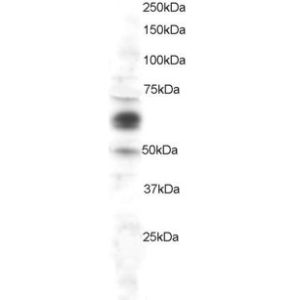
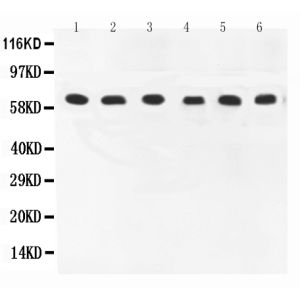
PTGS1 antibody - N-terminal region

Cat# ARP41835_T100
Size : 100ul
Brand : Aviva Systems Biology
Contact local distributor :

Phone : +1 850 650 7790
PTGS1 Antibody - N-terminal region (ARP41835_T100)
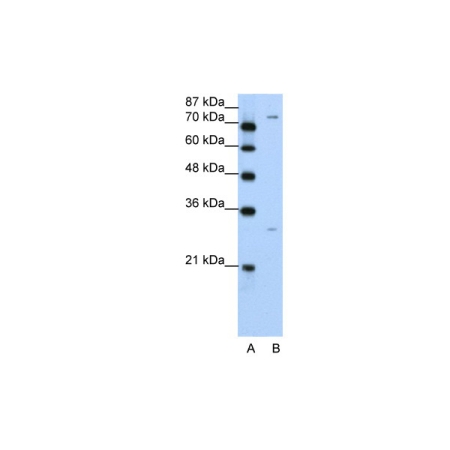
| Datasheets/Manuals | Printable datasheet for anti-PTGS1 (ARP41835_T100) antibody |
|---|
| Tested Species Reactivity | Human |
|---|---|
| Predicted Species Reactivity | Human, Mouse, Rat, Cow, Dog, Guinea Pig, Horse, Sheep |
| Product Format | Liquid. Purified antibody supplied in 1x PBS buffer with 0.09% (w/v) sodium azide and 2% sucrose. |
| Clonality | Polyclonal |
| Host | Rabbit |
| Application | IHC, WB |
| Reconstitution and Storage | For short term use, store at 2-8C up to 1 week. For long term storage, store at -20C in small aliquots to prevent freeze-thaw cycles. |
| Immunogen | The immunogen is a synthetic peptide directed towards the N terminal region of human PTGS1 |
| Purification | Protein A purified |
| Predicted Homology Based on Immunogen Sequence | Cow: 79%; Dog: 93%; Guinea Pig: 86%; Horse: 93%; Human: 100%; Mouse: 100%; Rat: 93%; Sheep: 79% |
| Peptide Sequence | Synthetic peptide located within the following region: LDRYQCDCTRTGYSGPNCTIPGLWTWLRNSLRPSPSFTHFLLTHGRWFWE |
| Concentration | 1.0 mg/ml |
| Blocking Peptide | For anti-PTGS1 (ARP41835_T100) antibody is Catalog # AAP41835 (Previous Catalog # AAPP10883) |
| Reference | Chubb,A.J., (2006) Biochemistry 45 (3), 811-820 |
|---|---|
| Gene Symbol | PTGS1 |
| Gene Full Name | Prostaglandin-endoperoxide synthase 1 (prostaglandin G/H synthase and cyclooxygenase) |
| Alias Symbols | COX1, COX3, PHS1, PCOX1, PES-1, PGHS1, PTGHS, PGG/HS, PGHS-1 |
| NCBI Gene Id | 5742 |
| Protein Name | Prostaglandin G/H synthase 1 |
| Description of Target | Prostaglandin-endoperoxide synthase (PTGS), also known as cyclooxygenase, is the key enzyme in prostaglandin biosynthesis, and acts both as a dioxygenase and as a peroxidase. There are two isozymes of PTGS: a constitutive PTGS1 and an inducible PTGS2, which differ in their regulation of expression and tissue distribution. This gene encodes PTGS1, which regulates angiogenesis in endothelial cells, and is inhibited by nonsteroidal anti-inflammatory drugs such as aspirin. PTGS1 is thought to be involved in cell-cell signaling and maintaining tissue homeostasis.Prostaglandin-endoperoxide synthase (PTGS), also known as cyclooxygenase, is the key enzyme in prostaglandin biosynthesis, and acts both as a dioxygenase and as a peroxidase. There are two isozymes of PTGS: a constitutive PTGS1 and an inducible PTGS2, which differ in their regulation of expression and tissue distribution. This gene encodes PTGS1, which regulates angiogenesis in endothelial cells, and is inhibited by nonsteroidal anti-inflammatory drugs such as aspirin. PTGS1 is thought to be involved in cell-cell signaling and maintaining tissue homeostasis. Alternative splicing of this gene generates two transcript variants. The expression of these two transcripts is differentially regulated by relevant cytokines and growth factors. |
| Uniprot ID | P23219 |
| Protein Accession # | NP_000953 |
| Nucleotide Accession # | NM_000962 |
| Protein Size (# AA) | 599 |
| Molecular Weight | 69kDa |
| Protein Interactions | FBXO6; PTGS2; NCL; CAV2; CAV1; PTGIS; Dlg4; PTGS1; NUCB1; |