


Inquiry
Dispatch Time: About 3 working days
- Product Name
- PerCP-Cy5.5 Anti-Human CD279/PD-1 Antibody(EH12.2H7)
- Catalogue No.
- PCP55-30036
- Form
- liquid
- Conjugation
- PerCP-Cy5.5
- Conjugation Information
- PerCP-Cy5.5 is designed to be excited by the blue laser (488 nm) and detected using an optical filter centered near 675 nm (e.g., a 690/50 nm bandpass filter).
- Clonality
- Monoclonal
- Isotype
- IgG1, κ
- Clone ID
- EH12.2H7
- Storage
- PBS with 0. 1% sodium azide, 1%BSA, pH 7.3, 2-8℃ for 12 months (Avoid repeated freeze / thaw cycles.)
Immunogen
- Alternative Names
- PD1|PDCD1|Protein PD-1|hPD-1 antibody
- UniProt ID
- Q15116
Application
- Tested Applications
- FC
- Recommended dilution
- Volume per test: 5μL. Each lot of this antibody is quality control tested by flow cytometric analysis. The amount of the reagent is suggested to be used 5 µL of antibody per test (million cells in 100 µL staining volume or per 100 µL of whole blood). Please check your vial before the experiment. Since applications vary, the appropriate dilutions must be determined for individual use.
Validated Images
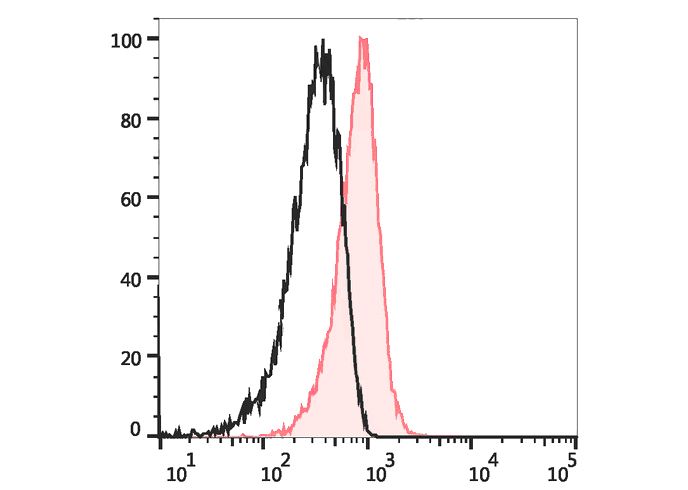 MOLT-4 cells treated with 500 ng/ml Ionomycin and 10 ng/ml Phorbol-12-myristate-13-acetate (PMA) for 24 hours are stained with PerCP-Cy5.5 Anti-Human CD279/PD-1 Antibody (filled gray histogram) or PerCP-Cy5.5 Mouse IgG1, κ Isotype Control (black histogram).
- Background
- Programmed cell death 1 (PD-1), also known as CD279, is a 55 kD member of the immunoglobulin superfamily. CD279 contains the immunoreceptor tyrosine-based inhibitory motif (ITIM) in the cytoplasmic region and plays a key role in peripheral tolerance and autoimmune disease. CD279 is expressed predominantly on activated T cells, B cells, and myeloid cells. PD-L1 and PD-L2 are ligands of CD279 (PD-1) and are members of the B7 gene family. Evidence suggests overlapping functions for these two PD-1 ligands and their constitutive expression on some normal tissues and upregulation on activated antigen-presenting cells. Interaction of CD279 ligands results in inhibition of T cell proliferation and cytokine secretion.