


Inquiry
Dispatch Time: About 3 working days
- Product Name
- PE-Cy7 Anti-Mouse CD66A Antibody(Mab-CC1)
- Catalogue No.
- PC7-30240
- Form
- liquid
- Conjugation
- PE-Cy7
- Conjugation Information
- PE-Cy7 is designed to be excited by the Blue (488 nm), Green (532 nm) and yellow-green (561 nm) lasers and detected using an optical filter centered near 775 nm (e.g., a 780/60 nm bandpass filter).
- Clonality
- Monoclonal
- Isotype
- IgG1, κ
- Clone ID
- Mab-CC1
- Storage
- PBS with 0. 1% sodium azide, 1%BSA, pH 7.3, 2-8℃ for 12 months (Avoid repeated freeze / thaw cycles.)
Immunogen
- Alternative Names
- CEACAM1a|Bgp antibody
- UniProt ID
- P31809
Application
- Tested Applications
- FC
- Recommended dilution
- Volume per test: 5μL. Each lot of this antibody is quality control tested by flow cytometric analysis. The amount of the reagent is suggested to be used 5 µL of antibody per test (million cells in 100 µL staining volume or per 100 µL of whole blood). Please check your vial before the experiment. Since applications vary, the appropriate dilutions must be determined for individual use.
Validated Images
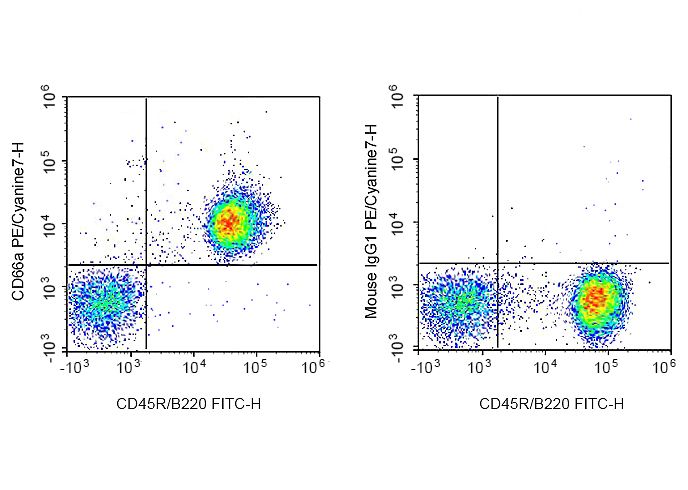 Staining of C57BL/6 murine splenocytes cells with FITC Anti-Mouse CD45R/B220 Antibody and PE-Cy7 Anti-Mouse CD66A Antibody(Mab-CC1)(left) or PE-Cy7 Mouse IgG1, κ (right). Total viable cells were used for analysis.
- Background
- CD66a, known as CEACAM1a, carcinoembryonic antigen-related cell adhesion molecule 1a, is a glycoprotein of the immunoglobulin superfamily and the carcinoembryonic antigen family. Isoforms expressing either two or four alternatively spliced Ig-like domains in mice have been found in a number of epithelial, endothelial, or hematopoietic tissues. CEACAM1a functions as an intercellular adhesion molecule, an angiogenic factor, and a tumor cell growth inhibitor. It also serves as a signal regulatory protein influencing B cell receptor complex-mediated activation. The mouse and human CEACAM1a proteins are targets of viral or bacterial pathogens, respectively. It was reported that targeted disruption of the CEACAM1a gene resulting in a partial ablation of the protein in mice led to reduced susceptibility to virus infection. The antibody recognizes the N-terminal domain of murine CEACAM1a, it does not recognize murine CEACAM1b, an allele in SJL mice.